Ikeda Aya, Shimokawa Asami, Harada Kazuhiro, Tsukahara-Kawamura Tomoko, Huang Jane, Ozaki Hiroaki, Uchio Eiichi
Department of Ophthalmology, Fukuoka University School of Medicine, Fukuoka, Japan.
Clin Ophthalmol. 2024 Sep 7;18:2575-2582. doi: 10.2147/OPTH.S479607. eCollection 2024.
We have previously studied the physiological and mechanical responses of the eye to blunt trauma in various situations using finite element analysis (FEA). In this study, we evaluated the volume kinetics of an airbag impact on the eye using FEA to sequentially determine the volume change rates of intraocular segments at various airbag deployment velocities.
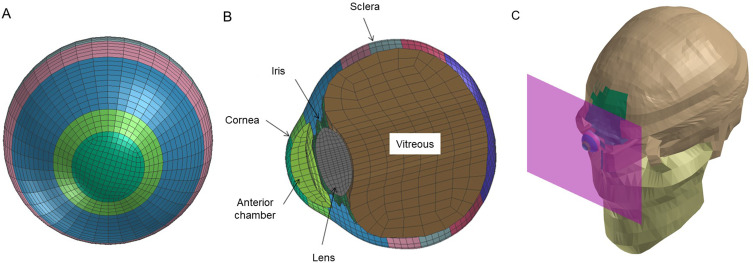
The human eye model we created was used in simulations with the FEA program PAM-GENERIS (Nihon ESI, Tokyo, Japan). Different airbag deployment velocities, 30, 40, 50, 60 and 70 m/s, were applied in the forward direction. The volume of the deformed eye impacted by the airbag was calculated as the integrated value of all meshes in each segment, and the decrease rate was calculated as the ratio of the decreased volume of each segment at particular timepoints to the value before the airbag impact.
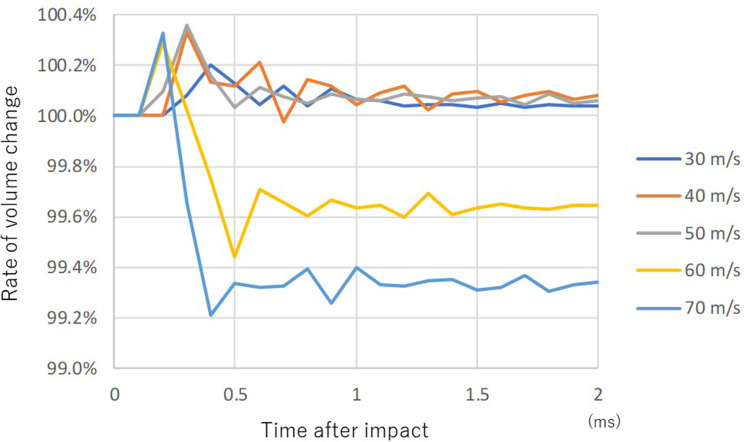
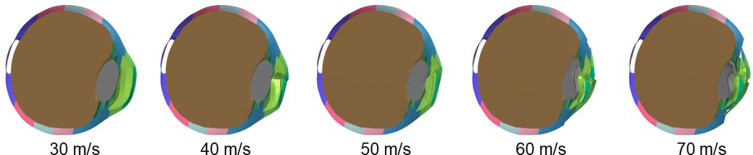
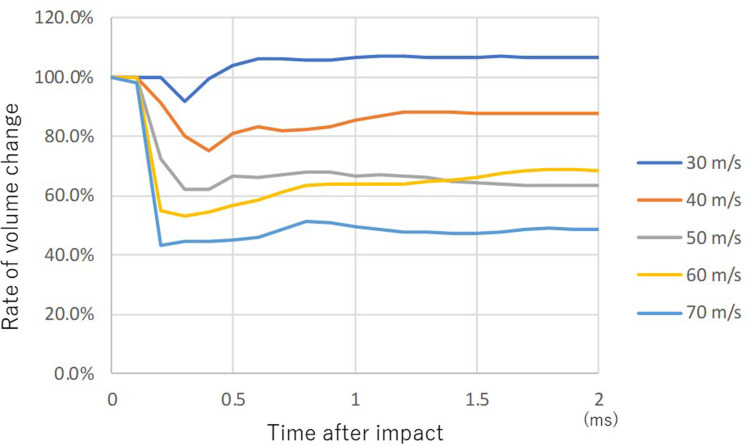
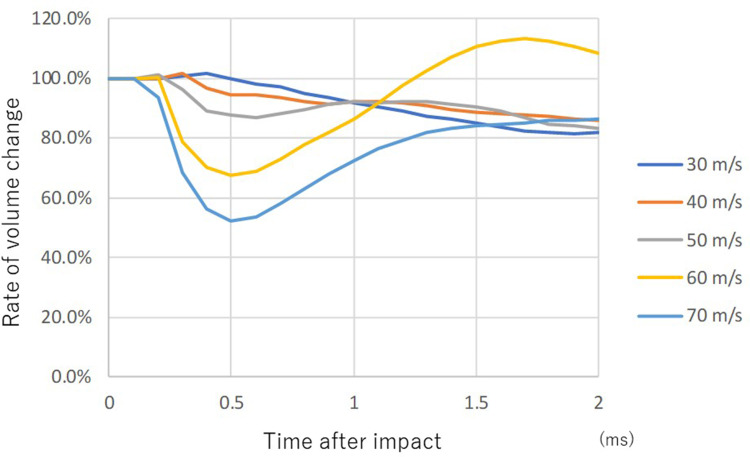
The minimum volume of the anterior chamber was 63%, 69% and 50% at 50, 60 and 70 m/s airbag impact velocity, respectively, showing a curve with a sharp decline followed by gradual recovery. In contrast to the anterior chamber, the volume of the lens recovered promptly, reaching 80-90% at the end of observation, except for the case of 60 m/s. Following the decrease, the volume increased to more than that of baseline at 60 m/s. The rate of volume change of the vitreous was distributed in a narrow range, 99.2-100.4%.
In this study, we found a large, prolonged decrease of volume in the anterior chamber, a similar large decrease followed by prompt recovery of volume in the lens, and a time-lag in the volume decrease between these tissues. These novel findings may provide an important insight into the pathophysiological mechanism of airbag ocular injuries through this further evaluation, employing a refined FEA model representing cuboidal deformation, to develop a more safe airbag system.
我们之前利用有限元分析(FEA)研究了眼睛在各种情况下对钝性创伤的生理和力学反应。在本研究中,我们使用FEA评估安全气囊对眼睛撞击的体积动力学,以依次确定在不同安全气囊展开速度下眼内各节段的体积变化率。
我们创建的人眼模型用于FEA程序PAM-GENERIS(日本电产ESI,东京,日本)的模拟。向前方向施加不同的安全气囊展开速度,即30、40、50、60和70米/秒。安全气囊撞击后变形眼睛的体积计算为每个节段中所有网格的积分值,减少率计算为特定时间点每个节段减少的体积与安全气囊撞击前值的比率。
在安全气囊撞击速度为50、60和70米/秒时,前房的最小体积分别为63%、69%和50%,呈现出先急剧下降然后逐渐恢复的曲线。与前房不同,晶状体的体积迅速恢复,在观察结束时达到80-90%,60米/秒的情况除外。减少之后,60米/秒时体积增加到超过基线水平。玻璃体的体积变化率分布在较窄的范围内,为99.2-100.4%。
在本研究中,我们发现前房体积大幅、持续减少,晶状体体积也有类似的大幅减少但随后迅速恢复,并且这些组织之间在体积减少方面存在时间滞后。这些新发现可能通过进一步评估,采用代表长方体变形的精细FEA模型,为安全气囊眼部损伤的病理生理机制提供重要见解,以开发更安全的安全气囊系统。