Abebe Tekeste, Hymete Ariaya, Giday Mirutse, Bisrat Daniel
Pharmacy School, College of Health Sciences and Medicine, Wolaita Sodo University, P.O. Box 138, Wolaita Sodo, Ethiopia.
Department of Pharmaceutical Chemistry and Pharmacognosy, School of Pharmacy, College of Health Sciences, Addis Ababa University, P.O. Box 1176, Addis Ababa, Ethiopia.
Evid Based Complement Alternat Med. 2024 Feb 3;2024:6680821. doi: 10.1155/2024/6680821. eCollection 2024.
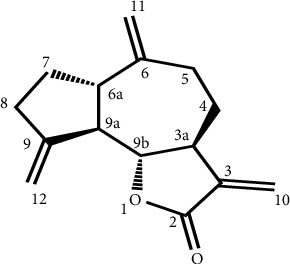
Depression, a global cause of disability and premature death, is often treated by traditional healers in Africa using medicinal herbs such as (L.). With recent pharmacological studies showing the potential antidepressant properties of extract, this study aimed to evaluate the antidepressant-like effects of the compound(s) isolated from extract using the forced swim test (FST) and tail suspension test (TST) models predictive of depression. The extracts, administered orally within a dose range of 100-400 mg/kg, notably decreased the immobility time in both the FST and the TST. The most significant reduction occurred at the highest dose of 400 mg/kg, with a decrease of 117.66 s in FST and 53.5 s in TST. However, this reduction in immobility was not linked to changes in movements, as observed in an open-field test (OFT), suggesting that the effect of the extracts was not due to activation of locomotion. Subsequently, a sesquiterpene lactone, dehydrocostus lactone () was isolated through solubility-based fractionation and column chromatography of the active root bark extract of . Dehydrocostus lactone (400 mg/kg) demonstrated a 46.50 s reduction in immobility time in the FST, which was comparable to the positive control, imipramine (30 mg/kg). With a highly favorable docking score of -8.365 kcal/mol on an antidepressant target, monoamine oxidase A (MAO-A; pdb ID: 2BXS), dehydrocostus lactone () potentially outperforms the standard MAO-A inhibitor drug, isocarboxazid (-5.847 kcal/mol). Dehydrocostus lactone () displayed strong interactions involving hydrogen bond and hydrophobic and electrostatic interactions with specific MAO-A binding site residues. These findings highlight that the antidepressant-like activity of is partly attributed to the presence of dehydrocostus lactone. Additionally, it also supports the traditional medicinal use of the plant for treating depression.
抑郁症是导致全球残疾和过早死亡的原因,在非洲,传统治疗师常使用诸如(L.)等草药来治疗抑郁症。近期的药理学研究表明提取物具有潜在的抗抑郁特性,本研究旨在使用预测抑郁症的强迫游泳试验(FST)和悬尾试验(TST)模型,评估从提取物中分离出的化合物的抗抑郁样作用。提取物以100 - 400毫克/千克的剂量范围口服给药,显著缩短了FST和TST中的不动时间。在400毫克/千克的最高剂量下,不动时间减少最为显著,FST中减少了117.66秒,TST中减少了53.5秒。然而,正如在旷场试验(OFT)中观察到的那样,这种不动时间的减少与运动变化无关,这表明提取物的作用并非由于运动激活。随后,通过基于溶解度的分级分离和活性根皮提取物的柱色谱法,分离出一种倍半萜内酯,脱氢木香内酯()。脱氢木香内酯(400毫克/千克)在FST中使不动时间减少了46.50秒,这与阳性对照丙咪嗪(30毫克/千克)相当。在抗抑郁靶点单胺氧化酶A(MAO - A;蛋白质数据银行ID:2BXS)上,脱氢木香内酯()具有高度有利的对接分数-8.365千卡/摩尔,其潜在性能优于标准的MAO - A抑制剂药物异卡波肼(-5.847千卡/摩尔)。脱氢木香内酯()与特定的MAO - A结合位点残基表现出涉及氢键、疏水和静电相互作用的强相互作用。这些发现突出表明的抗抑郁样活性部分归因于脱氢木香内酯的存在。此外,这也支持了该植物在传统医学中用于治疗抑郁症的用途。