Takeda Development Center Americas, Inc, Cambridge, MA, USA.
College of Allied Health Sciences, Augusta University, Augusta, GA, USA.
Ann Hematol. 2024 Nov;103(11):4567-4580. doi: 10.1007/s00277-024-05984-6. Epub 2024 Sep 12.
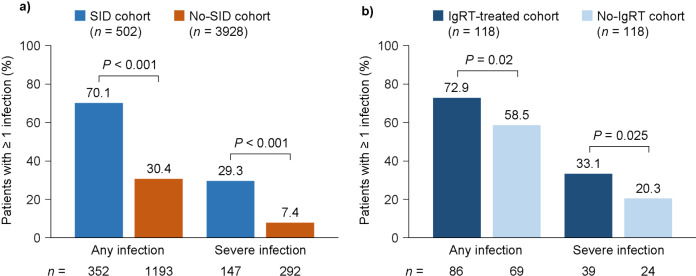
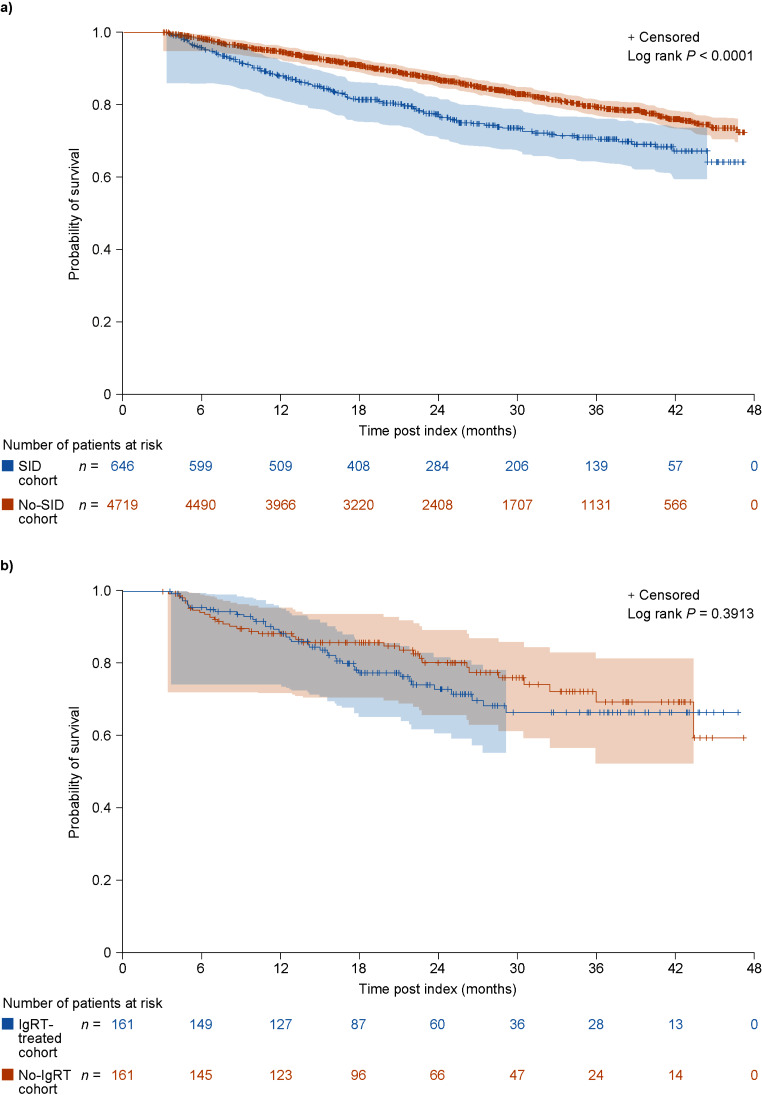
Patients with chronic lymphocytic leukemia/small lymphocytic lymphoma (CLL/SLL) and secondary immunodeficiency disease (SID) are susceptible to severe, recurrent, or persistent infections. This retrospective cohort study assessed the burden of infection in patients with CLL/SLL with and without SID, and in immunoglobulin replacement therapy (IgRT)-treated and -untreated patients with CLL/SLL and SID. Anonymized data from the US Optum-Humedica database (Oct-1-2015-Mar-10-2020) were used. Eligible patients aged ≥ 18 years with a confirmed CLL/SLL diagnosis were assigned to cohorts (SID or no-SID) using an algorithm based on serum IgG levels < 5.0 g/L, hypogammaglobulinemia diagnosis codes, and ≥ 1 major infection. A further sub-categorization was made based on patients with SID who received IgRT and those who did not. During 12-month follow-up, patients with CLL/SLL and SID were significantly more likely to experience infections (70.1% vs. 30.4%), including severe bacterial infections (39.8% vs. 9.2%), and infections requiring hospitalization (27.7% vs. 5.8%) than patients without SID. The use of anti-infectives and healthcare resource utilization (HCRU) was also higher in the SID cohort versus the no-SID cohort. Overall survival was shorter in patients with SID than those without (12.3 vs. 16.9 months). In patients with CLL/SLL and SID, burden of infection and HCRU were greater in IgRT-treated patients than in no-IgRT patients, potentially highlighting the IgRT-treated cohort as a more vulnerable population. Increasing understanding of SID burden may help to improve outcomes in patients with CLL/SLL. Further research is needed to develop guidance for IgRT use and to assess the benefits of IgRT in this vulnerable population.
患有慢性淋巴细胞白血病/小淋巴细胞淋巴瘤(CLL/SLL)和继发性免疫缺陷病(SID)的患者易发生严重、反复或持续感染。本回顾性队列研究评估了 CLL/SLL 伴或不伴 SID 患者、以及 CLL/SLL 伴 SID 且接受和未接受免疫球蛋白替代治疗(IgRT)患者的感染负担。该研究使用了美国 Optum-Humedica 数据库(2015 年 10 月 1 日至 2020 年 3 月 10 日)的匿名数据。使用基于血清 IgG 水平<5.0 g/L、低丙种球蛋白血症诊断代码和≥1 次主要感染的算法,将年龄≥18 岁且确诊为 CLL/SLL 的患者分配到队列(SID 或非 SID)中。根据 SID 患者是否接受 IgRT 进一步进行亚分类。在 12 个月的随访期间,与无 SID 的患者相比,CLL/SLL 伴 SID 的患者发生感染(70.1% vs. 30.4%)、包括严重细菌感染(39.8% vs. 9.2%)和需要住院的感染(27.7% vs. 5.8%)的可能性更高。SID 组患者使用抗感染药物和医疗保健资源利用率(HCRU)也高于非 SID 组。SID 组患者的总体生存率短于无 SID 组(12.3 个月 vs. 16.9 个月)。在 CLL/SLL 伴 SID 的患者中,与未接受 IgRT 的患者相比,接受 IgRT 的患者感染负担和 HCRU 更高,这可能凸显了 IgRT 治疗组是一个更脆弱的人群。更多地了解 SID 负担可能有助于改善 CLL/SLL 患者的结局。需要进一步研究以制定 IgRT 使用指南,并评估 IgRT 在这一脆弱人群中的获益。