Department of Biology, Boston University, 5 Cummington Mall, Boston, MA, 02215, USA.
Department of Natural Resources Science, University of Rhode Island, 1 Greenhouse Road, Kingston, RI, 02881, USA.
Heredity (Edinb). 2024 Nov;133(5):317-330. doi: 10.1038/s41437-024-00716-y. Epub 2024 Sep 12.
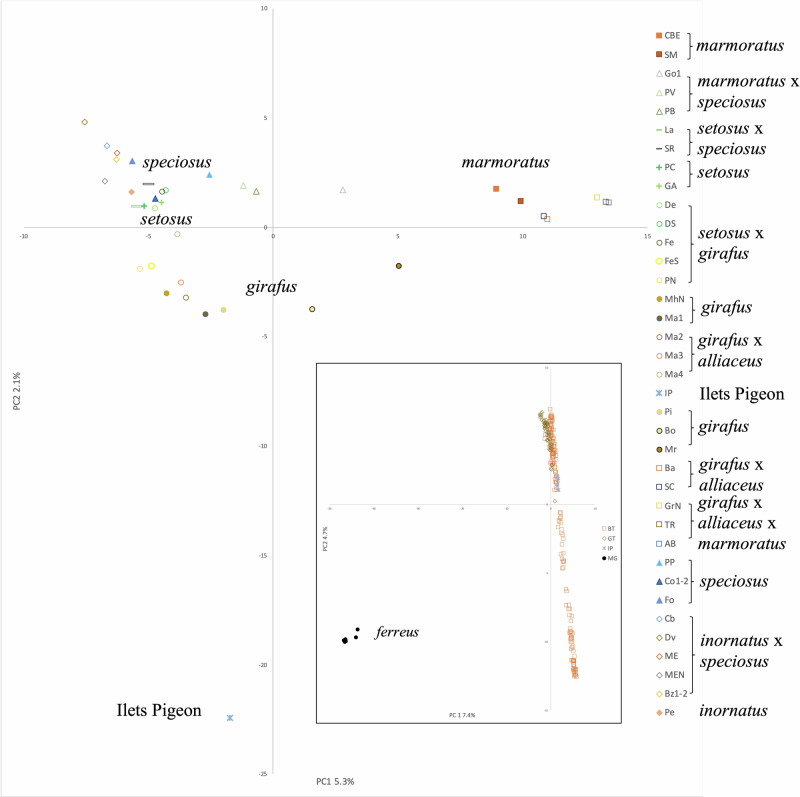
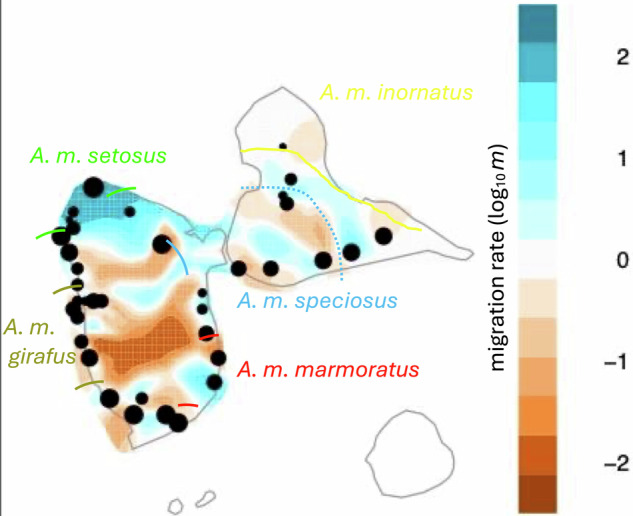
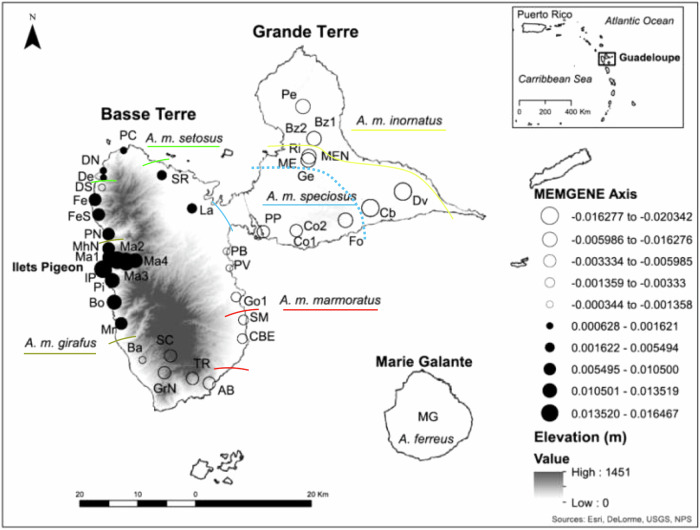
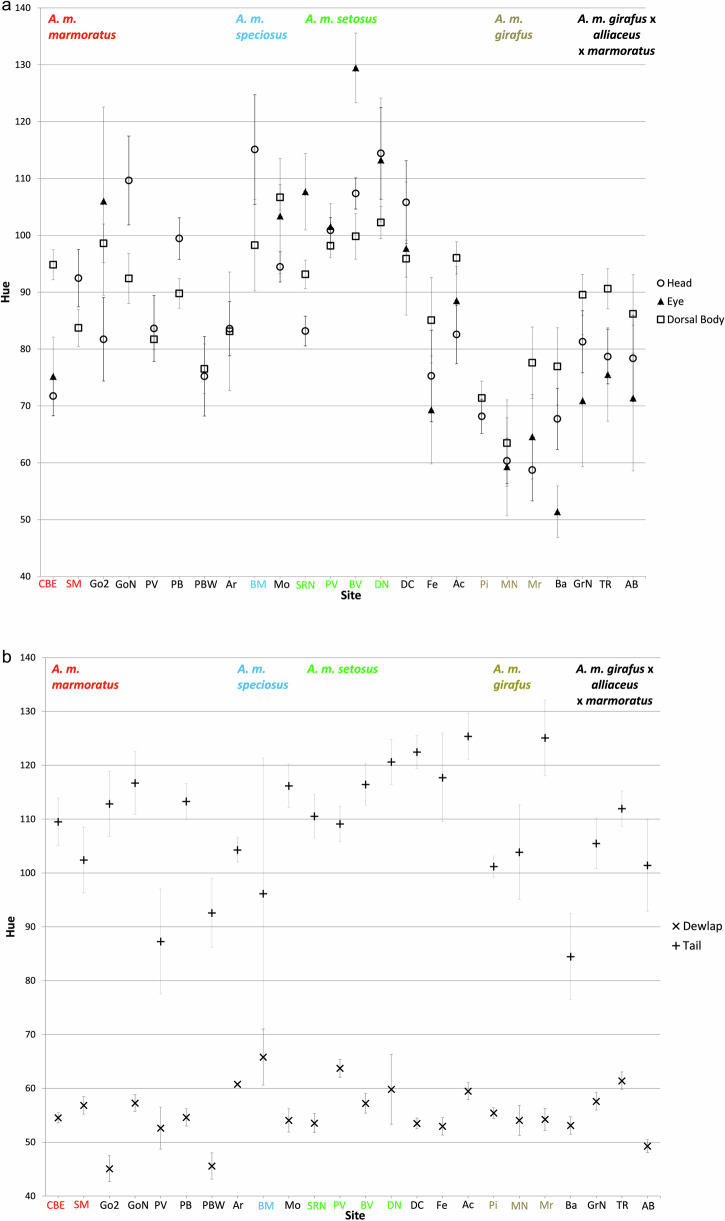
Lizards in the genus Anolis comprise hundreds of species that display a wide range of phenotypic variation closely related to their environment. One example is the Guadeloupean anole (Anolis marmoratus ssp.) that display extreme phenotypic variation, primarily in adult male color and pattern, with twelve described subspecies on the archipelago. Here we examine the relationship between phenotypic and genetic divergence among five subspecies on the two main islands and test the role of geographic isolation and the environment in reducing gene flow. We also examined two offshore island populations to assess the impact of complete geographic isolation on gene flow. We analyzed color phenotypes by measuring spectral reflectance and genomic diversity using SNPs. Genetic divergence was correlated with dorsolateral head and body color phenotypes, and slope and geographic distance were nearly equivalent at explaining this divergence. There was minimal genome-wide divergence at neutral loci among phenotypically disparate subspecies on the two main islands and their differentiation is consistent with a model of divergence with gene flow. Our spatial visualization of gene flow showed an impact of environmental features consistent with a hypothesis of ecologically driven divergence. Nonetheless, subspecies on the two main islands remain interconnected by substantial gene flow and their phenotypic variation is likely maintained at selection-gene flow equilibrium by divergent selection at loci associated with their color phenotypes. Greater isolation, such as inhabiting a remote island, may be required for reducing gene flow. Our findings highlight the role of the environment, adaptation, and geographic isolation on gene flow.
蜥蜴属的蜥蜴有数百种,其表型变异与环境密切相关。其中一个例子是瓜德罗普岛的变色龙(Anolis marmoratus ssp.),它们在成年雄性的颜色和图案上表现出极端的表型变异,在群岛上有 12 个描述的亚种。在这里,我们研究了五个亚种在两个主要岛屿上的表型和遗传分歧之间的关系,并测试了地理隔离和环境在减少基因流中的作用。我们还研究了两个近海岛屿的种群,以评估完全地理隔离对基因流的影响。我们通过测量光谱反射率和 SNP 来分析颜色表型,通过测量光谱反射率和 SNP 来分析基因组多样性。遗传分歧与背外侧头部和身体颜色表型相关,斜率和地理距离在解释这种分歧方面几乎等效。在两个主要岛屿上表现出明显表型差异的亚种之间,中性基因座的全基因组分化程度很小,它们的分化与有基因流的分化模式一致。我们对基因流的空间可视化显示,环境特征的影响与生态驱动分化的假设一致。尽管如此,两个主要岛屿上的亚种仍然通过大量的基因流相互连接,它们的表型变异可能通过与颜色表型相关的基因座的分歧选择保持在选择-基因流平衡状态。更大的隔离,如栖息在偏远的岛屿上,可能需要减少基因流。我们的研究结果强调了环境、适应和地理隔离对基因流的作用。