Division of Endocrinology, Diabetology and Metabolism, Department of Medical Sciences, University of Turin, Corso Dogliotti, 14, 10126, Turin, Italy.
Pituitary. 2024 Oct;27(5):714-722. doi: 10.1007/s11102-024-01454-4. Epub 2024 Sep 12.
The desmopressin daily dose requirement is highly variable among patients with arginine vasopressin (AVP) deficiency (i.e. central diabetes insipidus) and few studies to date have evaluated this topic, with often inconclusive results. The aim of our study was to identify clinical and biochemical predictors of such dose requirements in a cohort of patients with a confirmed diagnosis of permanent AVP deficiency who have good and stable control under substitutive treatment.
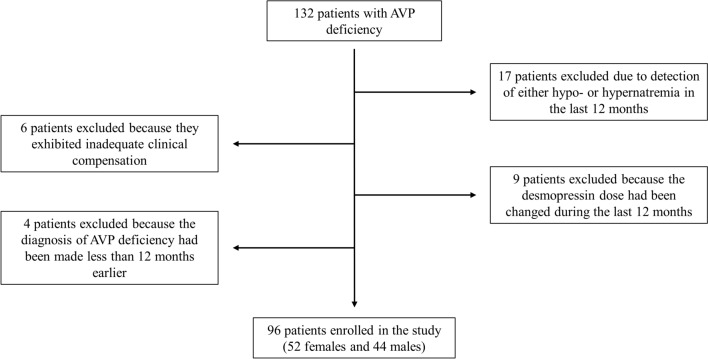
We retrospectively analyzed data of all patients with permanent AVP deficiency undergoing regular follow-up at our Division. Inclusion criteria were the presence of stable disease under therapy for at least 12 months and in good biochemical and clinical control. Patients with AVP deficiency who lacked intact thirst or had a disease duration of less than 12 months were excluded from the analysis.
Out of the 132 patients initially screened, 96 patients (M/F 44/52; age 51 [37-63] years) met the inclusion criteria. Patients on nasal spray therapy (n = 8) had a significantly longer disease duration (p = 0.002) than patients treated with oral lyophilizate (n = 88). In the bivariate analysis, considering only patients treated with the sublingual formulation, the drug dose was correlated positively with estimated glomerular filtration rate (eGFR) and weight (r = 0.410, p < 0.001; r = 0.224, p = 0.036, respectively) and negatively with age (r = - 0.433, p < 0.001). In the multivariate regression analysis taking into account age, weight, and eGFR, only age emerged as a significant predictor of the required sublingual desmopressin dose (β = - 1.426, p = 0.044).
Our data suggest that patient age appears to be the primary factor associated with the daily sublingual desmopressin dose required to achieve adequate clinical and biochemical control in patients with permanent AVP deficiency.
精氨酸加压素(AVP)缺乏症(即中枢性尿崩症)患者的去氨加压素每日剂量需求差异很大,迄今为止,很少有研究对此进行评估,且结果往往不一致。我们的研究目的是在一组已确诊为永久性 AVP 缺乏症且在替代治疗下病情稳定的患者中,确定这种剂量需求的临床和生化预测因子。
我们回顾性分析了在我院接受常规随访的所有永久性 AVP 缺乏症患者的数据。纳入标准为治疗至少 12 个月且生化和临床控制良好的稳定疾病患者。未出现完整渴感或疾病持续时间不足 12 个月的 AVP 缺乏症患者被排除在分析之外。
在最初筛选的 132 名患者中,96 名患者(男/女 44/52;年龄 51 [37-63] 岁)符合纳入标准。接受鼻喷治疗的患者(n=8)的疾病持续时间明显长于接受口服冻干制剂治疗的患者(n=88)(p=0.002)。在单变量分析中,仅考虑接受舌下制剂治疗的患者,药物剂量与估计肾小球滤过率(eGFR)和体重呈正相关(r=0.410,p<0.001;r=0.224,p=0.036),与年龄呈负相关(r=-0.433,p<0.001)。在考虑年龄、体重和 eGFR 的多变量回归分析中,只有年龄是舌下给予去氨加压素所需剂量的显著预测因子(β=-1.426,p=0.044)。
我们的数据表明,患者年龄似乎是与永久性 AVP 缺乏症患者达到充分临床和生化控制所需的每日舌下给予去氨加压素剂量相关的主要因素。