Lopes Alexandra, Sampaio Rute, Tavares Isaura
Department of Biomedicine, Unit of Experimental Biology, Faculty of Medicine, University of Porto, Porto, Portugal.
CINTESIS-Centre for Health Technology and Services Research, Porto, Portugal.
Front Integr Neurosci. 2024 Aug 29;18:1432270. doi: 10.3389/fnint.2024.1432270. eCollection 2024.
Pain is a complex phenomenon influenced by psychosocial variables, including the placebo effect. The effectiveness of mindfulness-based interventions (MBIs) for pain has been demonstrated in experimental studies and systematic reviews, but the mechanisms of action are only starting to be established. Whether the expectations of individuals experiencing pain can be manipulated during MBIs remains to be systematically evaluated, and what role placebo effects might play remains to be explored.
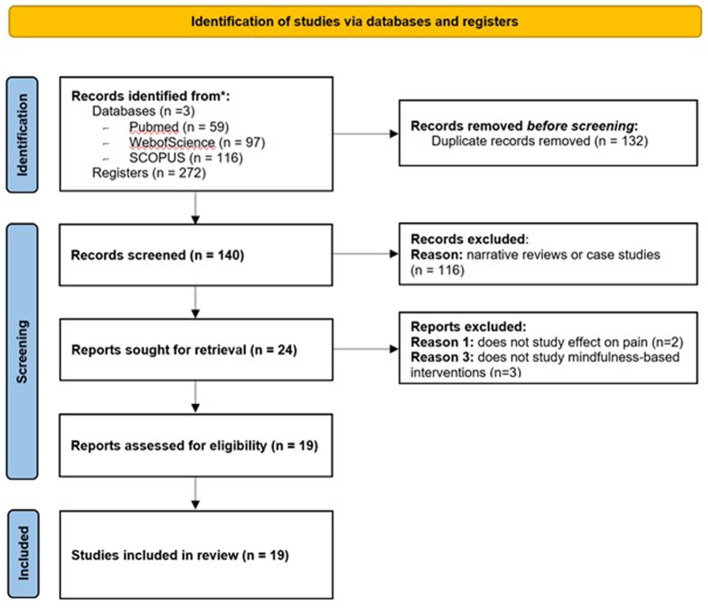
To evaluate the literature analyzing placebo effects in MBIs for pain, we performed a systematic review based on searches conducted in PubMed, Web of Science, and SCOPUS databases. Our search revealed a total of 272 studies, of which only 19 studies were included (10 acute pain and nine chronic pain), considering the inclusion and exclusion criteria related to expectations and placebo effects.
From the 19 included studies, six measured placebo effects only in relation to the pharmacological intervention used in the study and not to an MBI.
The results of the few studies that focused on the placebo effects of the MBIs indicate that placebo and expectations play a role in the MBIs' effects on pain. Although expectations and placebo effects are frequently discussed in the context of mindfulness and pain research, these results show that these factors are still not routinely considered in experimental designs. However, the results of the few studies included in this systematic review highlight a clear role for placebo and expectancy effects in the overall effects of MBIs for both acute and chronic pain, suggesting that routine measurement and further consideration in future studies are warranted. Additional research in this fascinating and challenging field is necessary to fully understand the connection between MBIs, placebo/expectations, and their effects on pain relief.
疼痛是一种受心理社会变量影响的复杂现象,包括安慰剂效应。基于正念的干预措施(MBIs)对疼痛的有效性已在实验研究和系统评价中得到证实,但其作用机制才刚刚开始确立。在MBIs过程中,疼痛患者的期望是否能够被操控仍有待系统评估,安慰剂效应可能发挥何种作用也有待探索。
为了评估分析MBIs治疗疼痛中安慰剂效应的文献,我们基于在PubMed、科学网和Scopus数据库中进行的检索开展了一项系统评价。我们的检索共发现272项研究,考虑到与期望和安慰剂效应相关的纳入和排除标准,其中仅有19项研究被纳入(10项针对急性疼痛,9项针对慢性疼痛)。
在纳入的19项研究中,6项仅测量了与研究中使用的药物干预相关的安慰剂效应,而非与MBIs相关的安慰剂效应。
少数关注MBIs安慰剂效应的研究结果表明,安慰剂和期望在MBIs对疼痛的影响中发挥作用。尽管在正念和疼痛研究中经常讨论期望和安慰剂效应,但这些结果表明,在实验设计中这些因素仍未被常规考虑。然而,这项系统评价中纳入的少数研究结果凸显了安慰剂和期望效应在MBIs对急性和慢性疼痛的总体影响中所起的明确作用,表明在未来研究中进行常规测量和进一步考虑是有必要的。在这个引人入胜且具有挑战性的领域进行更多研究,对于充分理解MBIs、安慰剂/期望及其对疼痛缓解的影响之间的联系是必要的。