Bajorek Natalia, Filip Grzegorz, Malinowski Krzysztof, Kędziora Anna, Mazur Piotr, Ramaprabhu Krithika, Bartuś Krzysztof, Batko Jakub, Rams Daniel J, Deja Marek, Widenka Kazimierz, Tobota Zdzisław, Maruszewski Bohdan J, Burysz Marian, Litwinowicz Radoslaw
Department of Medical Education, Center for Innovative Medical Education, Jagiellonian University Medical College, Krakow, Poland.
Department of Cardiac and Vascular Diseases, John Paul II Hospital, Krakow, Poland.
J Thorac Dis. 2024 Aug 31;16(8):5018-5030. doi: 10.21037/jtd-22-1761. Epub 2024 Aug 28.
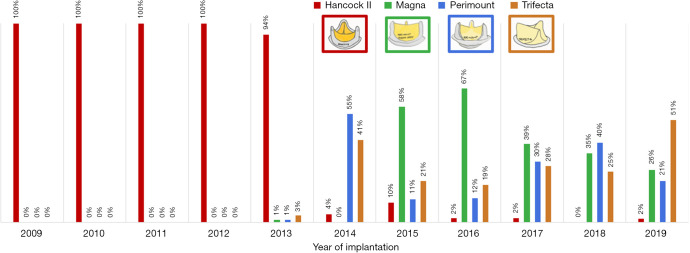
In the era of percutaneous aortic valve implantation, biological valves are the preferred prostheses implanted in patients undergoing surgical aortic valve replacement (sAVR). The aim was to present a real-life analysis of mid-term sAVR outcomes for the four aortic bioprostheses: the Hancock II, the Carpentier-Edwards Perimount Magna, the Carpentier-Edwards Perimount Magna Ease and the Trifecta valve.
This is a retrospective study based on data from the Polish National Cardiac Surgery Database. The study population comprised of 1,589 consecutive patients, of whom 432 were in the Hancock II group, 356 in the Carpentier-Edwards Perimount Magna group, 427 in the Carpentier-Edwards Magna Ease group, and 374 in the Trifecta group. A comparison of the four groups was performed using analysis of variance (ANOVA) or Kruskal-Wallis test with appropriate post hoc tests (Tukey HSD or Steel-Dwass, respectively).
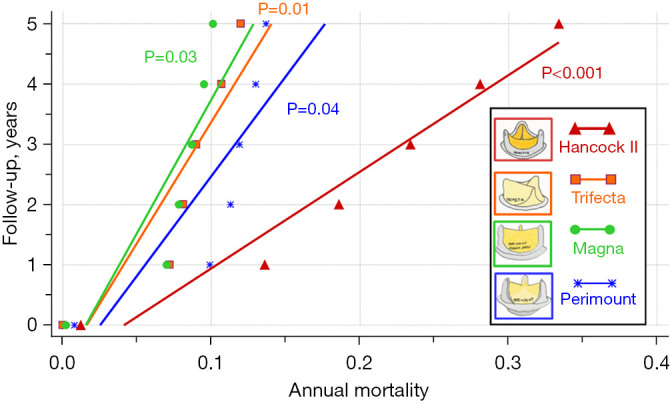
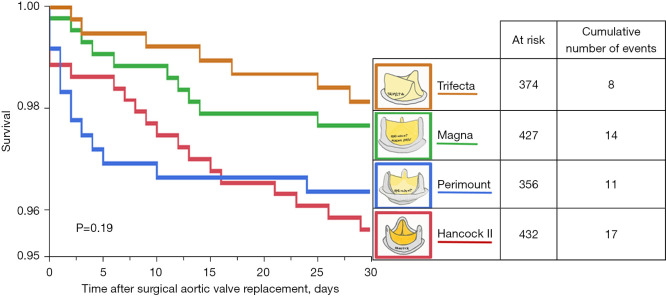
Patients in the Hancock II group were older, had higher New York Heart Association (NYHA) and Canadian Cardiovascular Society (CCS) classes, had lower prevalence of hypertension and hyperlipidemia but higher prevalence of diabetes. The lowest mean valve size was observed in Trifecta group and the highest was in the Magna group (P<0.001). Survival analysis showed no significant differences in in-hospital mortality: 3.9% in Hancock II, 3.1% in Perimount, 3.3% in Magna and 2.1% in Trifecta group. Five-year mortality was significantly higher in Hancock II group (25.7%) compared to the other bioprostheses: 12.1% in Perimount, 9.1% in Magna and 10.70% in Trifecta group respectively.
The 5-year mortality rate was significantly higher in the Hancock II group compared to the other bioprostheses. In contrast, Trifecta, Perimount Magna, and Magna Ease had similar 5-year mortality rates.
在经皮主动脉瓣植入时代,生物瓣膜是接受外科主动脉瓣置换术(sAVR)患者的首选假体。目的是对四种主动脉生物假体(汉考克二代、卡朋蒂埃-爱德华兹Perimount Magna、卡朋蒂埃-爱德华兹Perimount Magna Ease和Trifecta瓣膜)的中期sAVR结果进行真实分析。
这是一项基于波兰国家心脏手术数据库数据的回顾性研究。研究人群包括1589例连续患者,其中汉考克二代组432例,卡朋蒂埃-爱德华兹Perimount Magna组356例,卡朋蒂埃-爱德华兹Magna Ease组427例,Trifecta组374例。使用方差分析(ANOVA)或Kruskal-Wallis检验及适当的事后检验(分别为Tukey HSD或Steel-Dwass)对四组进行比较。
汉考克二代组患者年龄更大,纽约心脏协会(NYHA)和加拿大心血管学会(CCS)分级更高,高血压和高脂血症患病率较低,但糖尿病患病率较高。Trifecta组的平均瓣膜尺寸最小,Magna组最大(P<0.001)。生存分析显示,住院死亡率无显著差异:汉考克二代组为3.9%,Perimount组为3.1%,Magna组为3.3%,Trifecta组为2.1%。汉考克二代组的五年死亡率(25.7%)显著高于其他生物假体:Perimount组为12.1%,Magna组为9.1%,Trifecta组为10.70%。
与其他生物假体相比,汉考克二代组的五年死亡率显著更高。相比之下,Trifecta、Perimount Magna和Magna Ease的五年死亡率相似。