
中国贵州老年肺结核患者的药物相关负担及其与用药依从性的关联:一项横断面研究
Medication-related burden and its association with medication adherence among elderly tuberculosis patients in Guizhou, China: a cross-sectional study.
作者信息
Wang Yun, Jian Sisi, Huang Zhongfeng, Chen Huijuan, Hu Yuanxia, Fang Shilin
机构信息
Key Laboratory of Environmental Pollution Monitoring and Disease Control, Ministry of Education, School of Public Health, Guizhou Medical University, Guiyang, China.
Department of Tuberculosis, Guiyang Public Health Clinical Center, Guiyang, China.
出版信息
Front Pharmacol. 2024 Aug 29;15:1416005. doi: 10.3389/fphar.2024.1416005. eCollection 2024.
INTRODUCTION
Tuberculosis (TB) morbidity and mortality are significantly increasing in the elderly worldwide. Their optimal health outcomes are hampered by medication related burden (MRB) and poor treatment adherence. Understanding th e MRB status from patients' perspectives and its association with adherence among elderly TB patients will help achieve the End TB targets. Thus, we aimed to identify the incidence of MRB and nonadherence among elderly TB patients in Guizhou, and determine their association.
METHODS
A cross-sectional study was conducted in three prefectures with high TB notifications in Guizhou in 2022. The data were collected via face-to-face structured interviews. MRB was measured using the Living with Medicines Questionnaire version 3 (LMQ-3), which consists of eight domains. Nonadherence was assessed by treatment interruption, which was defined as any interruption lasting at least 1 day at any time within the last 3 months. A binary unconditional logistic regression model was used to determine the association between variables.
RESULTS
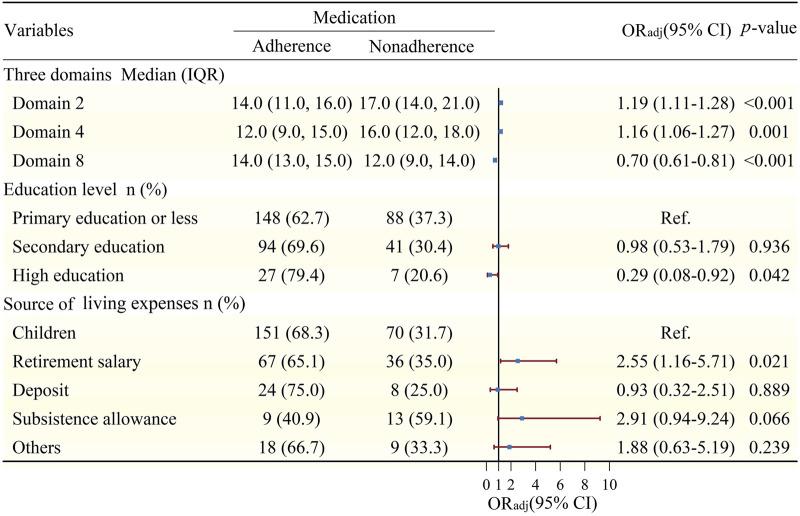
Of the 405 elderly TB patients enrolled, 49.4% and 42.7% of the respondents perceived suffering from moderate and high MRB, respectively. The incidence of nonadherence among patients was 33.6%. Patients with higher scores in domain 2 (practical difficulties) [ = 1.19; 95% (1.11-1.28)] and domain 4 (side effects burden of prescribed medications) [ = 1.16; 95% (1.06-1.27)] were more likely to experience nonadherence. But, patients with higher scores in domain 8 (control/autonomy of medicine use) [ = 0.70; 95% CI (0.61, 0.81)] were more likely to occur adherence. Patients with a high education level [ = 0.29; 95% (0.08, 0.92)] had a decreased risk of nonadherence, but those with a living expense from a retirement salary [ = 2.55; 95% (1.16, 5.71)] had an increased risk of nonadherence.
DISCUSSION
The incidence of MRB and medication nonadherence is high among elderly TB patients in Guizhou. The significant associations between the three domains of MRB and nonadherence highlight that measuring MRB in multiple dimensions using the LMQ-3 in elderly TB patients could assist clinicians in providing patient-centered care, and multifaceted interventions targeting the identified problems should be implemented to reduce MRB and nonadherence among elderly TB patients in Guizhou.
引言
全球范围内,老年人结核病(TB)的发病率和死亡率正在显著上升。药物相关负担(MRB)和较差的治疗依从性阻碍了他们获得最佳健康结果。从患者角度了解MRB状况及其与老年结核病患者依从性的关联,将有助于实现终结结核病目标。因此,我们旨在确定贵州老年结核病患者中MRB和不依从的发生率,并确定它们之间的关联。
方法
2022年在贵州结核病报告率较高的三个州进行了一项横断面研究。数据通过面对面的结构化访谈收集。使用药物生活问卷第3版(LMQ-3)测量MRB,该问卷由八个领域组成。不依从性通过治疗中断进行评估,治疗中断定义为在过去3个月内任何时间持续至少1天的任何中断。使用二元无条件逻辑回归模型确定变量之间的关联。
结果
在纳入的405名老年结核病患者中,分别有49.4%和42.7%的受访者认为自己患有中度和高度MRB。患者中不依从的发生率为33.6%。在第2个领域(实际困难)得分较高的患者[比值比(OR)=1.19;95%置信区间(CI)(1.11-1.28)]和第4个领域(处方药的副作用负担)得分较高的患者[OR=1.16;95%CI(1.06-1.27)]更有可能出现不依从。但是,在第8个领域(用药控制/自主权)得分较高的患者[OR=0.70;95%CI(0.61,0.81)]更有可能出现依从。受教育程度高的患者[OR=0.29;95%CI(0.08,0.92)]不依从风险降低,但靠退休工资生活的患者[OR=2.55;95%CI(1.16,5.71)]不依从风险增加。
讨论
贵州老年结核病患者中MRB和药物不依从的发生率较高。MRB的三个领域与不依从之间的显著关联突出表明,使用LMQ-3对老年结核病患者进行多维度的MRB测量可以帮助临床医生提供以患者为中心的护理,并且应该针对已确定的问题实施多方面的干预措施,以减少贵州老年结核病患者的MRB和不依从情况。


 Zotero 插件