Student Research Committee, Faculty of Medicine, Mashhad University of Medical Sciences, Mashhad, Iran.
Department of Biostatistics, School of Health, Mashhad University of Medical Sciences, Mashhad, Iran.
J Clin Lab Anal. 2024 Sep;38(17-18):e25095. doi: 10.1002/jcla.25095. Epub 2024 Sep 13.
Unbalanced levels of serum total cholesterol (TC) and its subgroups are called dyslipidemia. Several anthropometric indices have been developed to provide a more accurate assessment of body shape and the health risks associated with obesity. In this study, we used the random forest model (RF), decision tree (DT), and logistic regression (LR) to predict total cholesterol based on new anthropometric indices in a sex-stratified analysis.
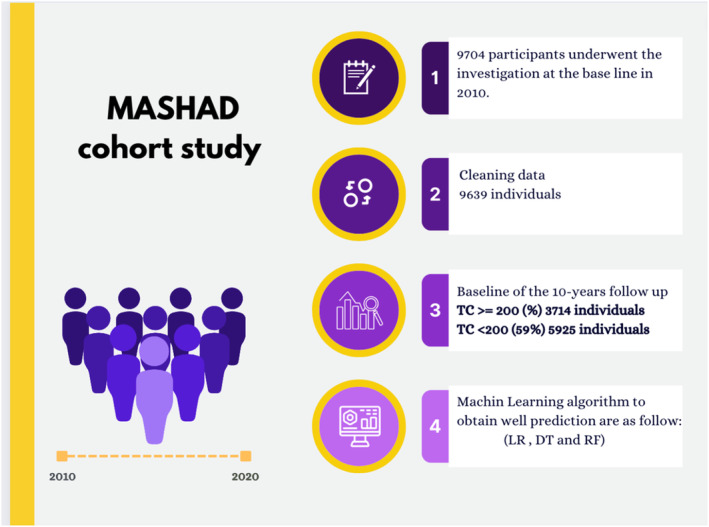
Our sample size was 9639 people in which anthropometric parameters were measured for the participants and data regarding the demographic and laboratory data were obtained. Aiding the machine learning, DT, LR, and RF were drawn to build a measurement prediction model.
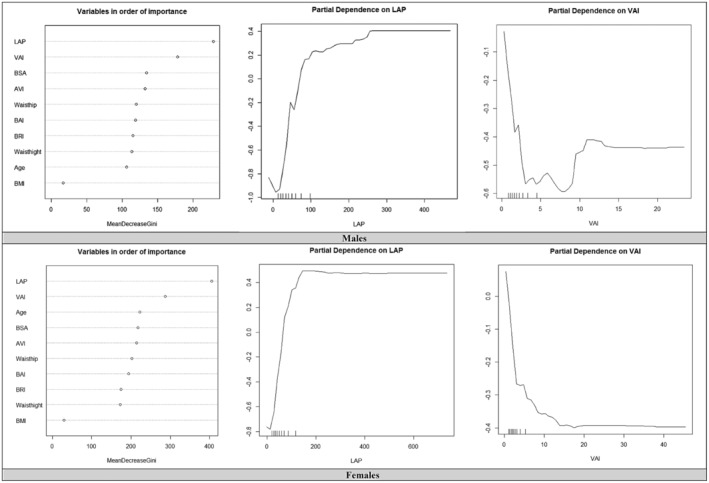
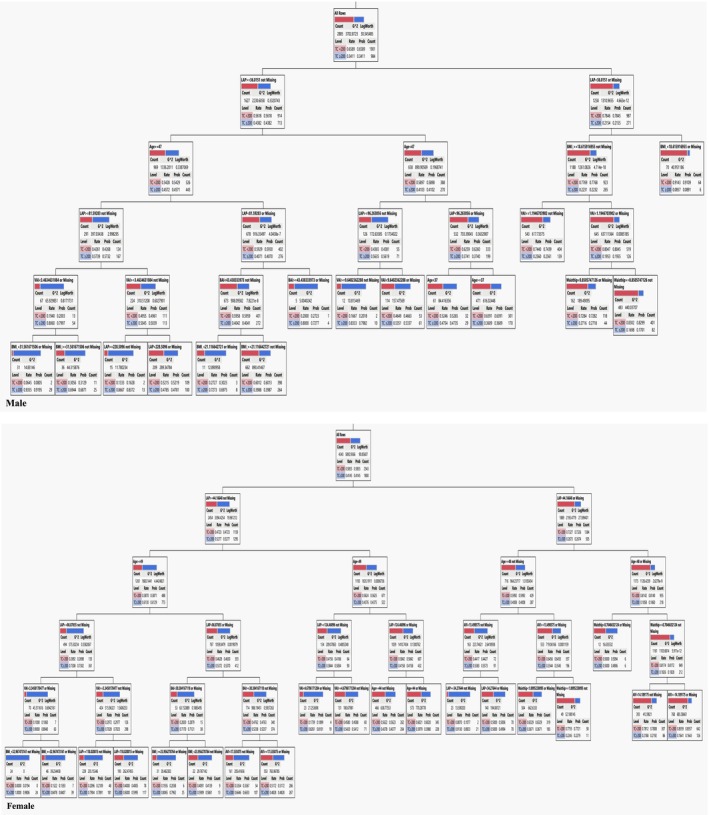
Anthropometric and other related variables were compared between both TC <200 and TC ≥200 groups. In both males and females, Lipid Accumulation Product (LAP) had the greatest effect on the risk of TC increase. According to results of the RF model, LAP and Visceral Adiposity Index (VAI) were significant variables for men. VAI also had a stronger correlation with HDL-C and triglyceride. We identified specific anthropometric thresholds based on DT analysis that could be used to classify individuals at high or low risk of elevated TC levels. The RF model determined that the most important variables for both genders were VAI and LAP.
We tend to present a picture of the Persian population's anthropometric factors and their association with TC level and possible risk factors. Various anthropometric indices indicated different predictive power for TC levels in the Persian population.
血清总胆固醇(TC)及其亚组水平失衡称为血脂异常。已经开发了几种人体测量指数,以更准确地评估体型和与肥胖相关的健康风险。在这项研究中,我们使用随机森林模型(RF)、决策树(DT)和逻辑回归(LR),根据新的人体测量指数,在性别分层分析中预测总胆固醇。
我们的样本量为 9639 人,其中对参与者进行了人体测量参数测量,并获得了关于人口统计学和实验室数据的信息。辅助机器学习,绘制了 DT、LR 和 RF 来构建测量预测模型。
比较了 TC<200 和 TC≥200 两组之间的人体测量和其他相关变量。在男性和女性中,脂质蓄积产物(LAP)对 TC 升高风险的影响最大。根据 RF 模型的结果,LAP 和内脏脂肪指数(VAI)是男性的重要变量。VAI 与 HDL-C 和甘油三酯的相关性也更强。我们根据 DT 分析确定了特定的人体测量阈值,可以用于对 TC 水平升高风险高或低的个体进行分类。RF 模型确定,VAI 和 LAP 是两性最重要的变量。
我们倾向于呈现出波斯人口的人体测量因素及其与 TC 水平和可能的危险因素的关联。各种人体测量指数表明,在波斯人群中,TC 水平的预测能力不同。