Penfield Jackson, Zhang Liqun
Chemical Engineering Department, Tennessee Technological University, Cookeville, TN, 38505, USA.
Chemical Engineering Department, University of Rhode Island, Kingston, RI, 02881, USA.
Commun Chem. 2024 Sep 13;7(1):205. doi: 10.1038/s42004-024-01280-6.
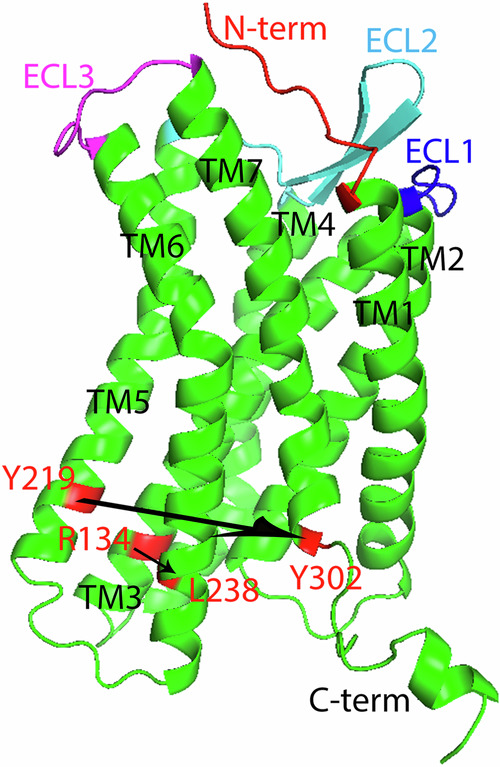
Chemokine receptor CXCR4 is involved in diverse diseases. A comparative study was conducted on CXCR4 embedded in a POPC lipid bilayer binding with CXCL12 in full and truncated forms, hBD-3 in wildtype, analog, and mutant forms based on in total 63 µs all-atom MD simulations. The initial binding structures of CXCR4 with ligands were predicted using HADDOCK docking or random-seed method, then μs-long simulations were performed to refine the structures. CXCR4&ligand binding structures predicted agree with available literature data. Both kinds of ligands bind stably to the N-terminus, extracellular loop 2 (ECL2), and ECL3 regions of CXCR4; the C2-C3 (K32-R38) region and occasionally the head of hBD-3 bind stably with CXCR4. hBD-3 analogs with Cys11-Cys40 disulfide bond can activate CXCR4 based on the Helix3-Helix6 distance calculation, but not other analogs or mutant. The results provide insight into understanding the dynamics and activation mechanism of CXCR4 receptor binding with different ligands.
趋化因子受体CXCR4参与多种疾病。基于总共63微秒的全原子分子动力学模拟,对嵌入在1-棕榈酰-2-油酰-sn-甘油-3-磷酸胆碱(POPC)脂质双层中的CXCR4与全长和截短形式的CXCL12、野生型、类似物和突变形式的人β-防御素3(hBD-3)进行了一项比较研究。使用HADDOCK对接或随机种子方法预测了CXCR4与配体的初始结合结构,然后进行了微秒级的模拟以优化结构。预测的CXCR4与配体的结合结构与现有文献数据一致。两种配体都稳定地结合到CXCR4的N端、细胞外环2(ECL2)和ECL3区域;hBD-3的C2-C3(K32-R38)区域以及偶尔的头部与CXCR4稳定结合。基于螺旋3-螺旋6距离计算,具有半胱氨酸11-半胱氨酸40二硫键的hBD-3类似物可以激活CXCR4,但其他类似物或突变体则不能。这些结果为理解CXCR4受体与不同配体结合的动力学和激活机制提供了见解。