Wahab Muhammad Aamir, Del Gaudio Nunzio, Gargiulo Biagio, Quagliariello Vincenzo, Maurea Nicola, Nebbioso Angela, Altucci Lucia, Conte Mariarosaria
Department of Precision Medicine, University of Campania "Luigi Vanvitelli", 80138 Naples, Italy.
Division of Cardiology, Istituto Nazionale Tumori-IRCCS-Fondazione G. Pascale, 80131 Naples, Italy.
Cancers (Basel). 2024 Aug 30;16(17):3026. doi: 10.3390/cancers16173026.
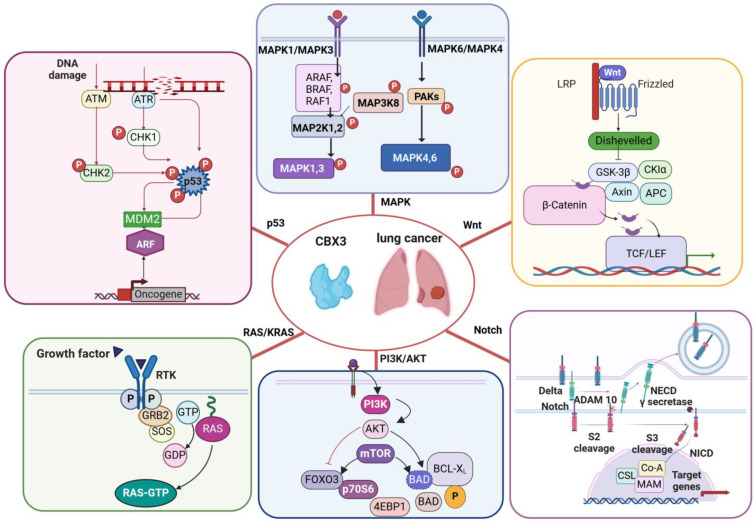
Epigenetic changes regulate gene expression through histone modifications, chromatin remodeling, and protein translation of these modifications. The PRC1 and PRC2 complexes shape gene repression via histone modifications. Specifically, the CBX protein family aids PRC1 recruitment to chromatin, impacting the progressive multistep process driving chromatin silencing. Among family members, CBX3 is a complex protein involved in aberrant epigenetic mechanisms that drive lung cancer progression. CBX3 promotes lung tumorigenesis by interacting with key pathways such as PI3K/AKT, Ras/KRAS, Wnt/β-catenin, MAPK, Notch, and p53, leading to increased proliferation, inhibition of apoptosis, and enhanced resistance to therapy. Given our current lack of knowledge, additional research is required to uncover the intricate mechanisms underlying CBX3 activity, as well as its involvement in molecular pathways and its potential biomarker evaluation. Specifically, the dissimilar roles of CBX3 could be reexamined to gain a greater insight into lung cancer pathogenesis. This review aims to provide a clear overview of the context-related molecular profile of CBX3, which could be useful for addressing clinical challenges and developing novel targeted therapies based on personalized medicine.
表观遗传变化通过组蛋白修饰、染色质重塑以及这些修饰的蛋白质翻译来调节基因表达。PRC1和PRC2复合物通过组蛋白修饰形成基因抑制。具体而言,CBX蛋白家族有助于PRC1募集到染色质上,影响驱动染色质沉默的渐进式多步骤过程。在家族成员中,CBX3是一种复杂的蛋白质,参与驱动肺癌进展的异常表观遗传机制。CBX3通过与PI3K/AKT、Ras/KRAS、Wnt/β-连环蛋白、MAPK、Notch和p53等关键信号通路相互作用促进肺肿瘤发生,导致增殖增加、细胞凋亡抑制和对治疗的抗性增强。鉴于我们目前知识的匮乏,需要进一步的研究来揭示CBX3活性背后的复杂机制,以及它在分子信号通路中的作用及其潜在的生物标志物评估。具体而言,CBX3的不同作用可以重新审视,以更深入地了解肺癌发病机制。本综述旨在清晰概述CBX3的相关分子概况,这可能有助于应对临床挑战并基于个性化医疗开发新的靶向治疗方法。