van der Woude Danny R, Takken Tim, Ruyten Thijs, Asselman Fay-Lynn, van Eijk Ruben P A, van der Pol W Ludo, Bartels Bart
Child Development and Exercise Center, Wilhelmina Children's Hospital, University Medical Center Utrecht, Lundlaan 6, 3584 EA Utrecht, The Netherlands.
Department of Neurology and Neurosurgery, UMC Utrecht Brain Center, University Medical Center Utrecht, 3584 CX Utrecht, The Netherlands.
J Clin Med. 2024 Sep 6;13(17):5285. doi: 10.3390/jcm13175285.
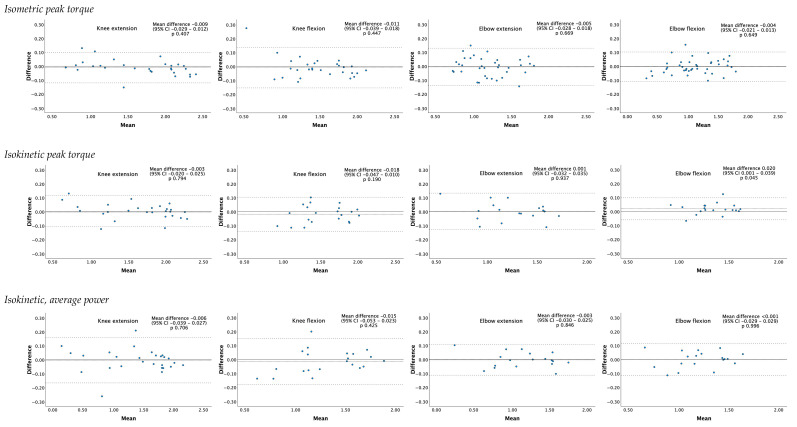
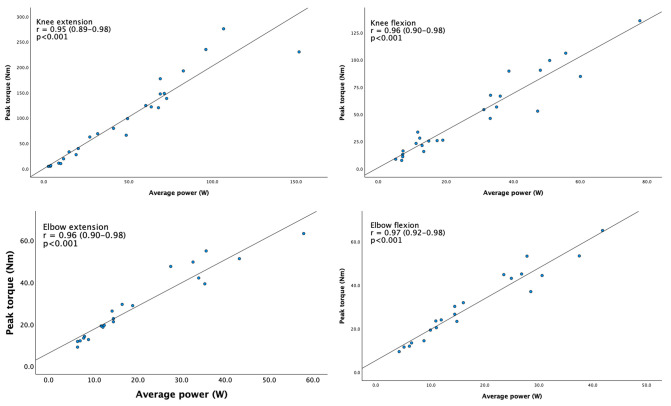
High-precision measurement tools are needed to measure relevant changes in strength and power in children with neuromuscular diseases. The aim of this study was to determine the feasibility (i), reproducibility (ii), and validity (iii) of isokinetic dynamometry in this population. Isometric and isokinetic knee and elbow flexion and extension were measured twice on the same day. Feasibility was based on completion rate and acceptability. Acceptability was measured with a 100 mm visual analog scale. We measured reproducibility as the intraclass correlation coefficient (ICC-agreement), standard error of measurement (SEM), and smallest detectable change (SDC). We investigated relationships between isometric strength and isokinetic power with Pearson's correlation coefficient. ROC curves were used to determine the cutoff of isometric strength to conduct isokinetic measurements. Fifty children with NMDs participated with completion rates of 78-90% for isometric and 39-75% for isokinetic measurements. Acceptability was high (mean (SD) = 73 (19) mm). The ICCs for all measurements were over 0.9 (95% confidence interval (CI) = 0.932-0.998). The SEM% ranged from 5 to 14% and the SDC% from 14 to 28%. The correlations of strength and power were high (Pearson's correlation coefficient >0.9 (95% CI: 0.89-0.98)). The isometric strength needed to conduct isokinetic measurements ranged from 11.1 N in elbow flexors to 24.9 N in knee extensors. Isokinetic dynamometry is a feasible and reproducible method for measuring isometric strength in children with neuromuscular diseases with moderate weakness to normal strength, and isokinetic measurements are only feasible in knee extension for children with moderate weakness to normal strength. The convergent validity between isometric strength and power at low velocities is high.
需要高精度测量工具来测量神经肌肉疾病患儿力量和功率的相关变化。本研究的目的是确定等速测力法在该人群中的可行性(i)、可重复性(ii)和有效性(iii)。在同一天对等长和等速膝关节及肘关节屈伸进行了两次测量。可行性基于完成率和可接受性。可接受性用100毫米视觉模拟量表进行测量。我们将可重复性测量为组内相关系数(ICC一致性)、测量标准误差(SEM)和最小可检测变化(SDC)。我们用Pearson相关系数研究了等长力量和等速功率之间的关系。ROC曲线用于确定进行等速测量的等长力量临界值。50名神经肌肉疾病患儿参与了研究,等长测量的完成率为78 - 90%,等速测量的完成率为39 - 75%。可接受性较高(均值(标准差)= 73(19)毫米)。所有测量的ICC均超过0.9(95%置信区间(CI)= 0.932 - 0.998)。SEM%范围为5%至14%,SDC%范围为14%至28%。力量和功率的相关性较高(Pearson相关系数>0.9(95% CI:0.89 - 0.98))。进行等速测量所需的等长力量范围从肘屈肌的11.1牛到膝伸肌的24.9牛。等速测力法是一种可行且可重复的方法,用于测量中度虚弱至正常力量的神经肌肉疾病患儿的等长力量,对于中度虚弱至正常力量的患儿,等速测量仅在膝关节伸展时可行。低速下等长力量和功率之间的收敛效度较高。