Division of Kidney Diseases and Hypertension, Alpert Medical School of Brown University, Providence, RI 02903, USA.
Lifespan Biostatistics, Epidemiology, Research Design, and Informatics Core, Providence, RI 02903, USA.
Nutrients. 2024 Sep 1;16(17):2928. doi: 10.3390/nu16172928.
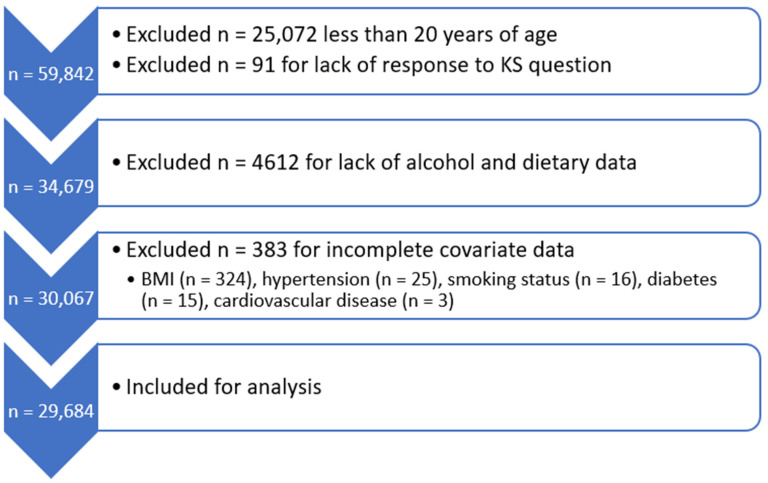
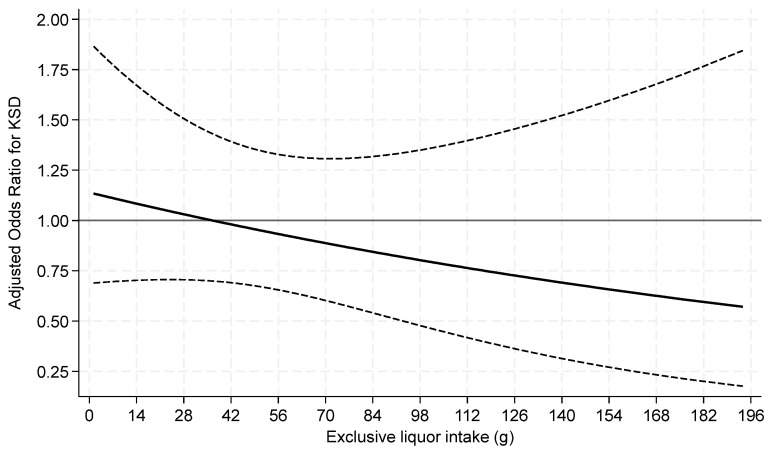
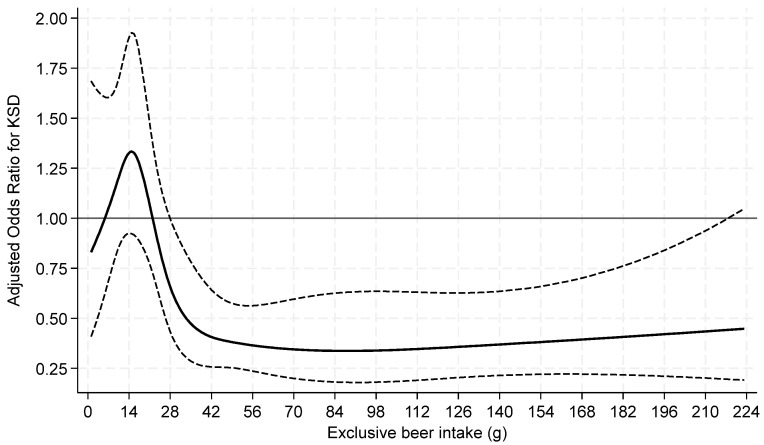
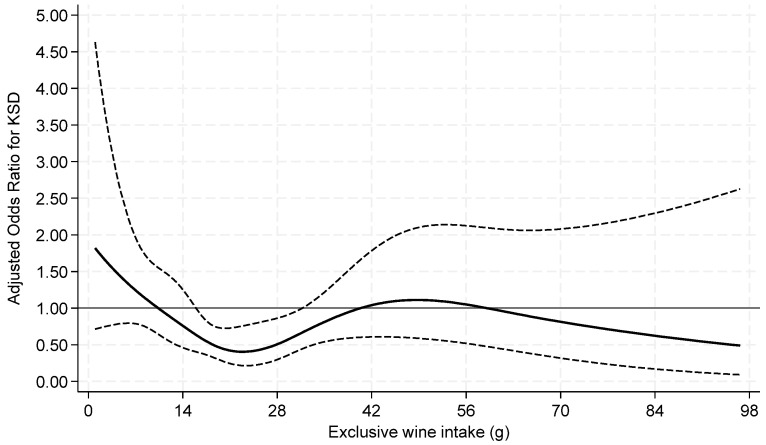
The association of alcohol intake with kidney stone disease (KSD) is not clear based on current clinical evidence. We examined the National Health and Nutrition Examination Survey (NHANES) 2007-2018 and used logistic regression analyses to determine the independent association between alcohol intake and prevalent KSD. In total, 29,684 participants were eligible for the final analysis, including 2840 prevalent stone formers (SFs). The mean alcohol intake was 37.0 ± 2.4 g/day among SFs compared to 42.7 ± 0.9 among non-SFs ( = 0.04). Beer [odds ratio (OR) = 0.76, 95% CI: 0.61-0.94, = 0.01] and wine (OR = 0.75, 95% CI: 0.59-0.96, = 0.03) intakes were strongly associated with lower odds of prevalent KSD, while liquor intake had no association. Furthermore, the effects of beer and wine intakes on stone formation were dose-dependent. The OR for comparing participants drinking 1-14 g/day of beer to non-drinkers was 1.41 (95%CI: 0.97-2.05, = 0.07), that of >14-≤28 g/day of beer to non-drinkers was 0.65 (95% CI: 0.42-1.00, = 0.05), that of >28-≤56 g/day of beer to non-drinkers was 0.60 (95% CI: 0.39-0.93, = 0.02), and that of >56 g/day of beer to non-drinkers was 0.34 (95% CI: 0.20-0.57, < 0.001). Interestingly, the effect of wine intake was only significant among participants drinking moderate amounts (>14-28 g/day), with an OR of 0.54 (95% CI: 0.36-0.81, = 0.003) compared to non-drinkers, but this effect was lost when comparing low-level (1-14 g/day) and heavy (>28 g/day) wine drinkers to non-drinkers. These effects were consistent in spline models. This study suggests that both moderate to heavy beer intake and moderate wine intake are associated with a reduced risk of KSD. Future prospective studies are needed to clarify the causal relationship.
目前的临床证据表明,饮酒与肾结石病(KSD)之间的关联尚不清楚。我们对 2007-2018 年全国健康和营养调查(NHANES)进行了研究,并使用逻辑回归分析来确定饮酒与 KSD 之间的独立关联。共有 29684 名参与者符合最终分析条件,其中包括 2840 名现患结石者(SFs)。SFs 的平均酒精摄入量为 37.0 ± 2.4 g/天,而非 SFs 的平均酒精摄入量为 42.7 ± 0.9 g/天( = 0.04)。啤酒[比值比(OR)= 0.76,95%可信区间:0.61-0.94, = 0.01]和葡萄酒(OR = 0.75,95%可信区间:0.59-0.96, = 0.03)的摄入量与 KSD 的低患病风险密切相关,而烈酒的摄入量则没有关联。此外,啤酒和葡萄酒摄入量对结石形成的影响呈剂量依赖性。与不饮酒者相比,每天饮用 1-14 克啤酒的参与者的 OR 为 1.41(95%CI:0.97-2.05, = 0.07),每天饮用>14-≤28 克啤酒的 OR 为 0.65(95%CI:0.42-1.00, = 0.05),每天饮用>28-≤56 克啤酒的 OR 为 0.60(95%CI:0.39-0.93, = 0.02),每天饮用>56 克啤酒的 OR 为 0.34(95%CI:0.20-0.57,<0.001)。有趣的是,葡萄酒摄入量的影响仅在饮用适量(>14-28 克/天)的参与者中具有统计学意义,与不饮酒者相比,OR 为 0.54(95%CI:0.36-0.81, = 0.003),但当比较低水平(1-14 克/天)和大量(>28 克/天)葡萄酒饮用者与不饮酒者时,这种影响则消失了。这些效应在样条模型中是一致的。本研究表明,适量至大量啤酒摄入和适量葡萄酒摄入均与 KSD 风险降低相关。未来需要前瞻性研究来阐明因果关系。