Division of Nephrology, Department of Internal Medicine, China Medical University Hospital, College of Medicine, China Medical University, 2, Yude Road, North District, Taichung, 404, Taiwan.
Graduate Institute of Biomedical Sciences, China Medical University, Taichung, Taiwan.
Public Health Nutr. 2022 Sep;25(9):2403-2414. doi: 10.1017/S1368980022001033. Epub 2022 May 6.
Evaluating the association of water intake and hydration status with nephrolithiasis risk at the population level.
It is a cross-sectional study in which daily total plain water intake and total fluid intake were estimated together with blood osmolality, urine creatinine, urine osmolality, urine flow rate (UFR), free water clearance (FWC) and urine/blood osmolality ratio (U:B). The associations of fluid intake and hydration markers with nephrolithiasis were evaluated using multivariable logistic regression.
General US population.
A total of 8195 adults aged 20 years or older from the National Health and Nutritional Examination Survey 2009-2012 cycles.
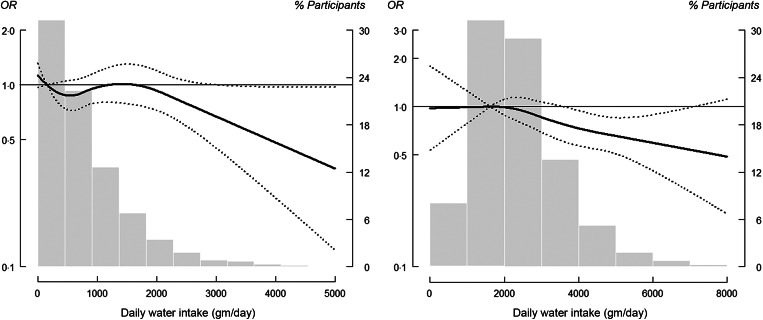
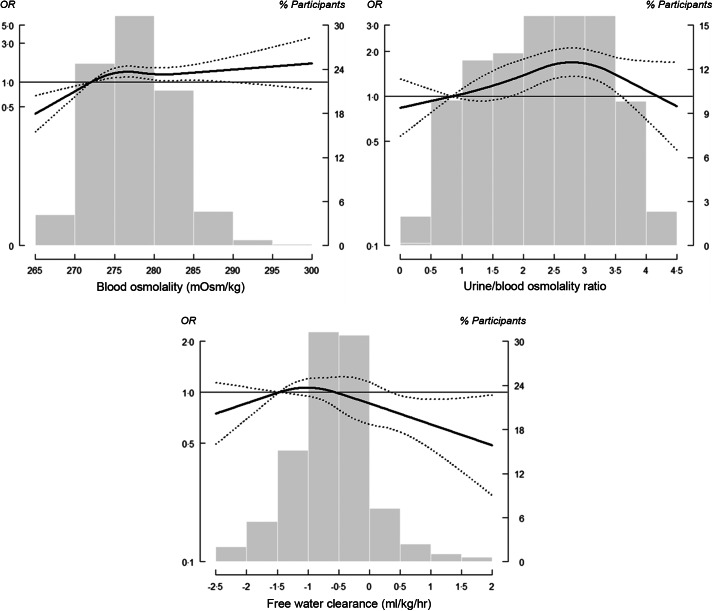
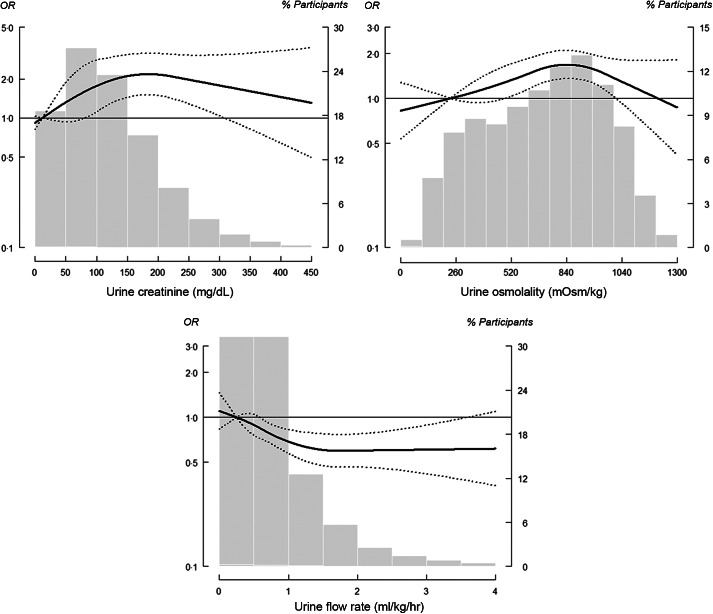
The population medians (interquartile ranges, IQR) for daily total plain water intake and total fluid intake were 807 (336-1481) and 2761 (2107-3577) ml/d, respectively. The adjusted OR (95 % CI) of nephrolithiasis for each IQR increase in total plain water intake and total fluid intake were 0·92 (95 % CI 0·79, 1·06) and 0·84 (95 % CI 0·72, 0·97), respectively. The corresponding OR of nephrolithiasis for UFR, blood osmolality, U:B and urine creatinine were 0·87 (95 % CI 0·76, 0·99), 1·18 (95 % CI 1·06, 1·32), 1·38 (95 % CI 1·17, 1·63) and 1·27 (95 % CI 1·11, 1·45), respectively. A linear protective relationship of fluid intake, UFR and FWC with nephrolithiasis risk was observed. Similarly, positive dose-response associations of nephrolithiasis risk with markers of insufficient hydration were identified. Encouraging a daily water intake of >2500 ml/d and maintaining a urine output of 2 l/d was associated with a lower prevalence of nephrolithiasis.
This study verified the beneficial role of general water intake recommendations in nephrolithiasis prevention in the general US population.
评估人群水平下饮水量和水合状态与肾结石风险的关联。
这是一项横断面研究,其中每日总白开水摄入量和总液体摄入量与血渗透压、尿肌酐、尿渗透压、尿流率(UFR)、自由水清除率(FWC)和尿/血渗透压比(U:B)一起进行评估。使用多变量逻辑回归评估液体摄入量和水合标志物与肾结石的关联。
美国普通人群。
来自 2009-2012 年全国健康和营养检查调查的 8195 名年龄在 20 岁或以上的成年人。
每日总白开水摄入量和总液体摄入量的人群中位数(四分位距,IQR)分别为 807(336-1481)和 2761(2107-3577)ml/d。总白开水摄入量和总液体摄入量每增加一个 IQR,肾结石的调整优势比(95%CI)分别为 0.92(95%CI 0.79,1.06)和 0.84(95%CI 0.72,0.97)。UFR、血渗透压、U:B 和尿肌酐的肾结石相应优势比分别为 0.87(95%CI 0.76,0.99)、1.18(95%CI 1.06,1.32)、1.38(95%CI 1.17,1.63)和 1.27(95%CI 1.11,1.45)。观察到液体摄入、UFR 和 FWC 与肾结石风险呈线性保护关系。同样,发现肾结石风险与水合不足标志物之间存在正剂量反应关系。鼓励每日摄入>2500ml/d 的水并保持 2L/d 的尿量与肾结石患病率降低相关。
本研究验证了一般人群中普遍的水摄入量建议在预防肾结石中的有益作用。