Mechanical Engineering Department, College of Engineering, California Polytechnic State University, San Luis Obispo, CA 93407, USA.
Biomedical Engineering Department, College of Engineering, California Polytechnic State University, San Luis Obispo, CA 93407, USA.
Sensors (Basel). 2024 Aug 23;24(17):5467. doi: 10.3390/s24175467.
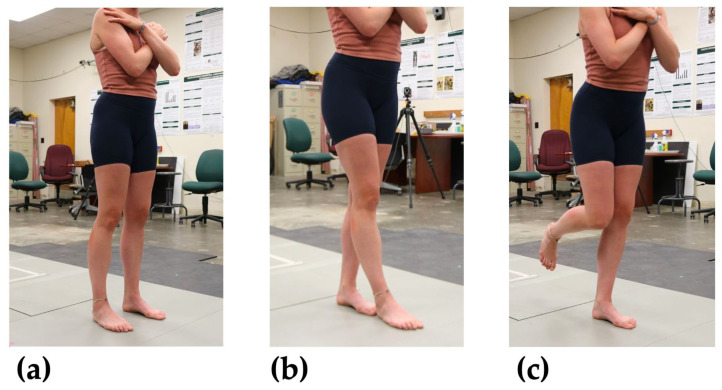
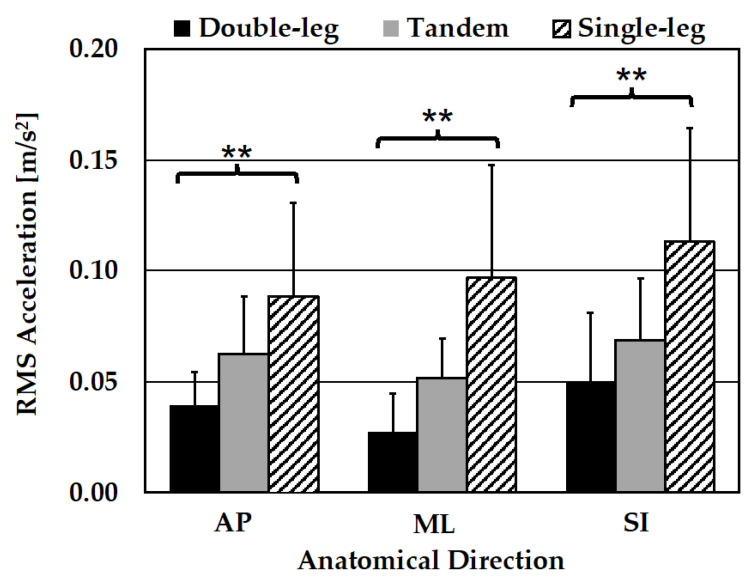
Most balance assessment studies using inertial measurement units (IMUs) in smartphones use a body strap and assume the alignment of the smartphone with the anatomical axes. To replace the need for a body strap, we have used an anatomical alignment method that employs a calibration maneuver and Principal Component Analysis (PCA) so that the smartphone can be held by the user in a comfortable position. The objectives of this study were to determine if correlations existed between angular velocity scores derived from a handheld smartphone with PCA functional alignment vs. a smartphone placed in a strap with assumed alignment, and to analyze acceleration score differences across balance poses of increasing difficulty. The handheld and body strap smartphones exhibited moderately to strongly correlated angular velocity scores in the calibration maneuver (r = 0.487-0.983, < 0.001). Additionally, the handheld smartphone with PCA functional calibration successfully detected significant variance between pose type scores for anteroposterior, mediolateral, and superoinferior acceleration data ( < 0.001).
大多数使用智能手机中的惯性测量单元 (IMU) 进行平衡评估的研究都使用身体带,并假设智能手机与解剖轴对齐。为了替代身体带的需求,我们使用了一种解剖对齐方法,该方法采用校准操作和主成分分析 (PCA),以便用户可以以舒适的姿势握持智能手机。本研究的目的是确定源自具有 PCA 功能对齐的手持智能手机与假设对齐的智能手机的角速度得分之间是否存在相关性,以及分析在平衡姿势难度增加时加速度得分的差异。在校准操作中,手持和身体带智能手机的角速度得分具有中度到高度相关性(r = 0.487-0.983, < 0.001)。此外,使用 PCA 功能校准的手持智能手机成功检测到前-后、内-外侧和上-下加速度数据的姿势类型得分之间存在显著差异( < 0.001)。