Department of Neurology, University Hospital Schleswig-Holstein, Arnold-Heller-Strasse 3, Haus D, 24105 Kiel, Germany.
Digital Signal Processing and System Theory, Institute of Electrical and Information Engineering, Kiel University, Kaiserstrasse 2, 24143 Kiel, Germany.
Int J Environ Res Public Health. 2021 Mar 31;18(7):3644. doi: 10.3390/ijerph18073644.
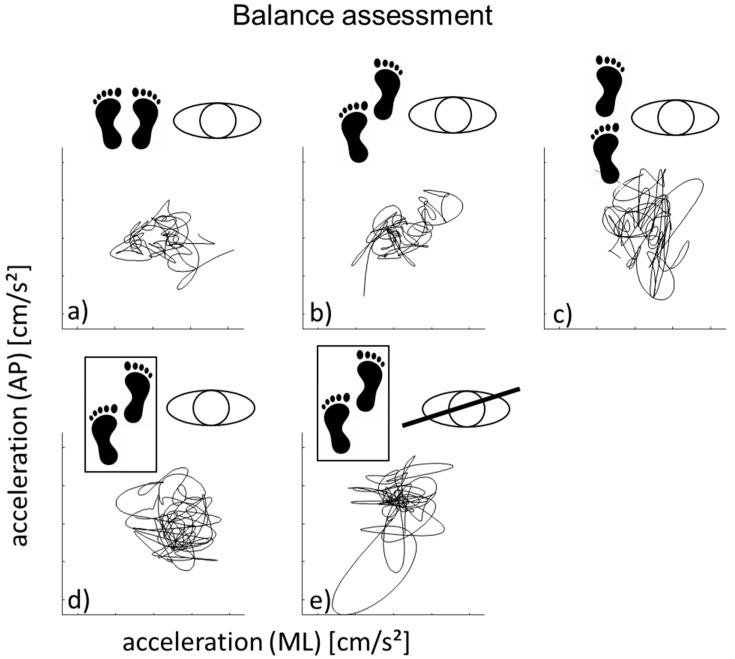
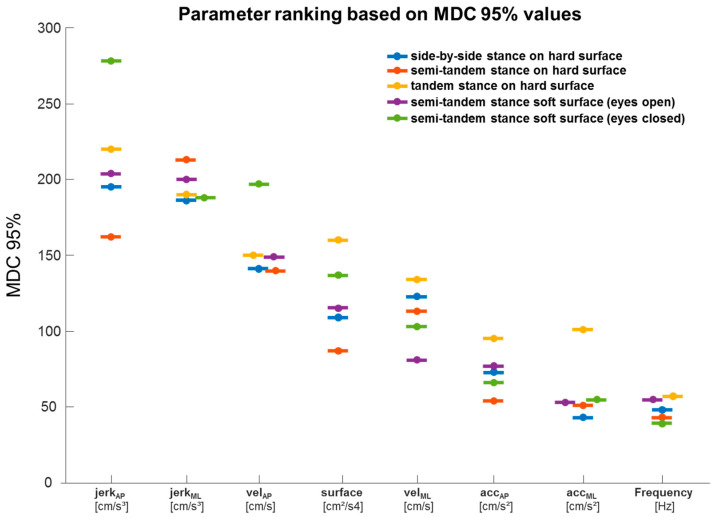
Static balance is a commonly used health measure in clinical practice. Usually, static balance parameters are assessed via force plates or, more recently, with inertial measurement units (IMUs). Multiple parameters have been developed over the years to compare patient groups and understand changes over time. However, the day-to-day variability of these parameters using IMUs has not yet been tested in a neurogeriatric cohort. The aim of the study was to examine day-to-day variability of static balance parameters of five experimental conditions in a cohort of neurogeriatric patients using data extracted from a lower back-worn IMU. A group of 41 neurogeriatric participants (age: 78 ± 5 years) underwent static balance assessment on two occasions 12-24 h apart. Participants performed a side-by-side stance, a semi-tandem stance, a tandem stance on hard ground with eyes open, and a semi-tandem assessment on a soft surface with eyes open and closed for 30 s each. The intra-class correlation coefficient (two-way random, average of the k raters' measurements, ICC2, k) and minimal detectable change at a 95% confidence level (MDC95%) were calculated for the sway area, velocity, acceleration, jerk, and frequency. Velocity, acceleration, and jerk were calculated in both anterior-posterior (AP) and medio-lateral (ML) directions. Nine to 41 participants could successfully perform the respective balance tasks. Considering all conditions, acceleration-related parameters in the AP and ML directions gave the highest ICC results. The MDC95% values for all parameters ranged from 39% to 220%, with frequency being the most consistent with values of 39-57%, followed by acceleration in the ML (43-55%) and AP direction (54-77%). The present results show moderate to poor ICC and MDC values for IMU-based static balance assessment in neurogeriatric patients. This suggests a limited reliability of these tasks and parameters, which should induce a careful selection of potential clinically relevant parameters.
静态平衡是临床实践中常用的健康测量指标。通常,通过测力板或最近的惯性测量单元(IMU)来评估静态平衡参数。多年来,已经开发出多种参数来比较患者群体并了解随时间的变化。然而,使用 IMU 测量这些参数的日常可变性尚未在神经老年患者队列中进行测试。本研究旨在使用从佩戴在腰部的 IMU 中提取的数据,检查神经老年患者队列中五种实验条件下静态平衡参数的日常可变性。一组 41 名神经老年患者(年龄:78 ± 5 岁)在两次间隔 12-24 小时的情况下进行静态平衡评估。参与者分别进行了侧并立位、半并立位、硬地面睁眼的全并立位和半并立位在软表面睁眼和闭眼各 30 秒的评估。计算了摆动面积、速度、加速度、冲击和频率的组内相关系数(双向随机,k 个评分者测量值的平均值,ICC2,k)和 95%置信水平下的最小可检测变化(MDC95%)。在前后(AP)和中间-外侧(ML)方向计算了速度、加速度和冲击。9 到 41 名参与者可以成功完成各自的平衡任务。考虑到所有条件,AP 和 ML 方向的加速度相关参数给出了最高的 ICC 结果。所有参数的 MDC95%值范围为 39%至 220%,其中频率最一致,为 39%-57%,其次是 ML(43%-55%)和 AP 方向(54%-77%)的加速度。本研究结果表明,神经老年患者基于 IMU 的静态平衡评估的 ICC 和 MDC 值中等至较差。这表明这些任务和参数的可靠性有限,应谨慎选择潜在的临床相关参数。