National Center for Birth Defects Monitoring, West China Second University Hospital, Sichuan University, Chengdu, Sichuan, 610041, China.
The Joint Laboratory for Pulmonary Development and Related Diseases, West China Institute of Women and Children's Health, West China Second University Hospital, Sichuan University, Chengdu, Sichuan, China.
BMC Pediatr. 2024 Sep 14;24(1):584. doi: 10.1186/s12887-024-05056-8.
Gastroschisis is a common abdominal wall defect that increases infant mortality risk and health care costs. However, recent epidemiological data on gastroschisis in China is limited.
Using 2007-2020 data from the Chinese Birth Defects Monitoring Network (CBDMN), we analyzed gastroschisis prevalence rates stratified by birth year, maternal age group, residence area, geographical region, and infant sex. We also examined the temporal variations in prevalence, pregnancy outcomes of affected infants, prenatal diagnoses, and co-occurring anomalies.
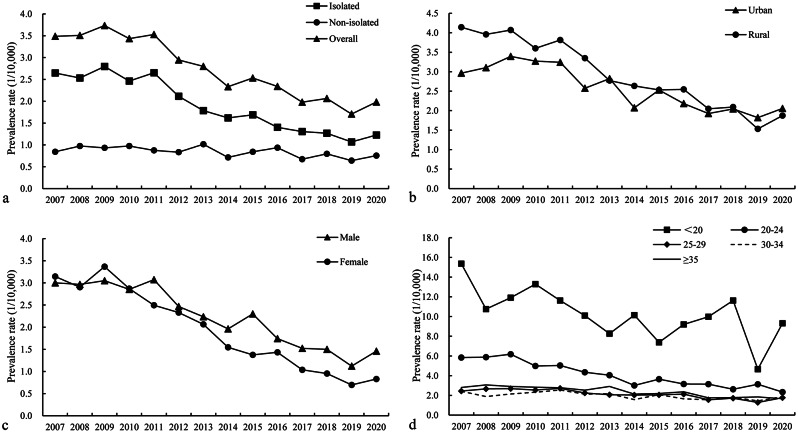
From 2007 to 2020, a total of 6,813 cases of gastroschisis were identified among 25,909,000 births, comprising 4,675 isolated and 2,138 non-isolated cases. Prevalence rates per 10,000 live and still births were 2.63, 1.80, and 0.83 for the overall, isolated, and non-isolated gastroschisis, respectively, all showing a decreasing trend over the study period. The prevalence of overall gastroschisis varied significantly by maternal age (< 20 years, 9.88/10,000; 20-24 years, 4.17/10,000; 25-29 year, 2.08/10,000; 30-34 years, 1.88/10,000;≥35 years, 2.24/10,000), maternal residence (urban, 2.45/10,000; rural, 2.85/10,000), geographic region (central, 2.54/10,000; east, 2.57/10,000; west, 2.80/10,000), and infant sex (male, 2.13/10,000; female, 1.79/10,000). Non-isolated gastroschisis cases had a higher early neonatal mortality rate than isolated cases (41.91% vs. 28.10%) and frequently co-occurred with musculoskeletal anomalies.
This study highlights a declining trend in gastroschisis prevalence in Chinese population, a contrast to previous studies, and underscores the need for improved perinatal management due to adverse pregnancy outcomes associated with this condition.
先天性腹壁裂是一种常见的腹壁缺陷,会增加婴儿的死亡率和医疗保健费用。然而,目前中国关于先天性腹壁裂的流行病学数据有限。
利用中国出生缺陷监测网络(CBDMN)2007 年至 2020 年的数据,我们按出生年份、产妇年龄组、居住地区、地理区域和婴儿性别对先天性腹壁裂的流行率进行分层分析。我们还研究了流行率、受影响婴儿的妊娠结局、产前诊断和伴发畸形的时间变化。
2007 年至 2020 年,在 25909000 例活产和死产中,共发现 6813 例先天性腹壁裂病例,其中 4675 例为单纯性病例,2138 例为非单纯性病例。整体、单纯性和非单纯性先天性腹壁裂的活产和死产每 10000 例的患病率分别为 2.63、1.80 和 0.83,均呈下降趋势。整体先天性腹壁裂的患病率在产妇年龄(<20 岁,9.88/10000;20-24 岁,4.17/10000;25-29 岁,2.08/10000;30-34 岁,1.88/10000;≥35 岁,2.24/10000)、产妇居住地(城市,2.45/10000;农村,2.85/10000)、地理区域(中部,2.54/10000;东部,2.57/10000;西部,2.80/10000)和婴儿性别(男,2.13/10000;女,1.79/10000)方面存在显著差异。非单纯性先天性腹壁裂病例的新生儿早期死亡率高于单纯性病例(41.91% vs. 28.10%),且常伴有肌肉骨骼畸形。
本研究强调了中国人群中先天性腹壁裂流行率呈下降趋势,与以往研究形成对比,并突出了由于与该病症相关的不良妊娠结局,需要加强围产期管理。