Plant Ecology and Nature Conservation, Institute of Biochemistry and Biology, University of Potsdam, 14469, Potsdam, Germany.
Animal Ecology, Institute of Biochemistry and Biology, University of Potsdam, 14469, Potsdam, Germany.
Nat Commun. 2024 Sep 15;15(1):8079. doi: 10.1038/s41467-024-52381-8.
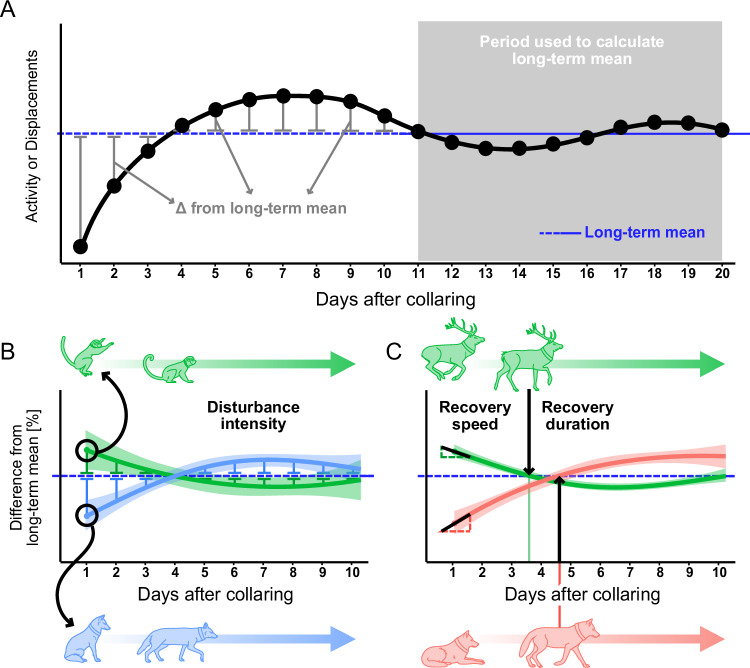
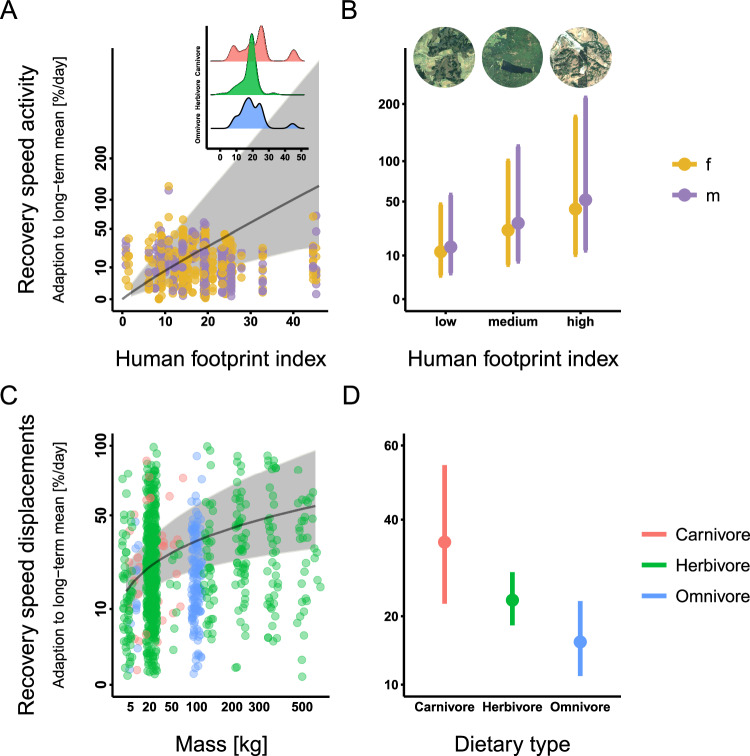
Wildlife tagging provides critical insights into animal movement ecology, physiology, and behavior amid global ecosystem changes. However, the stress induced by capture, handling, and tagging can impact post-release locomotion and activity and, consequently, the interpretation of study results. Here, we analyze post-tagging effects on 1585 individuals of 42 terrestrial mammal species using collar-collected GPS and accelerometer data. Species-specific displacements and overall dynamic body acceleration, as a proxy for activity, were assessed over 20 days post-release to quantify disturbance intensity, recovery duration, and speed. Differences were evaluated, considering species-specific traits and the human footprint of the study region. Over 70% of the analyzed species exhibited significant behavioral changes following collaring events. Herbivores traveled farther with variable activity reactions, while omnivores and carnivores were initially less active and mobile. Recovery duration proved brief, with alterations diminishing within 4-7 tracking days for most species. Herbivores, particularly males, showed quicker displacement recovery (4 days) but slower activity recovery (7 days). Individuals in high human footprint areas displayed faster recovery, indicating adaptation to human disturbance. Our findings emphasize the necessity of extending tracking periods beyond 1 week and particular caution in remote study areas or herbivore-focused research, specifically in smaller mammals.
野生动物标记为研究动物在全球生态系统变化中的运动生态、生理学和行为提供了重要的见解。然而,捕捉、处理和标记所带来的压力会影响释放后的运动和活动能力,从而影响研究结果的解读。在这里,我们利用项圈收集的 GPS 和加速度计数据,分析了 42 种陆地哺乳动物 1585 个个体的标记后效应。我们在释放后 20 天内评估了物种特异性位移和整体动态身体加速度(作为活动的代理),以量化干扰强度、恢复持续时间和速度。考虑到物种特异性特征和研究区域的人为足迹,我们评估了差异。超过 70%的分析物种在佩戴项圈后表现出明显的行为变化。食草动物的活动反应具有变异性,移动距离更远,而杂食动物和肉食动物最初的活动和移动能力较低。恢复持续时间很短,大多数物种在 4-7 天的跟踪天数内,变化就会减少。食草动物,特别是雄性,恢复位移的速度更快(4 天),但恢复活动的速度较慢(7 天)。在人类足迹较大的地区,个体的恢复速度较快,这表明它们适应了人类的干扰。我们的研究结果强调了在 1 周以上延长跟踪时间的必要性,并特别需要谨慎对待在偏远研究区域或专注于食草动物的研究中,特别是在小型哺乳动物中。