Suresh Balaji, Gunasekaran Rajasekar
Pediatric and Preventive Dentistry, Saveetha Dental College and Hospitals, Saveetha Institute of Medical and Technical Sciences, Saveetha University, Chennai, IND.
Cureus. 2024 Aug 16;16(8):e67012. doi: 10.7759/cureus.67012. eCollection 2024 Aug.
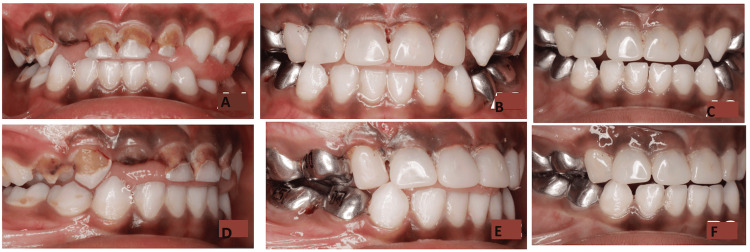
Background Restoration of primary canine teeth in pediatric dentistry requires a balance of functional, biological, and esthetic factors. Stainless steel crowns, while effective for posterior restorations, often have patient acceptance issues due to esthetic limitations. Resin-bonded composite strip crowns have gained traction for anterior restorations due to their superior esthetic qualities and repairability. However, their long-term performance in primary canines characterized by unique morphological and functional demands has not been thoroughly evaluated. This study investigates the efficacy of resin-bonded incisor strip crowns in primary canines over three years, assessing their functional durability, biological integrity, and esthetic performance to provide a comprehensive evaluation of their long-term success in this application. Methods This retrospective observational study, conducted from September 2023 to December 2023 at the Department of Pediatric and Preventive Dentistry, Saveetha Dental College and Hospitals, Chennai, Tamil Nadu, India, received ethical approval from the Institutional Human Ethical Committee (IHEC/SDC/PEDO-2103/23/131). Dental records from January 2020 to December 2020 were reviewed by two investigators to identify children aged six years or younger who had undergone pulpectomy in primary canine teeth and were restored with resin-bonded incisor strip crowns. Exclusions included records with missing contact details or post-treatment radiographs. The purpose was to ensure a three-year review period when contacting patients in 2023. Eligible parents were contacted by phone, informed about the study, and invited for a review. Informed consent was obtained in person. Children with exfoliated primary canines and those whose parents did not sign the consent form were excluded. The restored crowns were evaluated using World Dental Federation (FDI) criteria across functional, biological, and esthetic domains by two calibrated examiners. Statistical analysis was conducted using IBM SPSS Statistics for Windows, Version 24 (Released 2016; IBM Corp., Armonk, New York, United States), with categorical variables expressed as n (%), inter-examiner reliability assessed by Cohen's kappa, and chi-square test used for goodness of fit, setting significance at 95%. Results Of the 92 primary canines restored with resin-bonded incisor strip crowns, 60 children were evaluated. The retention rate at the three-year follow-up was 50 (83.3%). Functional evaluation revealed that 48 (80%) of crowns maintained surface texture, 42 (70%) preserved form and contour, and 52 (86.6%) demonstrated acceptable occlusion and wear. Biologically, 55 (91.7%) of the crowns had no secondary caries, and 56 (93.4%) had no dental hard tissue defects at the margin. Esthetically, 48 (80%) of crowns retained surface texture, 46 (76.6%) had a satisfactory color match, and 45 (71.6%) exhibited minimal marginal staining. Statistical analysis confirmed significant results for all functional and esthetic parameters (p < 0.05). Conclusion The technique of placing incisor strip crowns in the place of primary canines can be recommended considering its maintenance of functional, biological, and esthetic properties.
背景
儿童牙科中乳犬齿的修复需要平衡功能、生物学和美学因素。不锈钢冠虽然对后牙修复有效,但由于美学限制,患者接受度往往存在问题。树脂粘结复合带环冠因其卓越的美学品质和可修复性,在前牙修复中受到关注。然而,它们在具有独特形态和功能需求的乳犬齿中的长期性能尚未得到充分评估。本研究调查了树脂粘结切牙带环冠在乳犬齿中三年的疗效,评估其功能耐久性、生物学完整性和美学性能,以全面评估其在此应用中的长期成功率。
方法
这项回顾性观察研究于2023年9月至2023年12月在印度泰米尔纳德邦金奈萨维塔牙科学院和医院的儿童与预防牙科系进行,获得了机构人类伦理委员会(IHEC/SDC/PEDO - 2103/23/131)的伦理批准。两名研究人员回顾了2020年1月至2020年12月的牙科记录,以识别6岁及以下接受过乳犬齿牙髓摘除术并用树脂粘结切牙带环冠修复的儿童。排除标准包括联系细节缺失或治疗后X光片缺失的记录。目的是确保在2023年联系患者时有三年的回顾期。通过电话联系符合条件的家长,告知他们研究情况,并邀请他们进行复查。亲自获得知情同意。已脱落乳犬齿的儿童以及其家长未签署同意书的儿童被排除。由两名经过校准的检查人员使用世界牙科联盟(FDI)标准在功能、生物学和美学领域对修复的冠进行评估。使用IBM SPSS Statistics for Windows,版本24(2016年发布;IBM公司,美国纽约州阿蒙克)进行统计分析,分类变量表示为n(%),检查者间可靠性通过科恩kappa系数评估,卡方检验用于拟合优度检验,显著性设定为95%。
结果
在用树脂粘结切牙带环冠修复的92颗乳犬齿中,对60名儿童进行了评估。三年随访时的保留率为50颗(83.3%)。功能评估显示,48颗(80%)冠保持了表面纹理,42颗(70%)保持了形态和轮廓,52颗(86.6%)显示出可接受的咬合和磨损。生物学方面,55颗(91.7%)冠没有继发龋,56颗(93.4%)在边缘没有牙硬组织缺损。美学方面,48颗(80%)冠保持了表面纹理,46颗(76.6%)颜色匹配令人满意,45颗(71.6%)边缘染色最小。统计分析证实所有功能和美学参数均有显著结果(p < 0.05)。
结论
考虑到其对功能、生物学和美学特性的维持,推荐采用在乳犬齿位置放置切牙带环冠的技术。
