Cheng Qingmei, He Ke, Zhu Junyu, Li Xiaoxiao, Wu Xuan, Zeng Chao, Lei Guanghua, Wang Ning, Li Hui, Wei Jie
Hunan Key Laboratory of Joint Degeneration and Injury, Xiangya Hospital, Central South University, Changsha, China.
Key Laboratory of Aging-related Bone and Joint Diseases Prevention and Treatment, Ministry of Education, Xiangya Hospital, Central South University, Changsha, China.
J Orthop Translat. 2024 Aug 27;48:204-216. doi: 10.1016/j.jot.2024.08.007. eCollection 2024 Sep.
Memantine, which is an FDA-proven drug for the treatment of dementia, exerts its function by blocking the function of NMDA (N-methyl-D-aspartate) receptor, a calcium-permeable ion channel that reduces cytotoxic calcium overload. Chondrocyte senescence is a crucial cellular event that contributes to articular cartilage degeneration during osteoarthritis (OA) development. To date, the effects of memantine and its downstream NMDA receptor on chondrocyte senescence and OA have been rarely reported.
The protein levels of NMDA receptor and its agonistic ligand, glutamate, were compared between normal and OA chondrocytes. The quantity of intracellular calcium ions and the level of mitochondrial damage were evaluated using specific fluorescent probes and transmission electron microscopy (TEM), respectively. Chondrocyte senescence was evaluated by senescence-associated β-galactosidase (SA-β-Gal) staining and p16 analysis. The function of NMDA receptor in chondrocyte senescence and OA was tested via agonists activation and gene knockdown experiments. The therapeutic effects of memantine on OA were examined both and . Additionally, to verify the findings from animal samples, a propensity score-matched cohort study was conducted using data from a United Kingdom primary care database (i.e., IQVIA Medical Research Database [IMRD]) to compare the risk of OA-related joint replacement involved in memantine initiators versus active comparators (i.e., acetylcholinesterase [AchE] initiators) in patients with dementia.
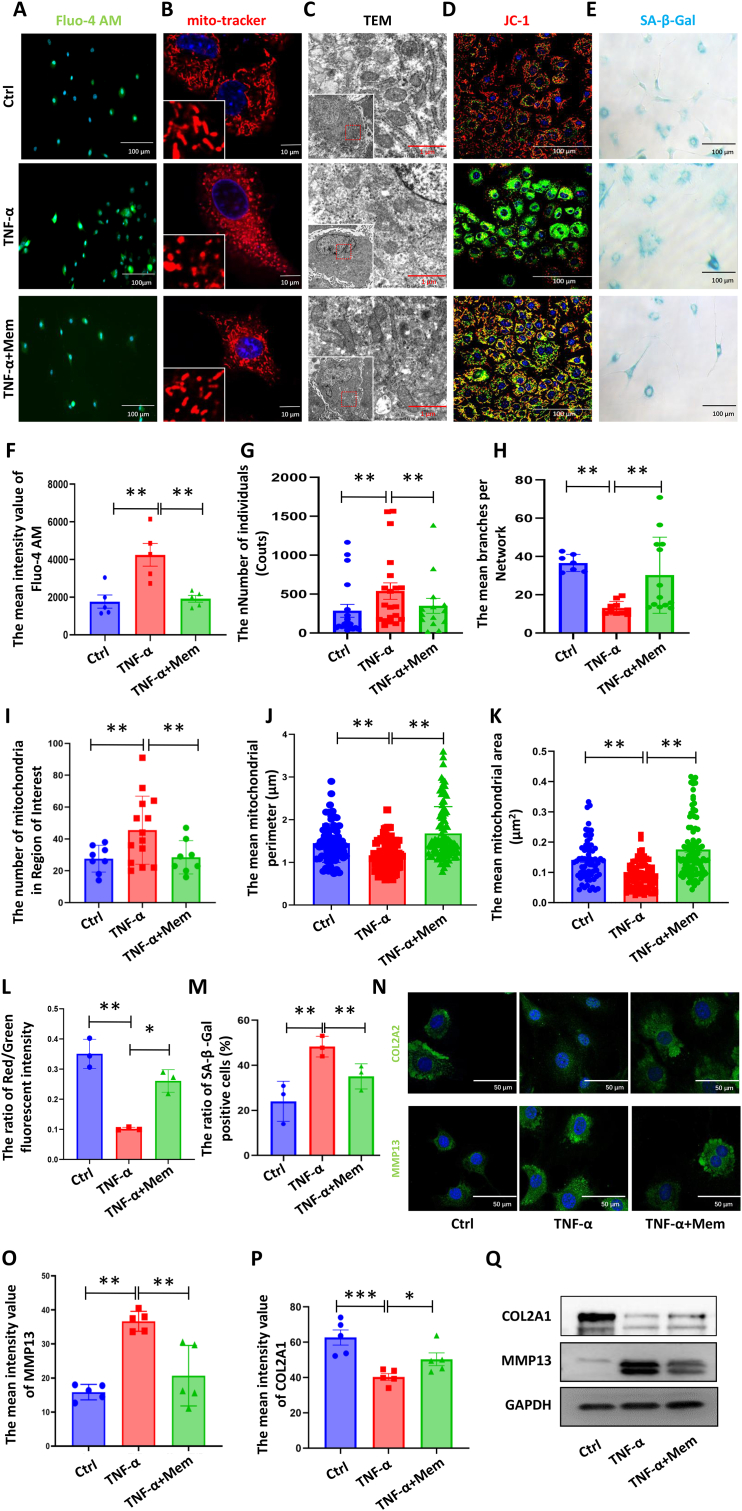
The protein expression of NMDA receptor and the secretion of glutamate were both significantly increased in OA chondrocytes. NMDA receptor activation was found to stimulate chondrocyte calcium overload, which further led to mitochondrial fragmentation and chondrocyte senescence. Blocking the NMDA receptor with memantine and N-methyl-D-aspartate receptor subunit 1(NR1, the gene encoding NMDA receptor) knockdown resulted in reduced calcium influx, mitochondrial fragmentation, as well as cellular senescence in OA chondrocytes. Intra-articular injection of memantine in OA mice also exhibited protective effects against cartilage degeneration. Moreover, in the 1:5 propensity score-matched cohort study consisting of 6218 patients (n = 1435 in the memantine cohort; n = 4783 in the AchE cohort), the memantine initiator was associated with a lower risk of OA-related joint replacement than AchE initiators (Hazard ratio = 0.56, 95 % confidence interval: 0.34 to 0.99).
NMDA receptor plays an important role in inflammatory-induced cytotoxic calcium overload in chondrocytes, while memantine can effectively block the NMDA receptor to reduce chondrocyte senescence and retard the development of OA.
As a clinically licensed drug used for the treatment of dementia, memantine has shown promising therapeutic effects on OA. Mechanistically, it functions by blocking NMDA receptor from mediating chondrocyte senescence. The protective effects of memantine against OA were verified not only by and experiments but also via a propensity score-matched human cohort study. These findings presented robust evidence for repurposing memantine for the treatment of OA.
美金刚是一种经美国食品药品监督管理局(FDA)验证可用于治疗痴呆症的药物,它通过阻断N-甲基-D-天冬氨酸(NMDA)受体的功能发挥作用,NMDA受体是一种可渗透钙的离子通道,能减少细胞毒性钙超载。软骨细胞衰老在骨关节炎(OA)发展过程中是导致关节软骨退变的关键细胞事件。迄今为止,美金刚及其下游NMDA受体对软骨细胞衰老和OA的影响鲜有报道。
比较正常软骨细胞和OA软骨细胞中NMDA受体及其激动剂配体谷氨酸的蛋白水平。分别使用特异性荧光探针和透射电子显微镜(TEM)评估细胞内钙离子数量和线粒体损伤水平。通过衰老相关β-半乳糖苷酶(SA-β-Gal)染色和p16分析评估软骨细胞衰老。通过激动剂激活和基因敲低实验检测NMDA受体在软骨细胞衰老和OA中的作用。研究了美金刚对OA的治疗效果。此外,为了验证动物样本中的研究结果,利用来自英国初级保健数据库(即艾昆纬医学研究数据库[IMRD])的数据进行了一项倾向评分匹配队列研究,以比较痴呆症患者中美金刚起始使用者与活性对照者(即乙酰胆碱酯酶[AchE]起始使用者)发生OA相关关节置换的风险。
OA软骨细胞中NMDA受体的蛋白表达和谷氨酸分泌均显著增加。发现NMDA受体激活会刺激软骨细胞钙超载,进而导致线粒体碎片化和软骨细胞衰老。用美金刚和N-甲基-D-天冬氨酸受体亚基1(NR1,编码NMDA受体的基因)敲低阻断NMDA受体可减少OA软骨细胞中的钙内流、线粒体碎片化以及细胞衰老。在OA小鼠中关节内注射美金刚也对软骨退变表现出保护作用。此外,在由6218例患者组成的1:5倾向评分匹配队列研究中(美金刚队列n = 1435;AchE队列n = 4783),与AchE起始使用者相比,美金刚起始使用者发生OA相关关节置换的风险更低(风险比=0.56,95%置信区间:0.34至0.99)。
NMDA受体在炎症诱导的软骨细胞毒性钙超载中起重要作用,而美金刚可有效阻断NMDA受体以减少软骨细胞衰老并延缓OA的发展。
作为一种用于治疗痴呆症的临床许可药物,美金刚已显示出对OA有良好的治疗效果。从机制上讲,它通过阻断NMDA受体介导软骨细胞衰老发挥作用。美金刚对OA的保护作用不仅通过实验得到验证,还通过倾向评分匹配的人类队列研究得到证实。这些发现为美金刚重新用于治疗OA提供了有力证据。