Chen Qiu-Yue, Liu Ming-Li, Li Ruo-Yu, Jiang Bin, Liu Kun-Yi, Xiao Yan-Qin, Wang Qi, Wang Teng, Zhao Lian-Qin, Wang Wei-Tao, Liu Zhi-Wei, Chen Li-Jiao, Ma Yan, Zhao Ming
College of Tea Science, Yunnan Agricultural University, Kunming, Yunnan 650201, China.
Research Institute of Tea Industry, Yibi, Sichuan 644000, China.
Curr Res Food Sci. 2024 Aug 28;9:100831. doi: 10.1016/j.crfs.2024.100831. eCollection 2024.
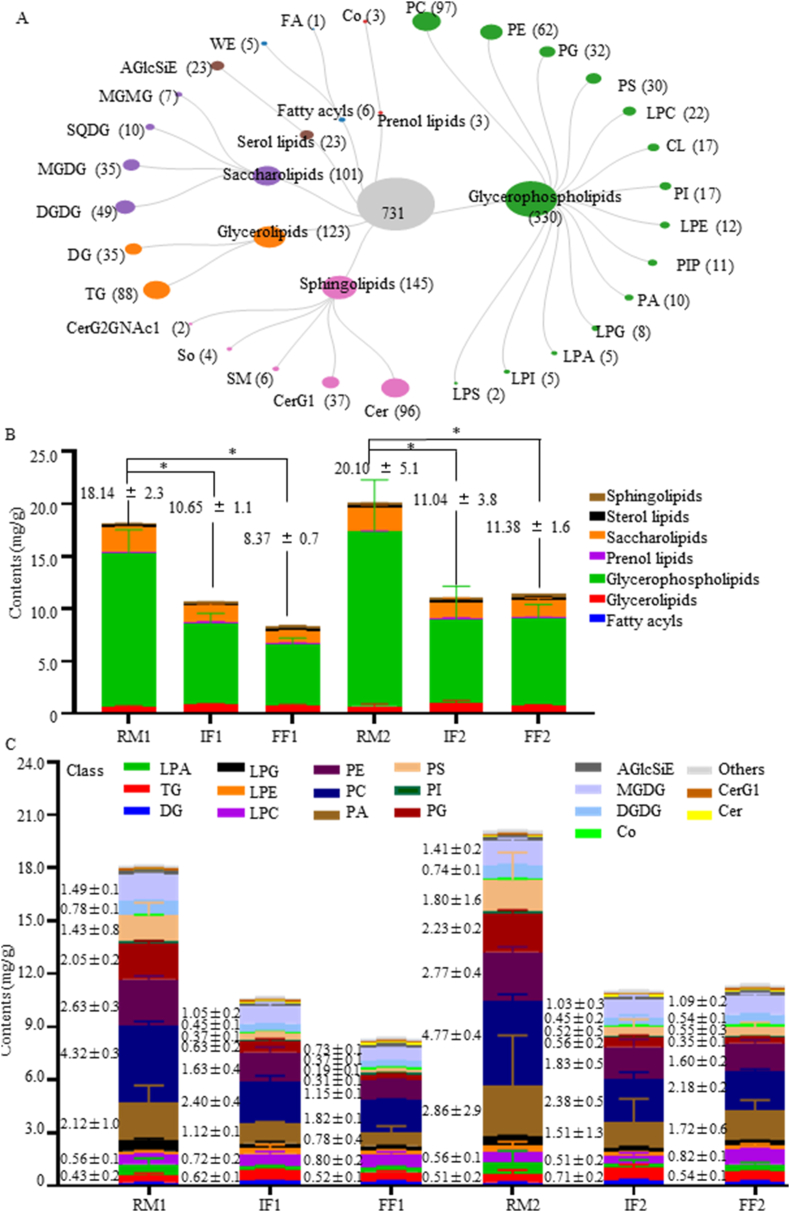
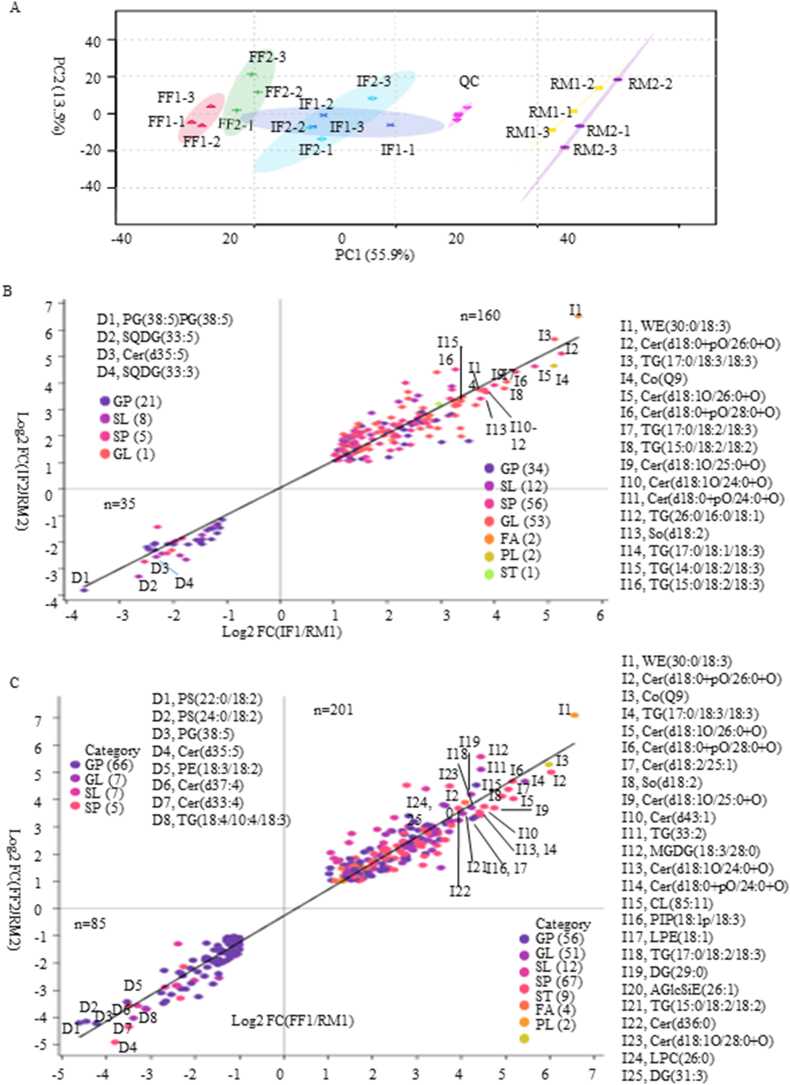
During the fermentation of ripened pu-erh tea (RPT), the composition of lipids and other compounds changes significantly. In this study, we conducted industrial fermentation of RPT and observed that the levels of water extract, tea polyphenols, free amino acids, catechins, caffeine, rutin, theophylline, luteolin, and myricetin decreased, while the level of soluble sugar increased. Additionally, the levels of gallic acid, quercetin, ellagic acid, and kaempferol first increased and then decreased during fermentation. We identified a total of 731 lipids, which were classified into seven categories using a lipomics method. Among these lipids, 85 with relatively high contents decreased, while 201 lipids with low contents increased after fermentation. This led to an overall decrease in the sum contents of lipids and dominant lipids, including glycerophospholipids and saccharolipids. We also detected 33 medium- and long-chain fatty acids, with α-linolenic acid (881.202 ± 12.13-1322.263 ± 19.78 μg/g), palmitic acid (797.275 ± 19.56-955.180 ± 30.49 μg/g), and linoleic acid (539.634 ± 15.551-706.869 ± 12.14 μg/g) being the predominant ones. Coenzymes Q9 (62.76-63.57 μg/g) and Q10 (50.82-59.33 μg/g) were also identified in the fermentation process. Our findings shed light on the changes in lipids during the fermentation of RPT and highlight the potential bio-active compounds, such as α-linolenic acid, linoleic acid, Coenzymes Q9, and Q10, in ripened pu-erh tea. This contributes to a better understanding of the fermentation mechanism for RPT.
在成熟普洱茶(RPT)发酵过程中,脂质和其他化合物的组成会发生显著变化。在本研究中,我们对RPT进行了工业发酵,观察到水浸出物、茶多酚、游离氨基酸、儿茶素、咖啡因、芦丁、茶碱、木犀草素和杨梅素的含量下降,而可溶性糖含量增加。此外,没食子酸、槲皮素、鞣花酸和山奈酚的含量在发酵过程中先升高后降低。我们共鉴定出731种脂质,采用脂质组学方法将其分为七类。在这些脂质中,85种含量相对较高的脂质在发酵后减少,而201种含量较低的脂质增加。这导致脂质和主要脂质(包括甘油磷脂和糖脂)的总含量总体下降。我们还检测到33种中长链脂肪酸,其中α-亚麻酸(881.202±12.13 - 1322.263±19.78μg/g)、棕榈酸(797.275±19.56 - 955.180±30.49μg/g)和亚油酸(539.634±15.551 - 706.869±12.14μg/g)为主要脂肪酸。发酵过程中还鉴定出辅酶Q9(62.76 - 63.57μg/g)和Q10(50.82 - 59.33μg/g)。我们的研究结果揭示了RPT发酵过程中脂质的变化,并突出了成熟普洱茶中潜在的生物活性化合物,如α-亚麻酸、亚油酸、辅酶Q9和Q10。这有助于更好地理解RPT的发酵机制。