Lu Ying, Yang Jinjin, Zhu Junwen, Shu Yao, Zou Xuan, Ruan Qiao, Luo Shuyuan, Wang Yong, Wen Jun
School of Stomatology, Southern Medical University, Guangzhou 510515, China.
Department of Stomatology, The Fifth Medical Center of PLA General Hospital, Beijing 100071, China.
J Oncol. 2023 Feb 9;2023:4616682. doi: 10.1155/2023/4616682. eCollection 2023.
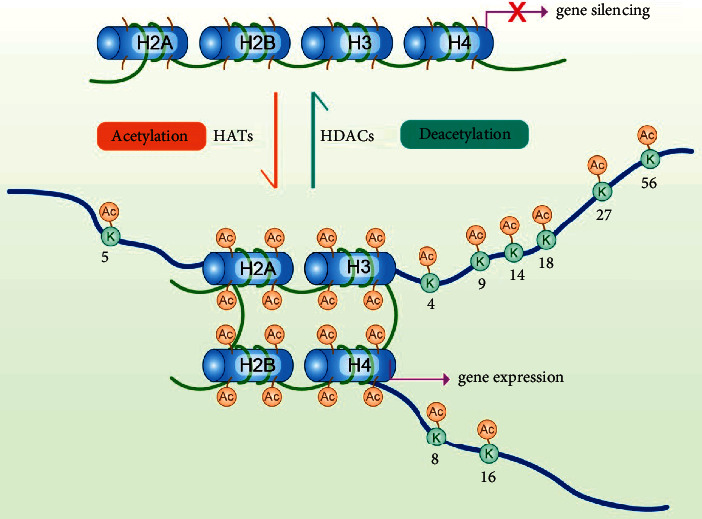
Oral squamous cell carcinoma (OSCC) is one of the common malignant tumors in the head and neck, characterized by high malignancy, rapid growth and metastasis, high invasive ability, and high mortality. In recent years, surgery combined with chemotherapy or radiotherapy remains the preferred clinical treatment for OSCC, despite considerable advances in diagnostic and therapeutic techniques. Hence, new targeted therapy is urgently needed. Histone modification affects the function of massive cells through histone acetyltransferase and histone deacetylase. Accompanied by the progress of some diseases, especially tumors, these proteins often show abnormal functions, and by reversing these abnormalities with drugs or gene therapy, the cancer phenotype can even be restored to normal. As a result, they are potential drug targets. This article reviewed the role of the histone dynamic process of acetylation modifications and their associated active modifying enzymes in the pathogenesis and progress of OSCC. Moreover, we explored the value of histone acetylation modification as a potential therapeutic target and the new progress of related drugs in clinical treatment.
口腔鳞状细胞癌(OSCC)是头颈部常见的恶性肿瘤之一,其特点是恶性程度高、生长和转移迅速、侵袭能力强且死亡率高。近年来,尽管诊断和治疗技术取得了长足进步,但手术联合化疗或放疗仍是OSCC的首选临床治疗方法。因此,迫切需要新的靶向治疗方法。组蛋白修饰通过组蛋白乙酰转移酶和组蛋白去乙酰化酶影响大量细胞的功能。随着一些疾病,尤其是肿瘤的进展,这些蛋白质常常表现出异常功能,通过药物或基因治疗逆转这些异常,甚至可以使癌症表型恢复正常。因此,它们是潜在的药物靶点。本文综述了组蛋白乙酰化修饰的动态过程及其相关活性修饰酶在OSCC发病机制和进展中的作用。此外,我们探讨了组蛋白乙酰化修饰作为潜在治疗靶点的价值以及相关药物在临床治疗中的新进展。