Vitale Alessandro, Trapani Silvia, Russo Francesco Paolo, Miele Luca, Svegliati Baroni Gianluca, Marchesini Giulio, Burra Patrizia, Ottoveggio Marco Salvatore, Romagnoli Renato, Martini Silvia, De Simone Paolo, Carrai Paola, Cescon Matteo, Morelli Maria Cristina, De Carlis Luciano, Belli Luca, Gruttadauria Salvatore, Volpes Riccardo, Colledan Michele, Fagiuoli Stefano, Di Benedetto Fabrizio, De Maria Nicola, Rossi Giorgio, Caccamo Lucio, Donato Francesca, Vennarecci Giovanni, Di Costanzo Giovan Giuseppe, Vivarelli Marco, Carraro Amedeo, Sacerdoti David, Ettorre Giuseppe Maria, Giannelli Valerio, Agnes Salvatore, Gasbarrini Antonio, Rossi Massimo, Ginanni Corradini Stefano, Mazzaferro Vincenzo, Bhoori Sherrie, Manzia Tommaso Maria, Lenci Ilaria, Zamboni Fausto, Mameli Laura, Baccarani Umberto, Toniutto Pierluigi, Lupo Luigi Giovanni, Tandoi Francesco, Rendina Maria, Andorno Enzo, Giannini Edoardo Giovanni, Spada Marco, Billato Ilaria, Marchini Andrea, Romano Pierluigi, Brancaccio Giuseppina, D'Amico Francesco, Ricci Andrea, Cardillo Massimo, Cillo Umberto
Azienda Ospedale-Università Di Padova, Università di Padova, Padova, Italy.
Centro Nazionale Trapianti, Istituto Superiore Di Sanitá, Italy.
JHEP Rep. 2024 Jun 22;6(9):101147. doi: 10.1016/j.jhepr.2024.101147. eCollection 2024 Sep.
BACKGROUND & AIMS: International consensus has recently introduced a new definition of metabolic dysfunction-associated steatotic liver disease (MASLD). We sought to analyse epidemiological trends, prognostic features, and transplant survival benefits of patients with MASLD and without MASLD waiting for liver transplantation (LT) in Italy.
Using the Italian Liver Transplant Registry database, we analysed data from adult patients listed for primary LT attributable to end-stage chronic liver disease between January 2012 and December 2022. Independent multivariable waiting lists and post-transplant survival models were developed for patients with and without hepatocellular carcinoma (HCC). A Monte Carlo simulation was used to create 5-year transplant benefit distributions based on the presence of MASLD, HCC, and model for end-stage liver disease (MELD)-sodium values.
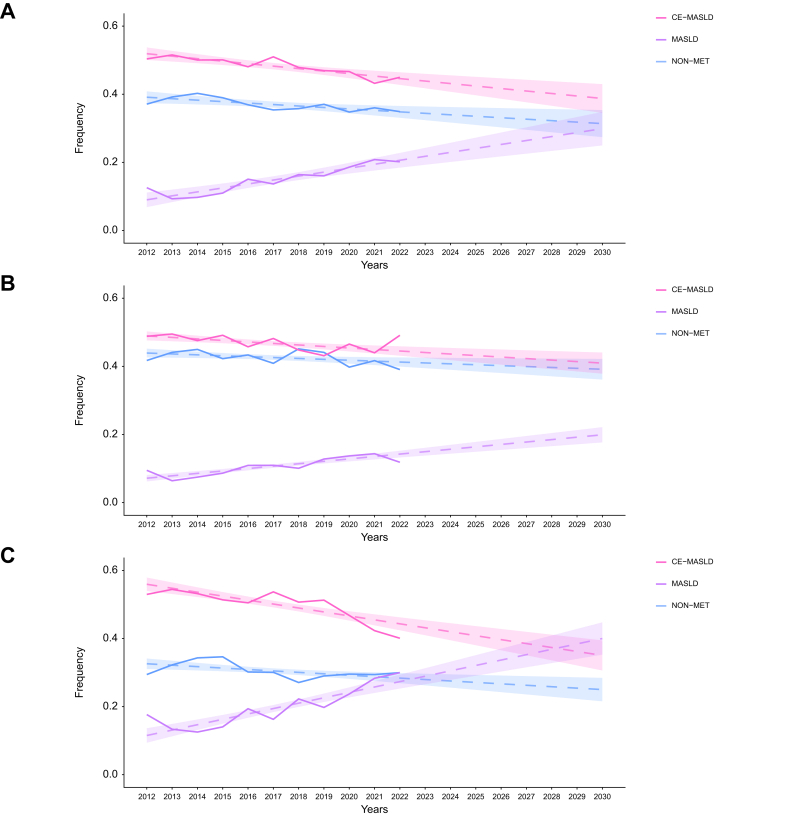
A total sample of 1,941 patients with MASLD and 11,201 patients without MASLD was considered. A significant increase in the prevalence of MASLD as an indication for LT was observed from 2012 to 2022, for both cohorts with HCC (from 17.7 to 30%) and without HCC (from 9.5 to 11.8%) cohorts. Projections suggest that, as early as next year, MASLD will overcome HCV as the second most common indication for transplantation after alcoholic liver disease in Italy. According to univariate and multivariate analyses, MASLD was not an independent predictive factor for patient survival after transplantation. However, it increased the risk of death for patients on the waiting list without HCC (hazard ratio 1.62, <0.001). At the same MELD-sodium, the 5-year transplant benefit was higher in patients with non-HCC MASLD, followed by patients with HCC, whereas it was lower in patients without HCC and without MASLD.
Patients with non-HCC MASLD had an increased waitlist mortality and 5-year transplant survival benefit compared with other candidates.
The present research addresses the critical need to understand the evolving landscape of liver transplantation indications, mainly focusing on metabolic dysfunction-associated steatotic liver disease (MASLD) in Italy. Given the significant rise in MASLD cases, these findings highlight that patients with non-HCC MASLD face increased waitlist mortality and benefit more from liver transplantation within 5 years compared with other candidates. The significance of these results lies in their emphasis on the necessity of focusing on patients with MASLD on waiting lists to improve outcomes. By tailoring transplant eligibility criteria and resource allocation, the study provides actionable insights to improve patient survival and optimise liver transplantation practices.
国际共识最近引入了代谢功能障碍相关脂肪性肝病(MASLD)的新定义。我们试图分析意大利等待肝移植(LT)的MASLD患者和非MASLD患者的流行病学趋势、预后特征以及移植生存获益情况。
利用意大利肝移植登记数据库,我们分析了2012年1月至2022年12月期间因终末期慢性肝病而列入初次LT的成年患者的数据。针对有和没有肝细胞癌(HCC)的患者分别建立了独立的多变量等待名单和移植后生存模型。使用蒙特卡洛模拟根据MASLD、HCC的存在情况以及终末期肝病模型(MELD)-钠值创建5年移植获益分布。
共纳入1941例MASLD患者和11201例非MASLD患者。2012年至2022年期间,观察到作为LT指征的MASLD患病率显著增加,在伴有HCC的队列(从17.7%增至30%)和不伴有HCC的队列(从9.5%增至11.8%)中均如此。预测表明,早在明年,MASLD将超过丙型肝炎病毒(HCV),成为意大利仅次于酒精性肝病的第二大常见移植指征。根据单因素和多因素分析,MASLD不是移植后患者生存的独立预测因素。然而,它增加了无HCC的等待名单上患者的死亡风险(风险比1.62,<0.001)。在相同的MELD-钠水平下,非HCC的MASLD患者的5年移植获益更高,其次是HCC患者,而无HCC且无MASLD的患者移植获益较低。
与其他候选者相比,非HCC的MASLD患者等待名单上的死亡率增加,5年移植生存获益更高。
本研究满足了理解肝移植指征不断变化的格局这一迫切需求,主要聚焦于意大利的代谢功能障碍相关脂肪性肝病(MASLD)。鉴于MASLD病例显著增加,这些发现凸显出非HCC的MASLD患者等待名单上的死亡率增加,且与其他候选者相比,在5年内从肝移植中获益更多。这些结果的意义在于强调了关注等待名单上的MASLD患者以改善结局的必要性。通过调整移植资格标准和资源分配,该研究提供了可采取行动的见解,以提高患者生存率并优化肝移植实践。