Peng Qianman, Arulsamy Kulandaisamy, Lu Yao Wei, Wu Hao, Zhu Bo, Singh Bandana, Cui Kui, Wylie-Sears Jill, Li Kathryn, Wong Scott, Cowan Douglas B, Aikawa Masanori, Wang Da-Zhi, Bischoff Joyce, Chen Kaifu, Chen Hong
Vascular Biology Program, Boston Children's Hospital and Department of Surgery, Harvard Medical School; Boston, MA, 02115, USA.
Department of Cardiology, Boston Children's Hospital, Harvard Medical School; Boston, MA, USA.
bioRxiv. 2024 Sep 12:2024.09.03.610974. doi: 10.1101/2024.09.03.610974.
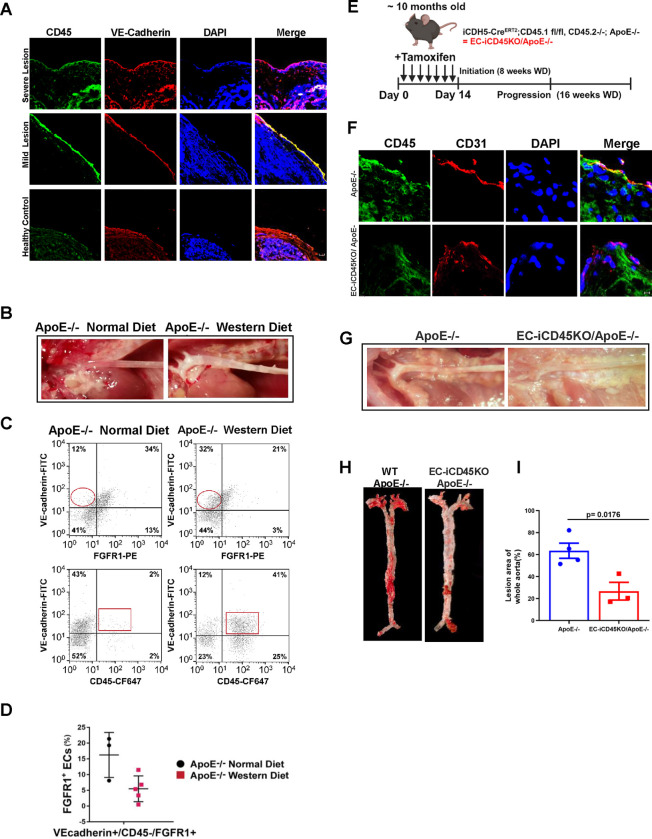
Protein-tyrosine-phosphatase CD45 is exclusively expressed in all nucleated cells of the hematopoietic system but is rarely expressed in endothelial cells. Interestingly, our recent study indicated that activation of the endogenous CD45 promoter in human endothelial colony forming cells (ECFCs) induced expression of multiple EndoMT marker genes. However, the detailed molecular mechanisms underlying CD45 that drive EndoMT and the therapeutic potential of manipulation of CD45 expression in atherosclerosis are entirely unknown.
We generated a tamoxifen-inducible EC-specific CD45 deficient mouse strain (EC-iCD45KO) in an ApoE-deficient (ApoE) background and fed with a Western diet (C57BL/6) for atherosclerosis and molecular analyses. We isolated and enriched mouse aortic endothelial cells with CD31 beads to perform single-cell RNA sequencing. Biomedical, cellular, and molecular approaches were utilized to investigate the role of endothelial CD45-specific deletion in the prevention of EndoMT in ApoE model of atherosclerosis.
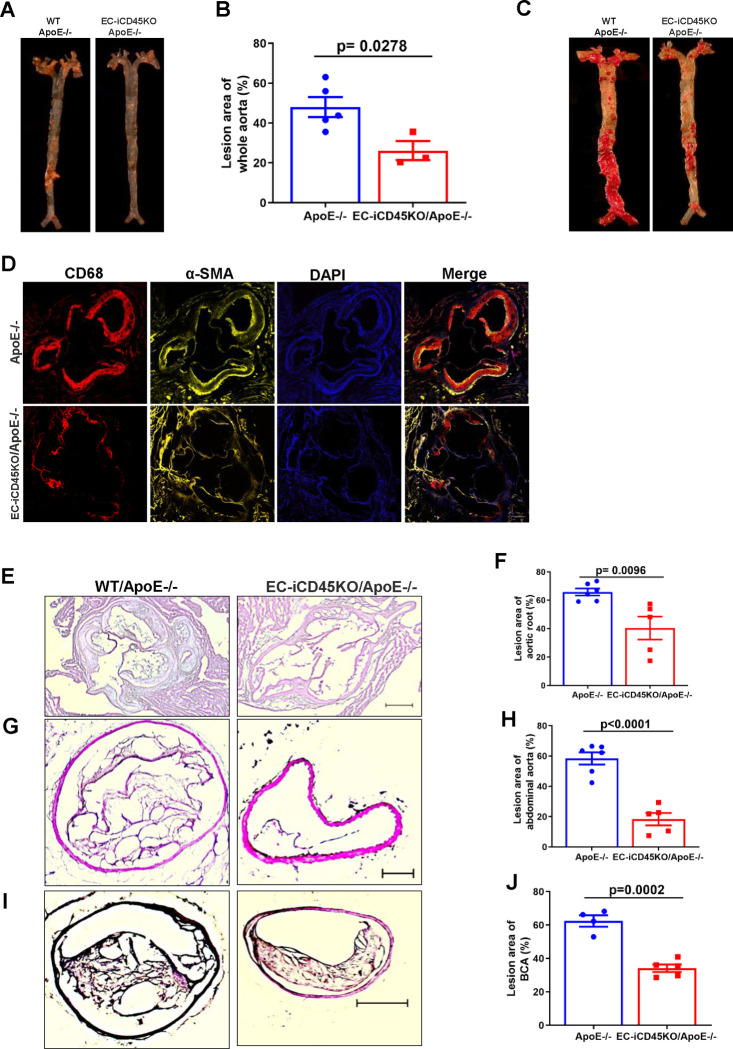
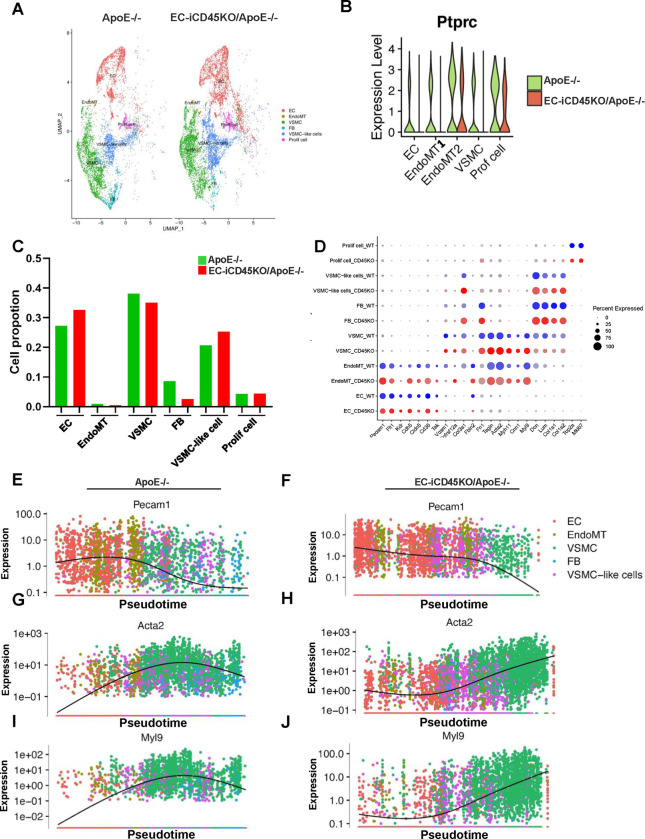
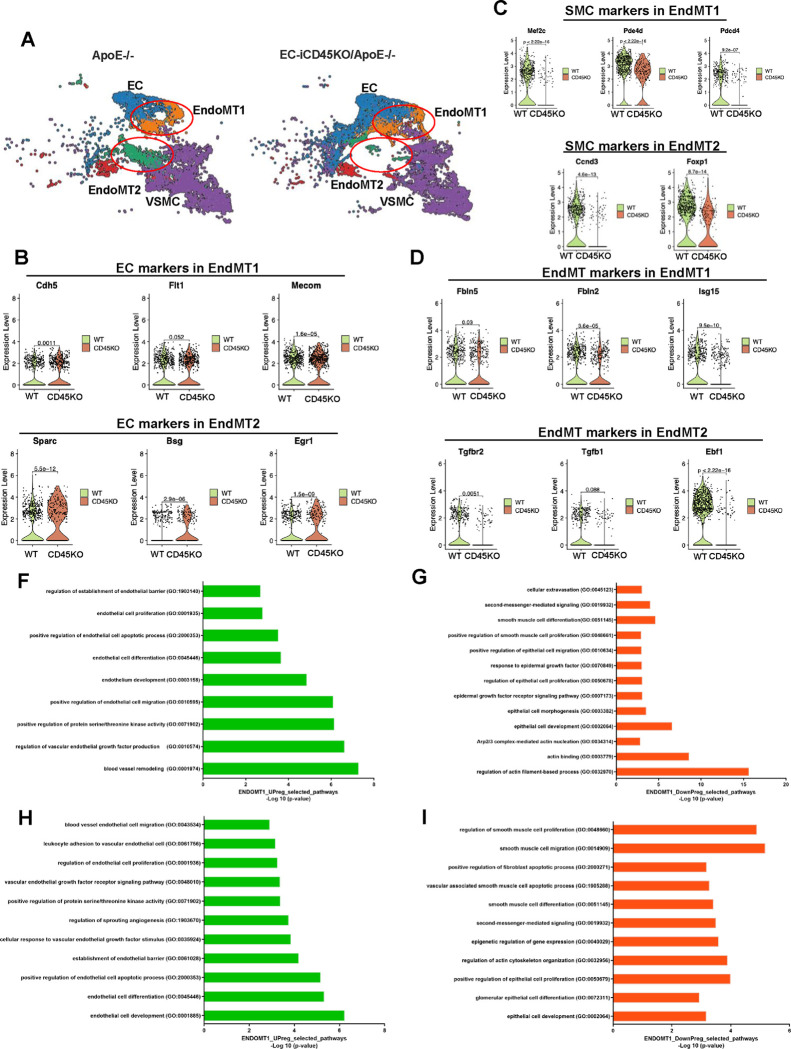
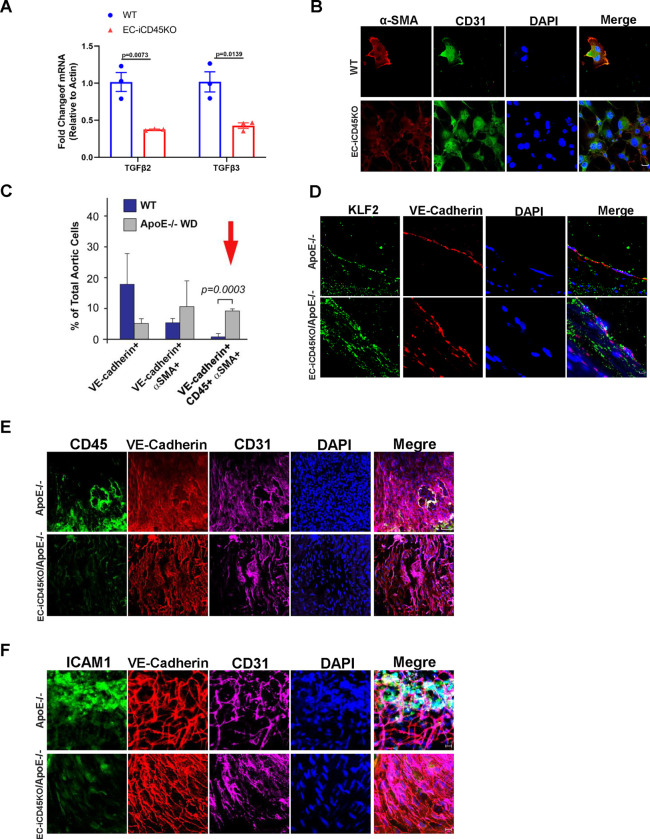
Single-cell RNA sequencing revealed that loss of endothelial CD45 inhibits EndoMT marker expression and transforming growth factor-β signaling in atherosclerotic mice. which is associated with the reductions of lesions in the ApoE mouse model. Mechanistically, the loss of endothelial cell CD45 results in increased KLF2 expression, which inhibits transforming growth factor-β signaling and EndoMT. Consistently, endothelial CD45 deficient mice showed reduced lesion development, plaque macrophages, and expression of cell adhesion molecules when compared to ApoE controls.
These findings demonstrate that the loss of endothelial CD45 protects against EndoMT-driven atherosclerosis, promoting KLF2 expression while inhibiting TGFβ signaling and EndoMT markers. Thus, targeting endothelial CD45 may be a novel therapeutic strategy for EndoMT and atherosclerosis.
蛋白酪氨酸磷酸酶CD45仅在造血系统的所有有核细胞中表达,而在内皮细胞中很少表达。有趣的是,我们最近的研究表明,人类内皮集落形成细胞(ECFCs)中内源性CD45启动子的激活诱导了多种内皮-间充质转化(EndoMT)标志物基因的表达。然而,驱动EndoMT的CD45的详细分子机制以及在动脉粥样硬化中操纵CD45表达的治疗潜力完全未知。
我们在载脂蛋白E缺陷(ApoE)背景下生成了一种他莫昔芬诱导的内皮细胞特异性CD45缺陷小鼠品系(EC-iCD45KO),并喂食西方饮食(C57BL/6)以进行动脉粥样硬化和分子分析。我们用CD31磁珠分离并富集小鼠主动脉内皮细胞以进行单细胞RNA测序。利用生物医学、细胞和分子方法研究内皮细胞CD45特异性缺失在ApoE动脉粥样硬化模型中预防EndoMT的作用。
单细胞RNA测序显示,内皮细胞CD45的缺失抑制了动脉粥样硬化小鼠中EndoMT标志物的表达和转化生长因子-β信号传导,这与ApoE小鼠模型中病变的减少有关。从机制上讲,内皮细胞CD45的缺失导致KLF2表达增加,从而抑制转化生长因子-β信号传导和EndoMT。一致地,与ApoE对照组相比,内皮细胞CD45缺陷小鼠的病变发展、斑块巨噬细胞和细胞粘附分子的表达减少。
这些发现表明,内皮细胞CD45的缺失可预防EndoMT驱动的动脉粥样硬化,促进KLF2表达,同时抑制TGFβ信号传导和EndoMT标志物。因此,靶向内皮细胞CD45可能是治疗EndoMT和动脉粥样硬化的一种新的治疗策略。