Jimbo Naoe, Ohbayashi Chiho, Fujii Tomomi, Takeda Maiko, Mitsui Suguru, Tanaka Yugo, Itoh Tomoo, Maniwa Yoshimasa
Department of Diagnostic Pathology, Kobe University Graduate School of Medicine, Kobe, Japan.
Department of Diagnostic Pathology, Shinko Hospital, Kobe, Japan.
J Pathol Clin Res. 2024 Sep;10(5):e70001. doi: 10.1002/2056-4538.70001.
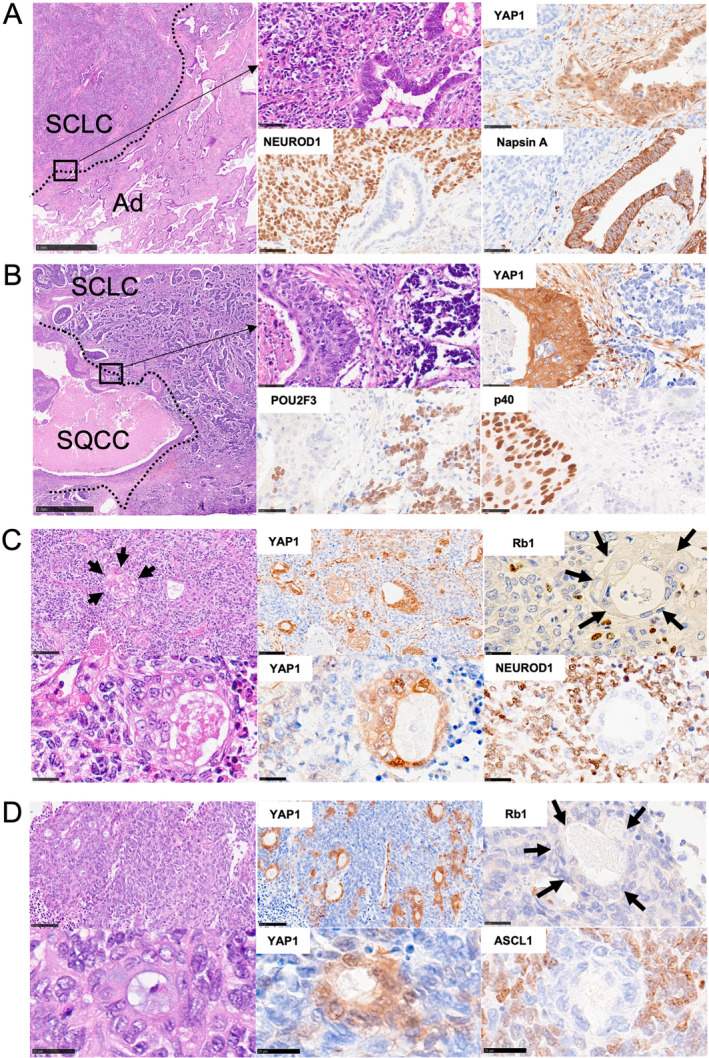
Lineage plasticity in small cell lung carcinoma (SCLC) causes therapeutic difficulties. This study aimed to investigate the pathological findings of plasticity in SCLC, focusing on combined SCLC, and elucidate the involvement of YAP1 and other transcription factors. We analysed 100 surgically resected SCLCs through detailed morphological observations and immunohistochemistry for YAP1 and other transcription factors. Component-by-component next-generation sequencing (n = 15 pairs) and immunohistochemistry (n = 35 pairs) were performed on the combined SCLCs. Compared with pure SCLCs (n = 65), combined SCLCs (n = 35) showed a significantly larger size, higher expression of NEUROD1, and higher frequency of double-positive transcription factors (p = 0.0009, 0.04, and 0.019, respectively). Notably, 34% of the combined SCLCs showed morphological mosaic patterns with unclear boundaries between the SCLC and its partner. Combined SCLCs not only had unique histotypes as partners but also represented different lineage plasticity within the partner. NEUROD1-dominant combined SCLCs had a significantly higher proportion of adenocarcinomas as partners, whereas POU2F3-dominant combined SCLCs had a significantly higher proportion of squamous cell carcinomas as partners (p = 0.006 and p = 0.0006, respectively). YAP1 expression in SCLC components was found in 80% of combined SCLCs and 62% of pure SCLCs, often showing mosaic-like expression. Among the combined SCLCs with component-specific analysis, the identical TP53 mutation was found in 10 pairs, and the identical Rb1 abnormality was found in 2 pairs. On immunohistochemistry, the same abnormal p53 pattern was found in 34 pairs, and Rb1 loss was found in 24 pairs. In conclusion, combined SCLC shows a variety of pathological plasticity. Although combined SCLC is more plastic than pure SCLC, pure SCLC is also a phenotypically plastic tumour. The morphological mosaic pattern and YAP1 mosaic-like expression may represent ongoing lineage plasticity. This study also identified the relationship between transcription factors and partners in combined SCLC. Transcription factors may be involved in differentiating specific cell lineages beyond just 'neuroendocrine'.
小细胞肺癌(SCLC)中的谱系可塑性导致治疗困难。本研究旨在调查SCLC中可塑性的病理表现,重点关注复合型SCLC,并阐明YAP1和其他转录因子的作用。我们通过详细的形态学观察以及对YAP1和其他转录因子进行免疫组织化学分析,对100例手术切除的SCLC进行了研究。对复合型SCLC进行了逐组分的二代测序(n = 15对)和免疫组织化学分析(n = 35对)。与单纯型SCLC(n = 65)相比,复合型SCLC(n = 35)显示出明显更大的尺寸、更高的NEUROD1表达以及更高频率的双阳性转录因子(分别为p = 0.0009、0.04和0.019)。值得注意的是,34%的复合型SCLC表现出形态镶嵌模式,SCLC与其伴发肿瘤之间边界不清。复合型SCLC不仅具有独特的组织学类型作为伴发肿瘤,而且在伴发肿瘤中表现出不同的谱系可塑性。以NEUROD1为主的复合型SCLC中腺癌作为伴发肿瘤的比例显著更高,而以POU2F3为主的复合型SCLC中鳞状细胞癌作为伴发肿瘤的比例显著更高(分别为p = 0.006和p = 0.0006)。在80%的复合型SCLC和62%的单纯型SCLC中发现SCLC成分中有YAP1表达,且常呈镶嵌样表达。在进行了组分特异性分析的复合型SCLC中,10对发现了相同的TP53突变,2对发现了相同的Rb1异常。免疫组织化学分析显示,34对出现相同的异常p53模式,24对发现Rb1缺失。总之,复合型SCLC表现出多种病理可塑性。虽然复合型SCLC比单纯型SCLC更具可塑性,但单纯型SCLC也是一种表型可塑性肿瘤。形态镶嵌模式和YAP1镶嵌样表达可能代表正在进行的谱系可塑性。本研究还确定了复合型SCLC中转录因子与伴发肿瘤之间的关系。转录因子可能不仅参与“神经内分泌”以外特定细胞谱系的分化。