Division of Genetics and Epidemiology, The Institute of Cancer Research, Sutton, UK.
Colon Cancer Genetics Group, Edinburgh Cancer Research Centre, Institute of Genetics and Cancer, University of Edinburgh, Edinburgh, UK.
Nat Genet. 2024 Oct;56(10):2104-2111. doi: 10.1038/s41588-024-01900-w. Epub 2024 Sep 16.
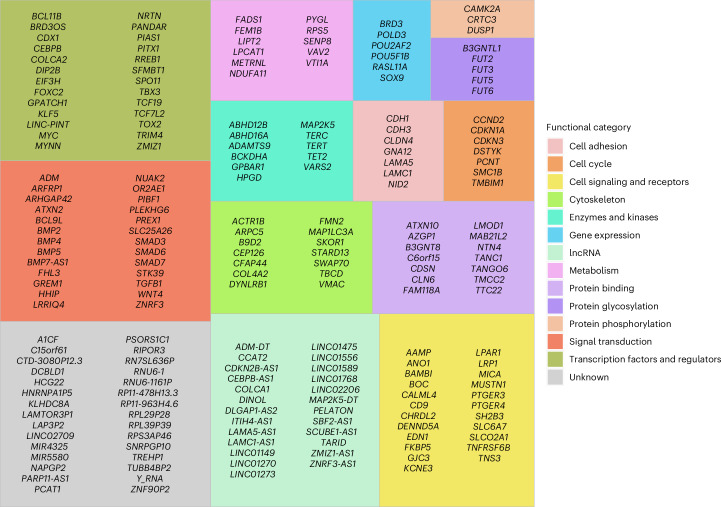
Genome-wide association studies of colorectal cancer (CRC) have identified 170 autosomal risk loci. However, for most of these, the functional variants and their target genes are unknown. Here, we perform statistical fine-mapping incorporating tissue-specific epigenetic annotations and massively parallel reporter assays to systematically prioritize functional variants for each CRC risk locus. We identify plausible causal variants for the 170 risk loci, with a single variant for 40. We link these variants to 208 target genes by analyzing colon-specific quantitative trait loci and implementing the activity-by-contact model, which integrates epigenomic features and Micro-C data, to predict enhancer-gene connections. By deciphering CRC risk loci, we identify direct links between risk variants and target genes, providing further insight into the molecular basis of CRC susceptibility and highlighting potential pharmaceutical targets for prevention and treatment.
全基因组关联研究已鉴定出 170 个结直肠癌(CRC)的常染色体风险位点。然而,对于这些位点中的大多数,其功能变体及其靶基因仍未知。在此,我们通过整合组织特异性表观遗传注释和大规模平行报告基因检测进行统计精细映射,系统地为每个 CRC 风险位点的功能变体排序。我们为 170 个风险位点中的 40 个确定了可能的因果变体。我们通过分析结肠特异性数量性状位点和实施活动接触模型,将这些变体与 208 个靶基因联系起来,该模型整合了表观基因组特征和 Micro-C 数据,以预测增强子-基因连接。通过解析 CRC 风险位点,我们确定了风险变体与靶基因之间的直接联系,为 CRC 易感性的分子基础提供了进一步的见解,并强调了预防和治疗的潜在药物靶点。