Augustin Matthias, Gottlieb Alice B, Lebwohl Mark, Pinter Andreas, Warren Richard B, Puig Luis, Warham Rhys, Lambert Jérémy, Wiegratz Susanne, Szilagyi Balint, Blauvelt Andrew
Institute for Health Services Research in Dermatology and Nursing (IVDP), University Medical Center Hamburg-Eppendorf (UKE), Hamburg, Germany.
Department of Dermatology, The Icahn School of Medicine at Mount Sinai, New York, NY, USA.
Dermatol Ther (Heidelb). 2024 Oct;14(10):2841-2857. doi: 10.1007/s13555-024-01261-6. Epub 2024 Sep 17.
With newer biologics, the achievement of complete skin clearance has become an attainable treatment goal for patients with plaque psoriasis. We evaluate how improvements in Psoriasis Area and Severity Index (PASI) responses, particularly at incremental improvements approaching complete skin clearance (PASI 100), translate into improvements in health-related quality of life (HRQoL) and patient-perceived symptoms.
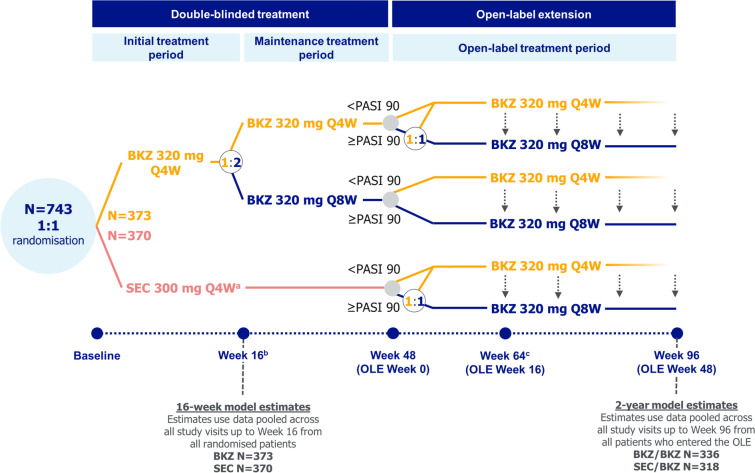
Data from the BE RADIANT phase 3b trial (NCT03536884) and its open-label extension (OLE), pooled across all study visits and treatments over 16 weeks (randomised patients) and 2 years (patients entering the OLE), were analysed using mixed-effects logistic regression models. Proportions of patients achieving a Dermatology Life Quality Index (DLQI) of 0/1, DLQI item scores of 0, and Psoriasis Symptoms and Impacts Measure (P-SIM) item scores of 0 for itching, scaling, and skin pain at specific PASI improvement levels were estimated.
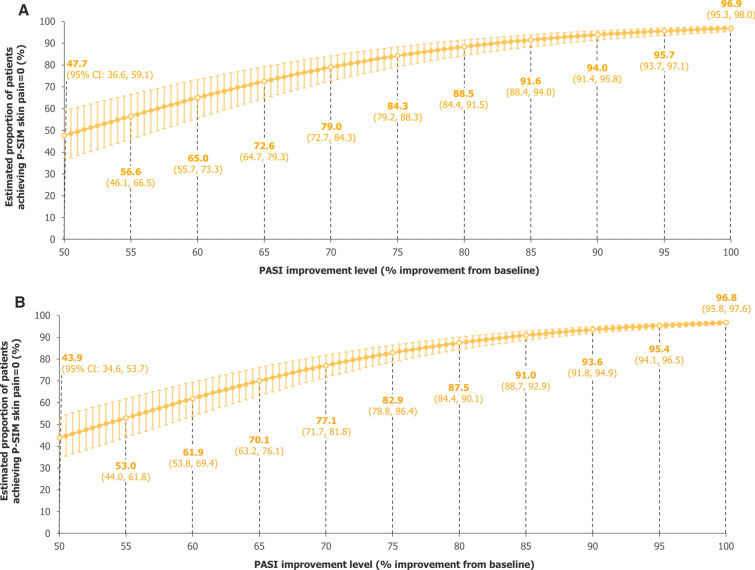
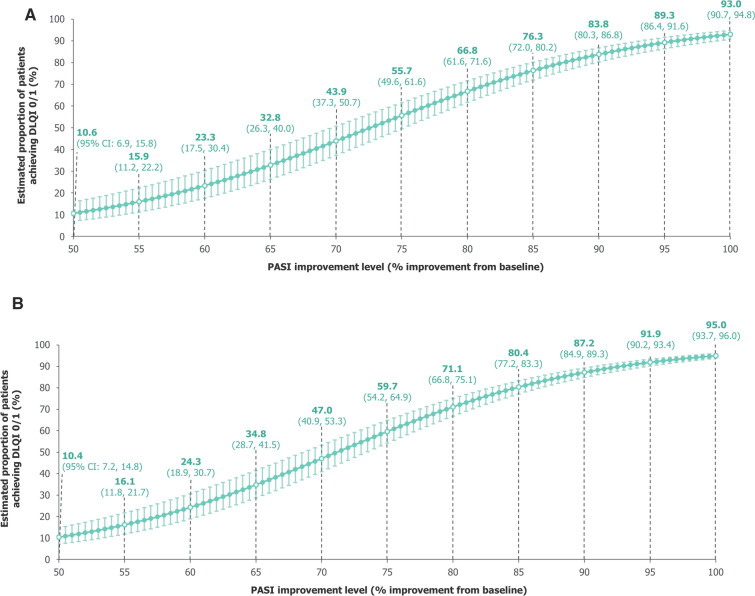
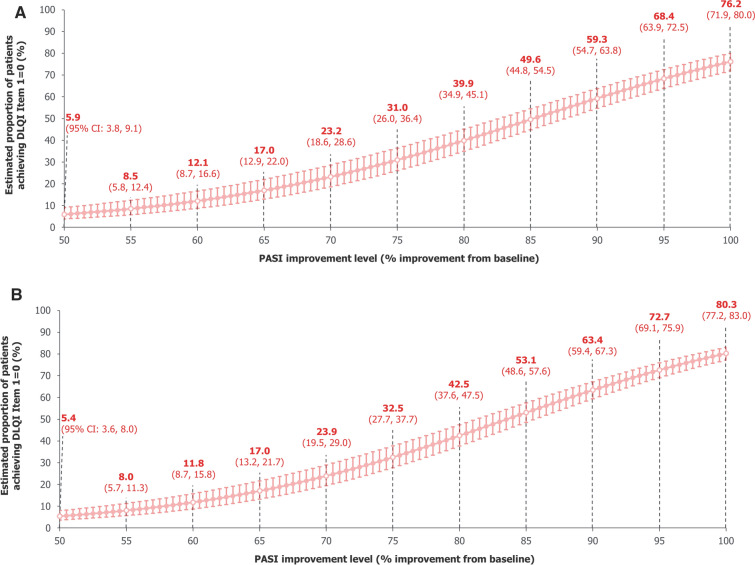
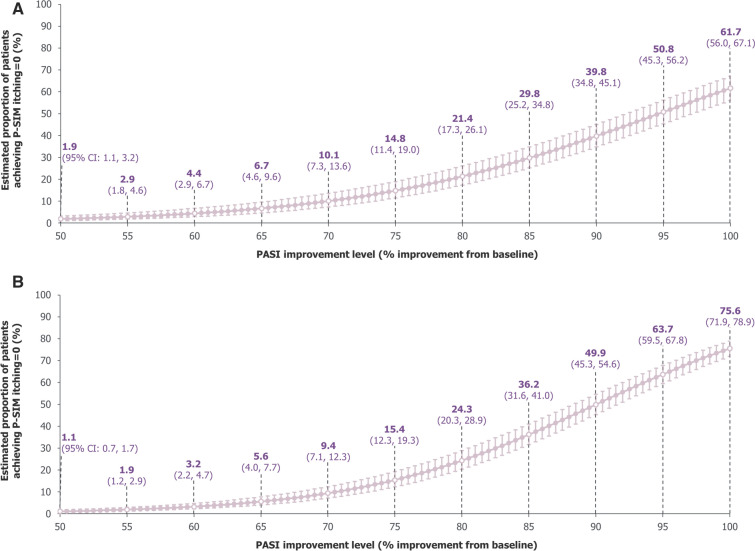
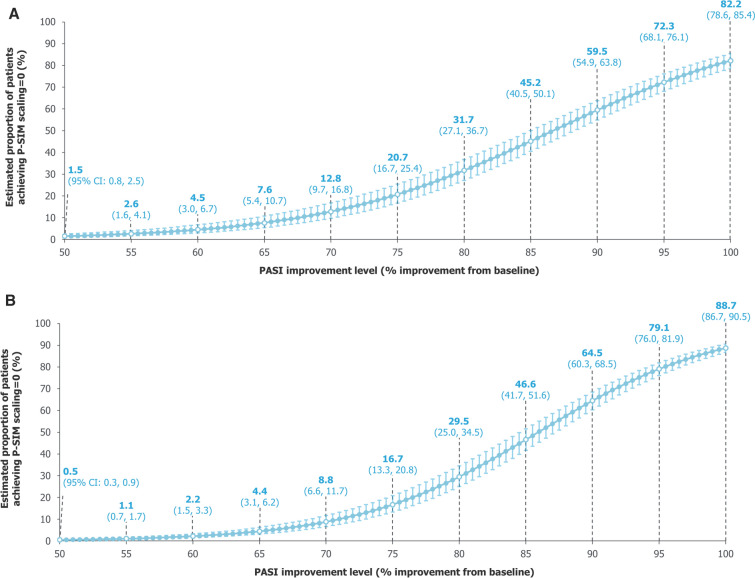
Seven hundred and forty-three patients were randomised to treatment; 654 entered the OLE. Using 16-week pooled data, there were incremental improvements in the proportions of patients estimated by our model to achieve DLQI 0/1 with PASI 100 compared with 95% (PASI = 95%) and 90% (PASI = 90%) improvements in PASI (93.0%, 89.3%, and 83.8% achieving DLQI 0/1, respectively). Estimated proportions achieving DLQI item scores of 0 had the greatest increases at higher PASI improvement levels for Items 1 (itchy, sore, painful, or stinging skin), 2 (embarrassment), and 4 (choice of clothing). Estimated proportions of patients achieving P-SIM = 0 were also higher for PASI 100 (itching: 61.7%; scaling: 82.2%; skin pain: 96.9%) than for PASI = 95% (50.8%; 72.3%; 95.7%) and PASI = 90% (39.8%; 59.5%; 94.0%). Similar benefits of incremental PASI improvements were estimated using 2-year data.
Complete skin clearance translated into the greatest benefits to HRQoL and patient-perceived symptoms, over and above skin clearance between 90% and 100%, highlighting the importance of targeting PASI 100 as a treatment outcome for patients with psoriasis.
NCT03536884. Complete skin clearance is associated with the greatest benefits to health-related quality of life and perceived symptoms for patients with psoriasis: KeyResults and Conclusions (MP4 72828 kb).
随着新型生物制剂的出现,实现皮肤完全清除已成为斑块状银屑病患者可达成的治疗目标。我们评估了银屑病面积和严重程度指数(PASI)反应的改善情况,特别是在接近皮肤完全清除(PASI 100)的渐进性改善过程中,这些改善如何转化为健康相关生活质量(HRQoL)的提高以及患者自我感知症状的改善。
对BE RADIANT 3b期试验(NCT03536884)及其开放标签扩展试验(OLE)的数据进行分析,这些数据汇总了16周(随机分组患者)和2年(进入OLE的患者)内所有研究访视和治疗的数据,使用混合效应逻辑回归模型进行分析。估计了在特定PASI改善水平下,达到皮肤病生活质量指数(DLQI)为0/1、DLQI单项评分为0以及银屑病症状和影响量表(P-SIM)中瘙痒、脱屑和皮肤疼痛单项评分为0的患者比例。
743例患者被随机分组接受治疗;654例进入OLE。使用16周汇总数据,与PASI改善95%(PASI = 95%)和90%(PASI = 90%)相比,我们的模型估计达到PASI 100时实现DLQI 0/1的患者比例有渐进性提高(分别为93.0%、89.3%和83.8%实现DLQI 0/1)。在较高PASI改善水平下,对于第1项(皮肤瘙痒、疼痛、刺痛)、第2项(尴尬)和第4项(服装选择),估计达到DLQI单项评分为0的比例增加最大。PASI 100时达到P-SIM = 0的患者估计比例也高于PASI = 95%(瘙痒:50.8%;脱屑:72.3%;皮肤疼痛:95.7%)和PASI = 90%(39.8%;59.5%;94.0%)。使用2年数据估计,PASI渐进性改善也有类似益处。
皮肤完全清除相较于90%至100%之间的皮肤清除,对HRQoL和患者自我感知症状带来的益处最大,这突出了将PASI 100作为银屑病患者治疗结局目标的重要性。
NCT03536884。皮肤完全清除对银屑病患者的健康相关生活质量和自我感知症状具有最大益处:关键结果和结论(MP4 72828 kb)