Junqueira Debora Leonor, Cavalcanti Alexandre Biasi, Sallum Juliana Maria Ferraz, Yasaki Erika, de Andrade Jesuíno Isabella, Stach Alline, Negrelli Karina, de Oliveira Silva Leila, Lopes Marcela Almeida, Caixeta Adriano, Chan Mark Yy, Ching Jianhong, Carvalho Valdemir Malechco, Faccio Andrea Tedesco, Tsutsui Jeane, Rizzatti Edgar, Fonseca Rafael Almeida, Summers Scott, Fonseca Henrique Almeida, Rochitte Carlos Eduardo, Krieger José Eduardo, de Carvalho Leonardo Pinto
Heart Hospital-HCOR, Desembargador Eliseu Guilherme, N° 147, Paraíso, São Paulo, CEP: 04004-030, Brazil.
Federal University of São Paulo State-UNIFESP, Rua Napoleão de Barros, N° 715, Vila Clementino, São Paulo, CEP: 04004-030, Brazil.
Clin Diabetes Endocrinol. 2024 Sep 17;10(1):32. doi: 10.1186/s40842-024-00186-5.
Ceramides have recently been identified as novel biomarkers associated with diabetes mellitus (DM) and major adverse cardiac and cerebrovascular events (MACCE). This study aims to explore their utility in diagnosing microvascular disease.
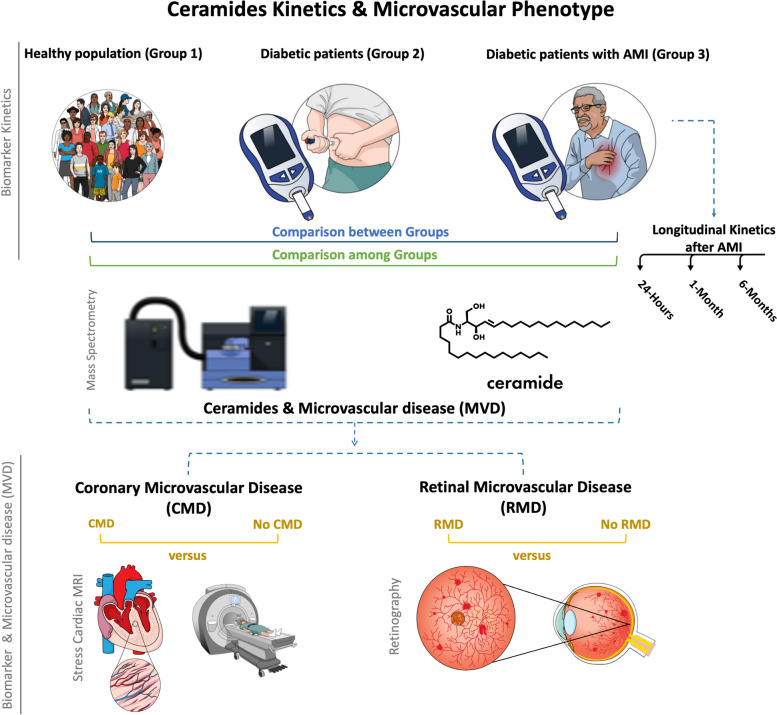
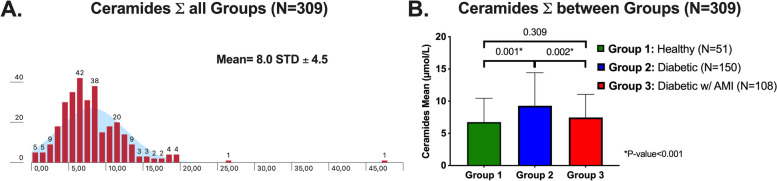
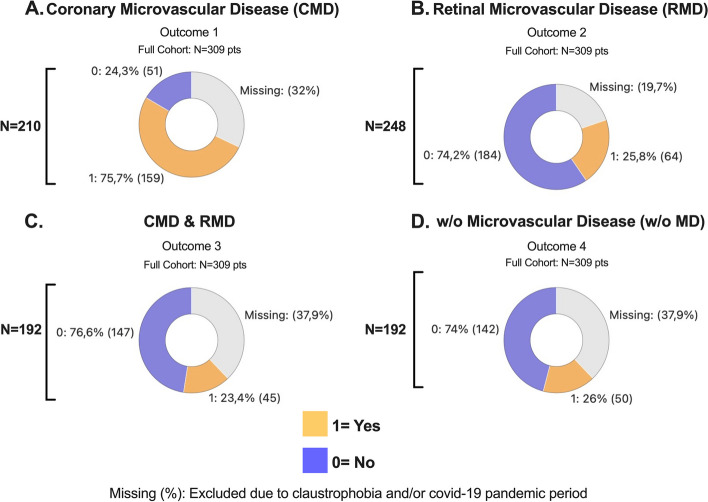
This study prospectively enrolled 309 patients from 2018 to 2020 into three groups: healthy controls (Group 1, N = 51), DM patients without acute myocardial infarction (AMI) (Group 2, N = 150), and DM patients with AMI (Group 3, N = 108). We assessed outcomes using stress perfusion cardiac magnetic resonance (CMR) imaging for coronary microvascular disease (CMD) (Outcome 1), retinography for retinal microvascular disease (RMD) (Outcome 2), both CMD and RMD (Outcome 3), and absence of microvascular disease (w/o MD) (outcome 4). We evaluated the classification performance of ceramides using receiver operating characteristic (ROC) analysis and multiple logistic regression. 11-ceramide panel previously identified by our research group as related to macrovascular disease were used.
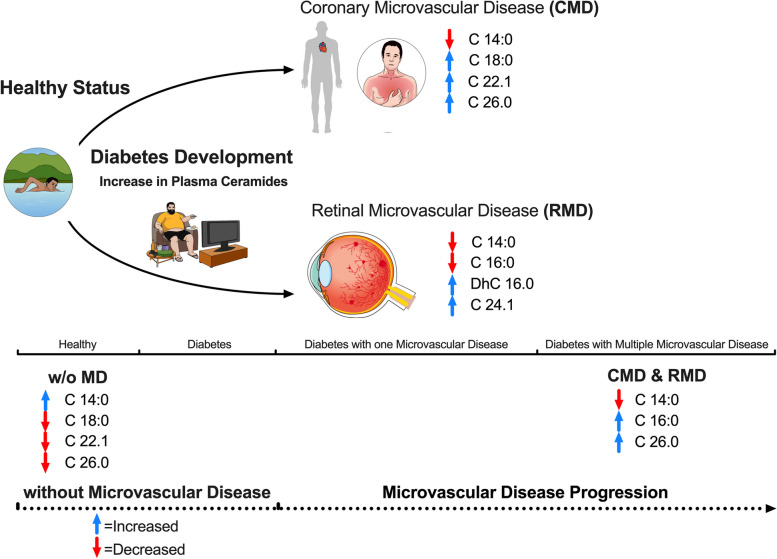
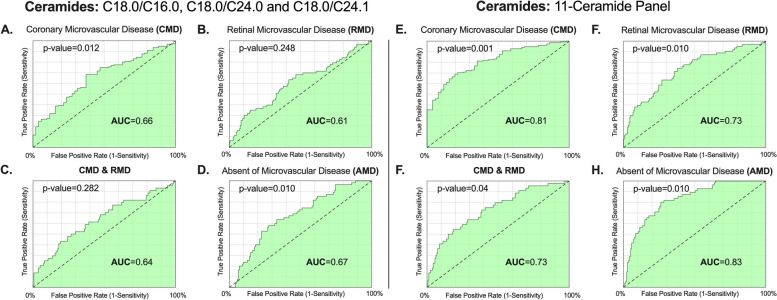
Average glycated hemoglobin (HbA1c) values were 5.1% in Group 1, 8.3% in Group 2, and 7.6% in Group 3. Within the cohort, CMD was present in 59.5% of patients, RMD in 25.8%, both CMD and RMD in 18.8%, and w/o MD in 38.5%. The AUC values for the reference ceramide ratios were as follows: CMD at 0.66 (p = 0.012), RMD at 0.61 (p = 0.248), CMD & RMD at 0.64 (p = 0.282), and w/o MD at 0.67 (p = 0.010). In contrast, the AUC values using 11-ceramide panel showed significant improvement in the outcomes prediction: CMD at 0.81 (p = 0.001), RMD at 0.73 (p = 0.010), CMD & RMD at 0.73 (p = 0.04), and w/o MD at 0.83 (p = 0.010). Additionally, the plasma concentration of C14.0 was notably higher in the w/o MD group (p < 0.001).
Plasma ceramides serve as potential predictors for health status and microvascular disease phenotypes in diabetic patients.
神经酰胺最近被确定为与糖尿病(DM)以及主要不良心脑血管事件(MACCE)相关的新型生物标志物。本研究旨在探讨其在诊断微血管疾病中的效用。
本研究在2018年至2020年期间前瞻性招募了309名患者,分为三组:健康对照组(第1组,N = 51)、无急性心肌梗死(AMI)的DM患者(第2组,N = 150)和患有AMI的DM患者(第3组,N = 108)。我们使用应力灌注心脏磁共振(CMR)成像评估冠状动脉微血管疾病(CMD)(结果1)、视网膜血管造影评估视网膜微血管疾病(RMD)(结果2)、CMD和RMD两者(结果3)以及无微血管疾病(无MD)(结果4)。我们使用受试者工作特征(ROC)分析和多元逻辑回归评估神经酰胺的分类性能。使用了我们研究小组先前确定的与大血管疾病相关的11种神经酰胺组合。
第1组的平均糖化血红蛋白(HbA1c)值为5.1%,第2组为8.3%,第3组为7.6%。在该队列中,59.5%的患者存在CMD,25.8%存在RMD,18.8%同时存在CMD和RMD,38.5%无MD。参考神经酰胺比率的AUC值如下:CMD为0.66(p = 0.012),RMD为0.61(p = 0.248),CMD和RMD为0.64(p = 0.282),无MD为0.67(p = 0.010)。相比之下,使用11种神经酰胺组合的AUC值在结果预测方面有显著改善:CMD为0.81(p = 0.001),RMD为0.73(p = 0.010),CMD和RMD为0.73(p = 0.04),无MD为0.83(p = 0.010)。此外,无MD组中C14.0的血浆浓度显著更高(p < 0.001)。
血浆神经酰胺可作为糖尿病患者健康状况和微血管疾病表型的潜在预测指标。