Nightingale Julie, Etty Sarah, Snaith Beverley, Sevens Trudy, Appleyard Rob, Kelly Shona
Centre for Applied Health and Care Research (CARe), Sheffield Hallam University, Sheffield, S10 2BP, United Kingdom.
Faculty of Health Studies, University of Bradford, Bradford, BD7 1DP, United Kingdom.
BJR Open. 2024 Sep 5;6(1):tzae026. doi: 10.1093/bjro/tzae026. eCollection 2024 Jan.
The imaging support workforce is a key enabler in unlocking imaging capacity and capability, yet no evidence exists of the workforce size and configuration. This research provides the first comprehensive analysis of workforce data to explore the deployment of the support workforce within National Health Service (NHS) imaging services in England.
Using a census methodology, an anonymized electronic staff record (ESR) data set extracted in December 2022 was analysed to identify support workers and their employment bandings at NHS Trust, regional and national (England) level. Support workforce proportions, median values, and Spearman's rank correlations were calculated.
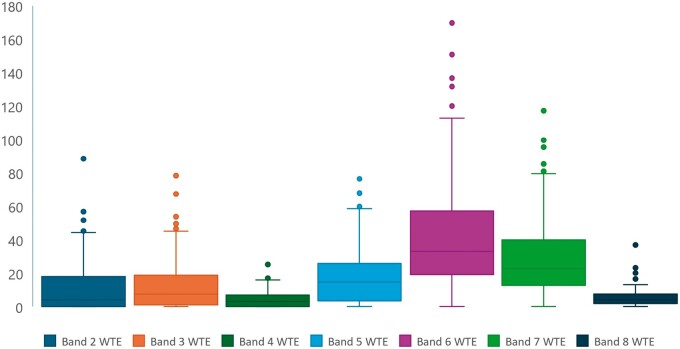
Analysis of 137 NHS Trusts, comprising 100% of acute trusts ( = 124) and specialist trusts with imaging services ( = 13), identified that the support workforce (pay bands 2-4) constitutes 23.6% of the imaging staff base. Ranking trusts into 3 categories based on the proportion of support workers in their imaging establishment, median values ranged from 30.7% (high) to 22.2% (medium) and 10.5% (low). Two opposing deployment models of band 2 and band 3 support workers were identified.
Comprising almost one-quarter of the imaging establishment, models of deployment at bands 2 and 3 are highly variable. Assistant practitioners (band 4) are under-utilised, providing an opportunity to introduce innovations to address workforce demands.
This census is the first to provide evidence of the size and structure of the support workforce, the first step in enabling effective workforce transformation. Further research is required to explain the two opposing deployment models.
影像支持人员队伍是释放影像能力的关键推动因素,但目前尚无关于该人员队伍规模和构成的证据。本研究首次对人员数据进行全面分析,以探究英格兰国民医疗服务体系(NHS)影像服务中支持人员队伍的配置情况。
采用普查方法,对2022年12月提取的匿名电子员工记录(ESR)数据集进行分析,以确定NHS信托机构、地区和国家(英格兰)层面的支持人员及其职等。计算了支持人员队伍比例、中位数以及斯皮尔曼等级相关性。
对137家NHS信托机构进行分析,其中包括100%的急症信托机构(n = 124)和提供影像服务的专科信托机构(n = 13),结果表明支持人员队伍(职等2 - 4)占影像工作人员总数的23.6%。根据各信托机构影像部门中支持人员的比例将其分为三类,中位数范围从30.7%(高)到22.2%(中)和10.5%(低)。确定了职等2和职等3支持人员的两种相反配置模式。
职等2和职等3的配置模式差异很大,占影像部门近四分之一。助理从业人员(职等4)未得到充分利用,这为引入创新措施以满足人员需求提供了契机。
本次普查首次提供了支持人员队伍规模和结构的证据,这是实现有效人员队伍转型的第一步。需要进一步研究来解释这两种相反的配置模式。