Hoskins Susan, Beale Sarah, Nguyen Vincent G, Byrne Thomas, Yavlinsky Alexei, Kovar Jana, Fong Erica Wing Lam, Geismar Cyril, Navaratnam Annalan M D, van Tongeren Martie, Johnson Anne M, Aldridge Robert W, Hayward Andrew
Institute of Health Informatics, University College London, London, England, NW1 2DA, UK.
Institute of Epidemiology and Health Care, University College London, London, WC1E 6BT, UK.
NIHR Open Res. 2023 Nov 3;3:58. doi: 10.3310/nihropenres.13443.1. eCollection 2023.
Understanding how non-household activities contributed to severe acute respiratory syndrome coronavirus 2 (SARS-CoV-2) infections under different levels of national health restrictions is vital.
Among adult Virus Watch participants in England and Wales, we used multivariable logistic regressions and adjusted-weighted population attributable fractions (aPAF) assessing the contribution of work, public transport, shopping, and hospitality and leisure activities to infections.
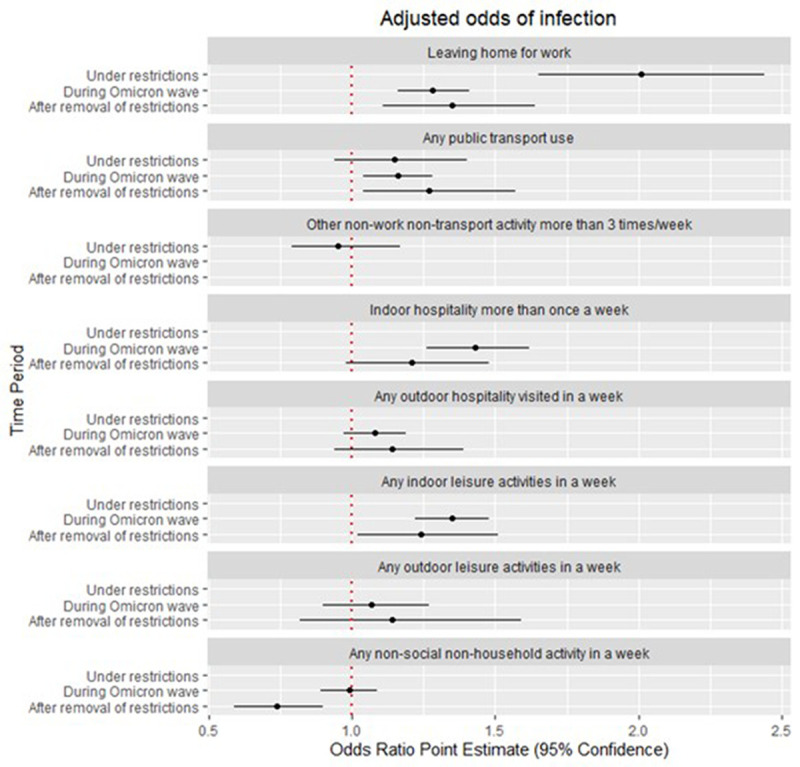
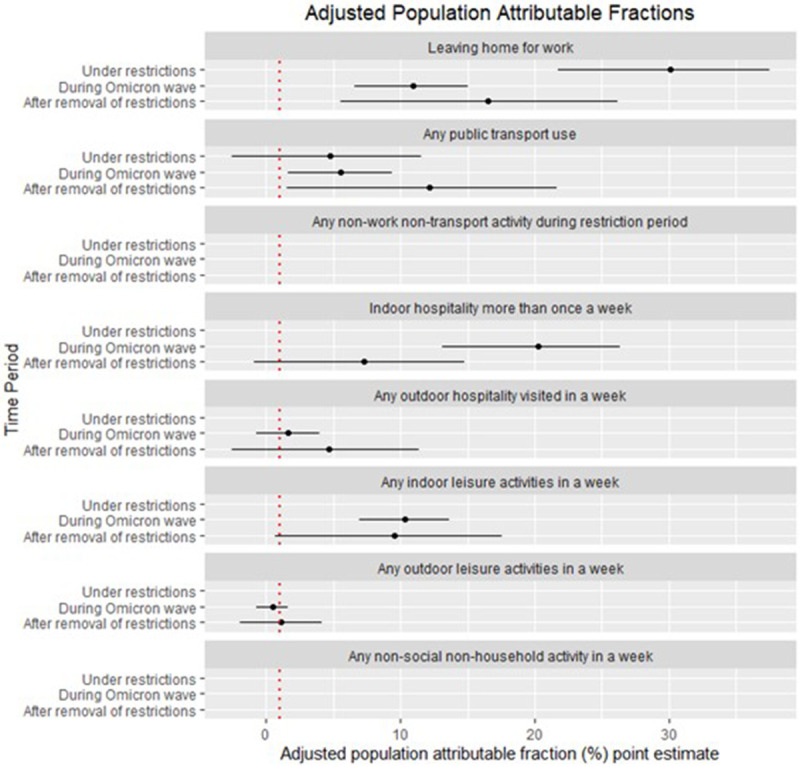
Under restrictions, among 17,256 participants (502 infections), work [adjusted odds ratio (aOR) 2.01 (1.65-2.44), (aPAF) 30% (22-38%)] and transport [(aOR 1.15 (0.94-1.40), aPAF 5% (-3-12%)], were risk factors for SARS-CoV-2 but shopping, hospitality and leisure were not. Following the lifting of restrictions, among 11,413 participants (493 infections), work [(aOR 1.35 (1.11-1.64), aPAF 17% (6-26%)] and transport [(aOR 1.27 (1.04-1.57), aPAF 12% (2-22%)] contributed most, with indoor hospitality [(aOR 1.21 (0.98-1.48), aPAF 7% (-1-15%)] and leisure [(aOR 1.24 (1.02-1.51), aPAF 10% (1-18%)] increasing. During the Omicron variant, with individuals more socially engaged, among 11,964 participants (2335 infections), work [(aOR 1.28 (1.16-1.41), aPAF (11% (7-15%)] and transport [(aOR 1.16 (1.04-1.28), aPAF 6% (2-9%)] remained important but indoor hospitality [(aOR 1.43 (1.26-1.62), aPAF 20% (13-26%)] and leisure [(aOR 1.35 (1.22-1.48), aPAF 10% (7-14%)] dominated.
Work and public transport were important to transmissions throughout the pandemic with hospitality and leisure's contribution increasing as restrictions were lifted, highlighting the importance of restricting leisure and hospitality alongside advising working from home, when facing a highly infectious and virulent respiratory infection.
了解在不同国家卫生限制水平下,非家庭活动如何导致严重急性呼吸综合征冠状病毒2(SARS-CoV-2)感染至关重要。
在英格兰和威尔士的成年病毒监测参与者中,我们使用多变量逻辑回归和调整加权人群归因分数(aPAF)来评估工作、公共交通、购物、酒店及休闲活动对感染的贡献。
在限制措施实施期间,17256名参与者中有502例感染,工作[调整优势比(aOR)2.01(1.65 - 2.44),(aPAF)30%(22 - 38%)]和交通[(aOR 1.15(0.94 - 1.40),aPAF 5%(-3 - 12%)]是SARS-CoV-2的危险因素,但购物、酒店及休闲活动不是。限制措施解除后,11413名参与者中有493例感染,工作[(aOR 1.35(1.11 - 1.64),aPAF 17%(6 - 26%)]和交通[(aOR 1.27(1.04 - 1.57),aPAF 12%(2 - 22%)]贡献最大,室内酒店活动[(aOR 1.21(0.98 - 1.48),aPAF 7%(-1 - 15%)]和休闲活动[(aOR 1.24(1.02 - 1.51),aPAF 10%(1 - 18%)]的贡献增加。在奥密克戎变异株流行期间,由于个人社交活动增多,11964名参与者中有2335例感染,工作[(aOR 1.28(1.16 - 1.41),aPAF(11%(7 - 15%)]和交通[(aOR 1.16(1.04 - 1.28),aPAF 6%(2 - 9%)]仍然很重要,但室内酒店活动[(aOR 1.43(1.26 - 1.62),aPAF 20%(13 - 26%)]和休闲活动[(aOR 1.35(1.22 - 1.48),aPAF 10%(7 - 14%)]占主导地位。
在整个疫情期间,工作和公共交通对传播很重要,随着限制措施的解除,酒店及休闲活动的贡献增加,这凸显了在面对高传染性和高致病性的呼吸道感染时,除了建议居家办公外,限制休闲和酒店活动的重要性。