
用于糖尿病伤口治疗的核酸递送策略的进展。
Advances in nucleic acid delivery strategies for diabetic wound therapy.
作者信息
Sarthi Soniya, Bhardwaj Harish, Kumar Jangde Rajendra
机构信息
University Institute of Pharmacy, Pt. Ravishankar Shukla University Raipur, Chhattisgarh 492010, India.
出版信息
J Clin Transl Endocrinol. 2024 Aug 30;37:100366. doi: 10.1016/j.jcte.2024.100366. eCollection 2024 Sep.
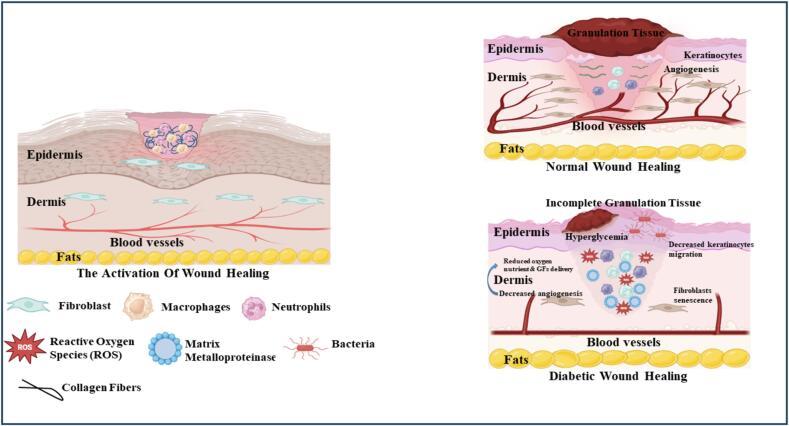
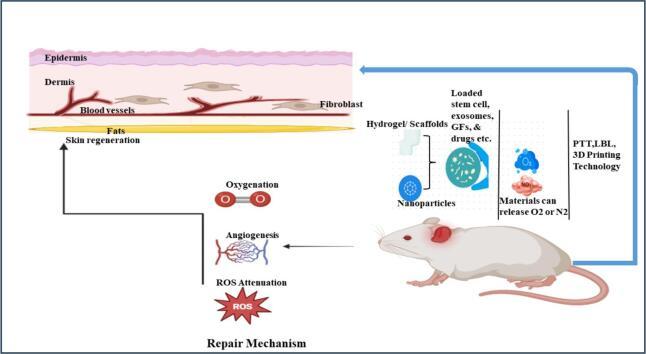
In recent years, the prevalence of diabetic wounds has significantly increased, posing a substantial medical challenge due to their propensity for infection and delayed healing. These wounds not only increase mortality rates but also lead to amputations and severe mobility issues. To address this, advancements in bioactive molecules such as genes, growth factors, proteins, peptides, stem cells, and exosomes into targeted gene therapies have emerged as a preferred strategy among researchers. Additionally, the integration of photothermal therapy (PTT), nucleic acid, and gene therapy, along with 3D printing technology and the layer-by-layer (LBL) self-assembly approach, shows promise in diabetic wound treatment. Effective delivery of small interfering RNA (siRNA) relies on gene vectors. This review provides an in-depth exploration of the pathophysiological characteristics observed in diabetic wounds, encompassing diminished angiogenesis, heightened levels of reactive oxygen species, and impaired immune function. It further examines advancements in nucleic acid delivery, targeted gene therapy, advanced drug delivery systems, layer-by-layer (LBL) techniques, negative pressure wound therapy (NPWT), 3D printing, hyperbaric oxygen therapy, and ongoing clinical trials. Through the integration of recent research insights, this review presents innovative strategies aimed at augmenting the multifaceted management of diabetic wounds, thus paving the way for enhanced therapeutic outcomes in the future.
近年来,糖尿病伤口的患病率显著上升,由于其易于感染和愈合延迟,带来了重大的医学挑战。这些伤口不仅会提高死亡率,还会导致截肢和严重的行动不便问题。为了解决这一问题,将基因、生长因子、蛋白质、肽、干细胞和外泌体等生物活性分子应用于靶向基因治疗的进展已成为研究人员首选的策略。此外,光热疗法(PTT)、核酸和基因治疗与3D打印技术以及逐层(LBL)自组装方法的结合,在糖尿病伤口治疗中显示出前景。小干扰RNA(siRNA)的有效递送依赖于基因载体。本综述深入探讨了糖尿病伤口中观察到的病理生理特征,包括血管生成减少、活性氧水平升高和免疫功能受损。它还进一步研究了核酸递送、靶向基因治疗、先进药物递送系统、逐层(LBL)技术、负压伤口治疗(NPWT)、3D打印、高压氧治疗以及正在进行的临床试验方面的进展。通过整合近期的研究见解,本综述提出了旨在加强糖尿病伤口多方面管理的创新策略,从而为未来提高治疗效果铺平道路。
 Zotero 插件