Dziedziech Alexis, Krupa Eva, Persson Kristina E M, Paul Richard, Bonnet Sarah
Institut Pasteur, Université Paris Cité, CNRS UMR 2000, INRAE USC 1510, Ecology and Emergence of Arthropod-borne Pathogens Unit, F-75015, Paris, France.
Department of Laboratory Medicine, Lund University, Lund, Sweden.
Curr Res Parasitol Vector Borne Dis. 2024 Aug 24;6:100212. doi: 10.1016/j.crpvbd.2024.100212. eCollection 2024.
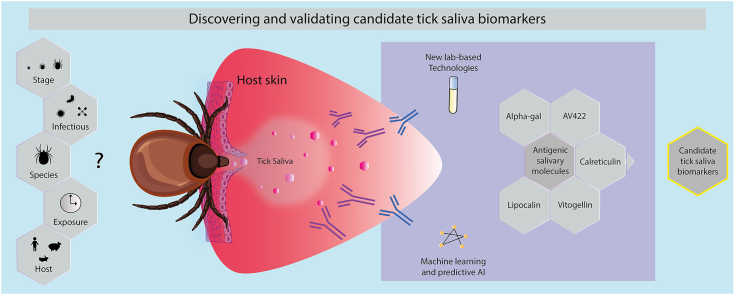
The spread of tick-borne disease (TBD) is escalating globally, driven by climate change and socio-economic shifts, underlining the urgency to improve surveillance, diagnostics, and control strategies. Ticks can transmit a range of pathogens increasing the risk of transmission of human and veterinary diseases such as Lyme disease, tick-borne encephalitis, theileriosis, anaplasmosis, or Crimean-Congo hemorrhagic fever. Surveillance methods play a crucial role in monitoring the spread of tick-borne pathogens (TBP). However, there are shortcomings in the current surveillance methods regarding risks related to ticks. Human-tick encounters offer a novel metric for disease risk assessment, integrating human behavior into traditional surveillance models. However, to more reliably measure tick exposure, a molecular marker is needed. The identification of antibodies against arthropod salivary proteins as biomarkers for vector exposure represents a promising avenue for enhancing existing diagnostic and surveillance metrics. Here we explore how the use of tick saliva biomarkers targeting recombinant proteins and synthetic peptides could significantly improve the assessment of TBD transmission risk and the effectiveness of vector control measures. With focused efforts on creating a biomarker against tick exposure suitable for humans and domestic animals alike, tick surveillance, diagnosis and control would be more achievable and aid in reducing the mounting threat of TBP through a One Health lens.
蜱传疾病(TBD)在气候变化和社会经济转变的推动下,在全球范围内呈上升趋势,这凸显了改进监测、诊断和控制策略的紧迫性。蜱虫可传播一系列病原体,增加了人类和兽医疾病传播的风险,如莱姆病、蜱传脑炎、泰勒虫病、无形体病或克里米亚-刚果出血热。监测方法在监测蜱传病原体(TBP)的传播中起着至关重要的作用。然而,目前的监测方法在蜱虫相关风险方面存在不足。人与蜱虫的接触为疾病风险评估提供了一种新的指标,将人类行为纳入传统监测模型。然而,为了更可靠地测量蜱虫暴露情况,需要一种分子标记物。将针对节肢动物唾液蛋白的抗体鉴定为媒介暴露的生物标志物,是增强现有诊断和监测指标的一个有前景的途径。在这里,我们探讨了使用针对重组蛋白和合成肽的蜱虫唾液生物标志物如何能够显著改善对蜱传疾病传播风险的评估以及媒介控制措施的有效性。通过集中精力创建一种适用于人类和家畜的蜱虫暴露生物标志物,蜱虫监测、诊断和控制将更易于实现,并有助于通过“同一健康”视角降低蜱传病原体日益增加的威胁。