Department of Fisheries and Wildlife, Michigan State University, East Lansing, Michigan 48824, United States.
Office of Research and Development, Center for Environmental Measurement and Modeling, Atlantic Coastal Environmental Sciences Division, U.S. Environmental Protection Agency, Narragansett, Rhode Island 02882, United States.
Environ Sci Technol. 2024 Oct 1;58(39):17235-17246. doi: 10.1021/acs.est.4c04207. Epub 2024 Sep 17.
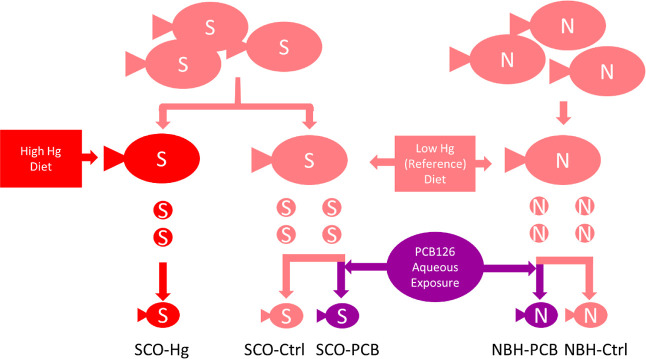
Molecular, cellular, and organismal alterations are important descriptors of toxic effects, but our ability to extrapolate and predict ecological risks is limited by the availability of studies that link measurable end points to adverse population relevant outcomes such as cohort survival and growth. In this study, we used laboratory gene expression and behavior data from two populations of Atlantic killifish [one reference site (SCOKF) and one PCB-contaminated site (NBHKF)] to inform individual-based models simulating cohort growth and survival from embryonic exposures to environmentally relevant concentrations of neurotoxicants. Methylmercury exposed SCOKF exhibited brain gene expression changes in the si:ch211-186j3.6, si:dkey-21c1.4, scamp1, and klhl6 genes, which coincided with changes in feeding and swimming behaviors, but our models simulated no growth or survival effects of exposures. PCB126-exposed SCOKF had lower physical activity levels coinciding with a general upregulation in nucleic and cellular brain gene sets (BGS) and downregulation in signaling, nucleic, and cellular BGS. The NBHKF, known to be tolerant to PCBs, had altered swimming behaviors that coincided with 98% fewer altered BGS. Our models simulated PCB126 decreased growth in SCOKF and survival in SCOKF and NBHKF. Overall, our study provides a unique demonstration linking molecular and behavioral data to develop quantitative, testable predictions of ecological risk.
分子、细胞和机体的改变是毒性作用的重要描述符,但我们将可测量的终点与不利的种群相关结果(如队列生存和生长)联系起来,以预测生态风险的能力受到限制,这些结果在可用的研究中是有限的。在这项研究中,我们使用了来自两个大西洋食蚊鱼种群的实验室基因表达和行为数据[一个参考点(SCOKF)和一个 PCB 污染点(NBHKF)],为个体基础模型提供信息,这些模型模拟了从胚胎暴露到环境相关浓度的神经毒物对队列生长和生存的影响。暴露于甲基汞的 SCOKF 表现出 si:ch211-186j3.6、si:dkey-21c1.4、scamp1 和 klhl6 基因的大脑基因表达变化,这与摄食和游泳行为的变化相吻合,但我们的模型模拟出暴露对生长或生存没有影响。暴露于 PCB126 的 SCOKF 表现出较低的身体活动水平,这与大脑基因集(BGS)中核酸和细胞的普遍上调以及信号、核酸和细胞 BGS 的下调相一致。众所周知,NBHKF 对 PCB 具有耐受性,其游泳行为发生了改变,与 98%的 BGS 改变有关。我们的模型模拟了 PCB126 降低了 SCOKF 的生长和 SCOKF 和 NBHKF 的生存。总的来说,我们的研究提供了一个独特的例证,将分子和行为数据联系起来,以对生态风险进行定量、可测试的预测。