Department of Dermatology, Ghent University Hospital, Corneel Heymanslaan 10, 9000, Ghent, Belgium.
Cancer Research Institute Ghent (CRIG), Ghent, Belgium.
Sci Rep. 2024 Sep 18;14(1):21739. doi: 10.1038/s41598-024-67740-0.
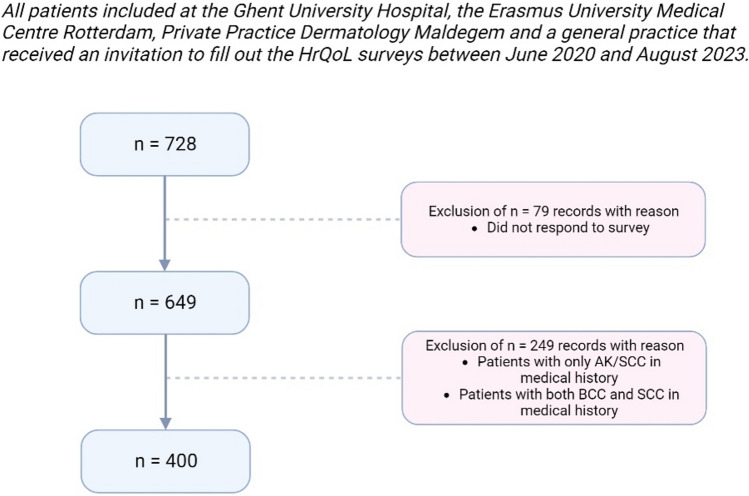
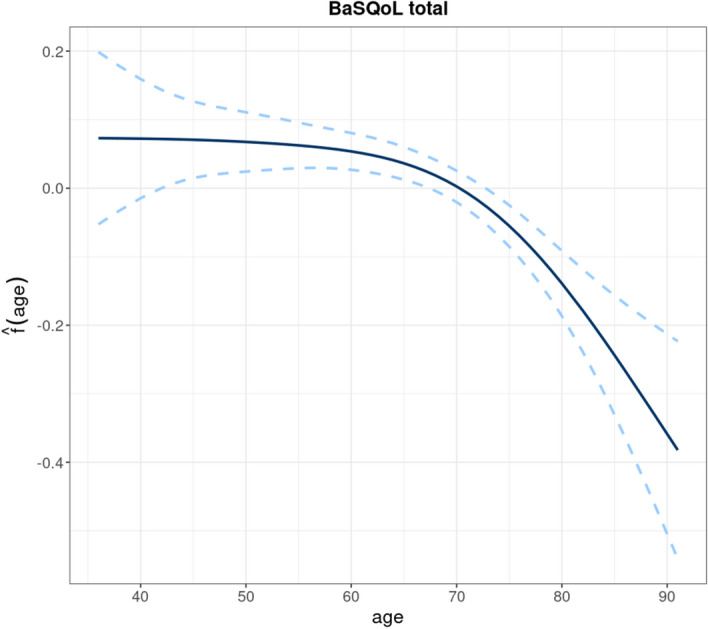
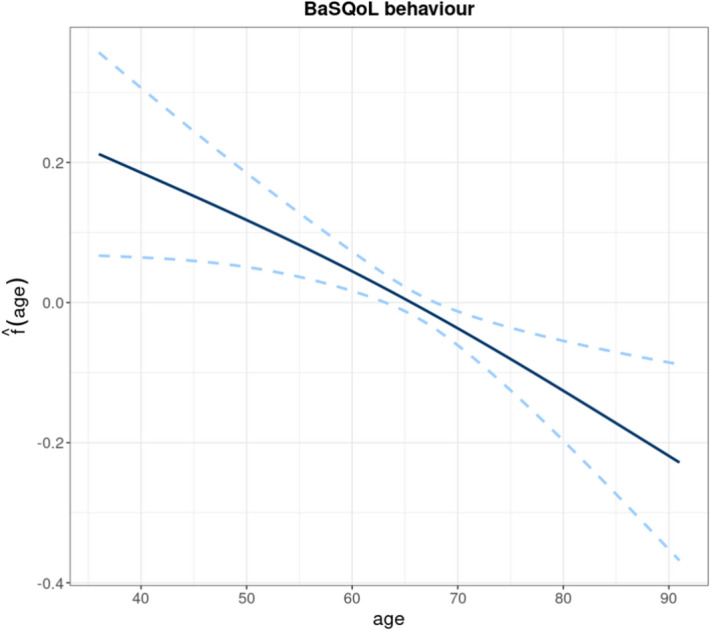
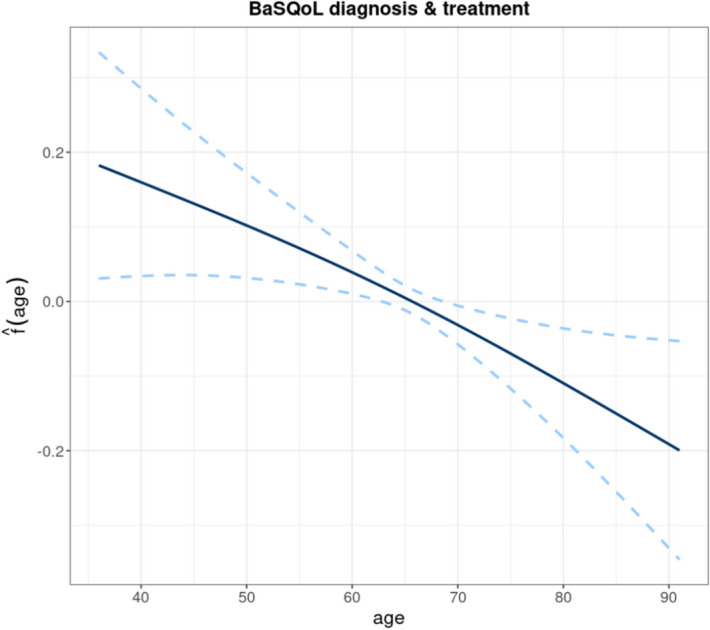
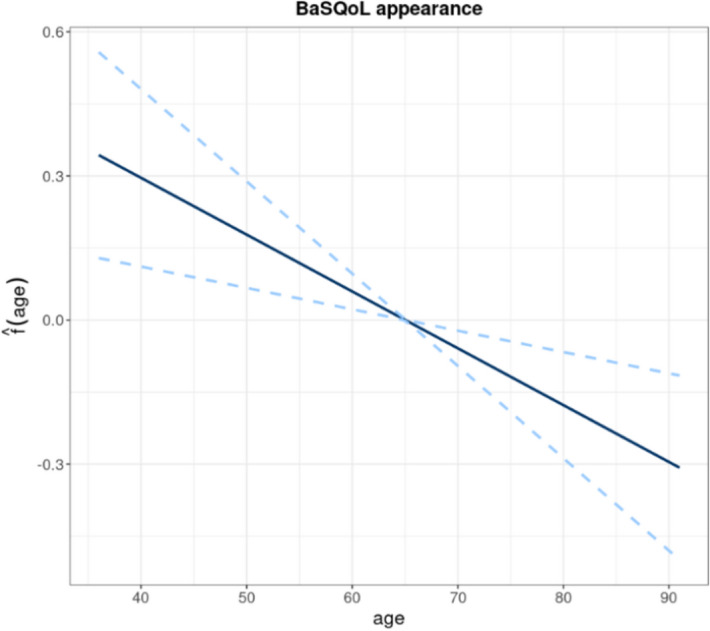
Basal cell carcinoma (BCC) is the most frequent malignant tumour worldwide and incidences are rising rapidly. BCC grow locally, but can invade surrounding tissues. Little is known concerning their impact on the health-related quality of life (HrQoL), and limited available data reports contradicting results. Measuring HrQoL in BCC patients should be done using disease-specific questionnaires such as the Basal and Squamous cell carcinoma Quality of Life (BaSQoL) questionnaire. The aim of this study was to assess the BCC-related HrQoL by examining all relevant patient, tumour and treatment characteristics to identify the main factors for the BCC-related impact. Specific attention for older BCC patients wass brought forward because of the often complex decisions in this subgroup. Patients ≥ 18 years with a history of BCC were asked to fill in the BaSQoL questionnaire, consisting of 5 subdomains. Multivariable analyses were done using a generalized additive model (GAM) because of the need for incorporation of non-linear functions. The study obtained approval of the Ethics Committee of the Ghent University Hospital (EC/2019/1352). Informed consent was obtained from all subjects. All experiments were performed in accordance with relevant guidelines and regulations. Four hundred patients with a median age of 66 were enrolled. Mean BaSQoL subscores were 0.78 (SD 0.63) for 'behaviour', 1.01 (SD 0.73) for 'diagnosis&treatment', 0.90 (SD 0.73) for 'worries', 0.40 (SD 0.63) for 'appearance' and 1.20 (SD 0.75) for 'other people', illustrating the low to moderate impact of BCC on the HrQoL. A GAM with subsequent ANOVA testing was done for all relevant variables. In 4 out of 5 BaSQoL subdomains 'age' showed a significant correlation ('behaviour' p = 0.007; 'diagnosis&treatment' p = 0.026; 'worries' p = 0.003; 'appearance' p = 0.008). Lower BaSQoL scores were seen in older patients, meaning less BCC-impact on their HrQoL. There was a clear non-linear correlation between BaSQoL scores and age, illustrating that the impact of BCC on the HrQoL shows a rapid decrease starting around the age of 70. This study is the first to illustrate the relation between the BCC-related HrQoL and the age of patients with the use of a disease-specific HrQoL instrument. We found a lower BaSQoL score in older adults, with a specific age group of interest starting around the age of 70-75. This is an argument for a potential wait-and-see strategy for BCC in these patients.
基底细胞癌(BCC)是全球最常见的恶性肿瘤,发病率迅速上升。BCC 局部生长,但可侵犯周围组织。关于它们对健康相关生活质量(HrQoL)的影响知之甚少,并且有限的可用数据报告结果相互矛盾。使用疾病特异性问卷(如基底细胞癌和鳞状细胞癌生活质量(BaSQoL)问卷)来测量 BCC 患者的 HrQoL。本研究的目的是通过检查所有相关的患者、肿瘤和治疗特征来评估 BCC 相关的 HrQoL,以确定 BCC 相关影响的主要因素。由于在该亚组中经常需要做出复杂的决策,因此特别关注老年 BCC 患者。询问≥18 岁有 BCC 病史的患者填写 BaSQoL 问卷,问卷由 5 个亚域组成。由于需要纳入非线性函数,因此使用广义加性模型(GAM)进行多变量分析。该研究获得了根特大学医院伦理委员会(EC/2019/1352)的批准。所有受试者均获得知情同意。所有实验均按照相关指南和规定进行。共纳入 400 名中位年龄为 66 岁的患者。BaSQoL 亚域的平均分数分别为:行为 0.78(SD 0.63)、诊断与治疗 1.01(SD 0.73)、担忧 0.90(SD 0.73)、外观 0.40(SD 0.63)和其他人 1.20(SD 0.75),表明 BCC 对 HrQoL 的影响较低至中度。对所有相关变量进行了 GAM 分析,随后进行了 ANOVA 检验。在 5 个 BaSQoL 亚域中的 4 个中,“年龄”显示出显著相关性(“行为”p=0.007;“诊断与治疗”p=0.026;“担忧”p=0.003;“外观”p=0.008)。年龄较大的患者 BaSQoL 评分较低,意味着 BCC 对其 HrQoL 的影响较小。BaSQoL 评分与年龄之间存在明显的非线性相关性,表明 BCC 对 HrQoL 的影响从 70 岁左右开始迅速下降。这项研究首次使用疾病特异性 HrQoL 工具阐明了 BCC 相关 HrQoL 与患者年龄之间的关系。我们发现,年龄较大的成年人的 BaSQoL 评分较低,一个特别关注的年龄组从 70-75 岁左右开始。这是对这些患者 BCC 采取观望策略的一个理由。