Department of Endocrinology and Metabolism, The First Affiliated Hospital of Zhejiang Chinese Medical University, No.54, Youdian Road, Shangcheng District, Hangzhou, 310009, Zhejiang, China.
Sci Rep. 2024 Sep 17;14(1):21724. doi: 10.1038/s41598-024-72961-4.
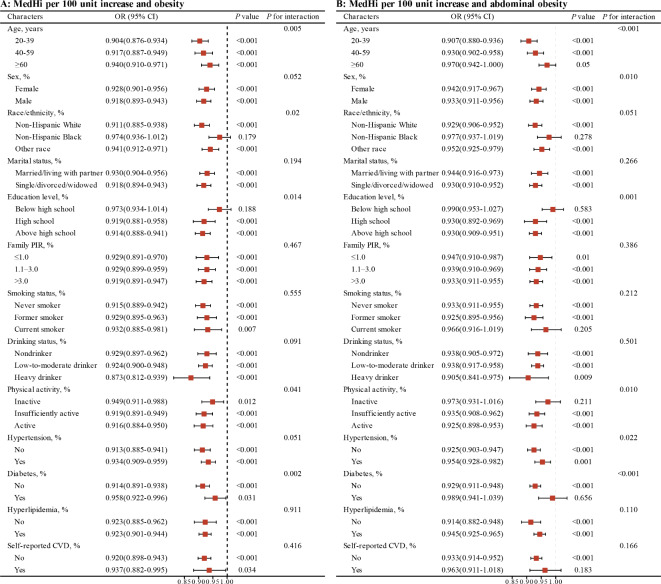
Obesity has become a global health problem. In recent years, the influence of dietary microbes in the obese population has attracted the attention of scholars. Our study aimed to investigate the link between live microbe intake and obesity in adults. Participants (aged over 20 years) for this study were from the 1999-2018 National Health and Nutrition Examination Survey (NHANES). Participants were categorised into low, medium and high dietary live microbe intake groups. Linear regression was used to analyse the link between live microbe intake and body mass index (BMI) and waist circumference (WC). Logistic regression was used to analyse the link between live microbe intake and obesity and abdominal obesity prevalence. Restricted cubic spline curves (RCS) were used to check whether there was a non-linear relationship between live microbe intake and obesity. A total of 42,749 participants were included in this study and the number of obese reached 15,463. We found that live microbe intake was negatively linked to BMI and WC. In models adjusted for all confounders, the high live microbe intake group had lower obesity (OR = 0.812, 95%CI: 0.754-0.873) and abdominal obesity prevalence (OR = 0.851, 95%CI: 0.785-0.923) than the lowest intake group. Upon further quantification of live microbe intake, we found similar results. RCS analyses showed that live microbe intake was nonlinearly negatively correlated with BMI, WC, obesity, and abdominal obesity prevalence (P for non-linearity < 0.05). This study preliminarily reveals a negative link between live microbe intake and obesity in adults.
肥胖已成为全球性健康问题。近年来,饮食微生物在肥胖人群中的影响引起了学者们的关注。我们的研究旨在探讨成年人中活菌摄入与肥胖之间的关系。本研究的参与者(年龄在 20 岁以上)来自 1999-2018 年全国健康和营养调查(NHANES)。参与者被分为低、中、高饮食活菌摄入组。线性回归用于分析活菌摄入与体重指数(BMI)和腰围(WC)之间的关系。逻辑回归用于分析活菌摄入与肥胖和腹型肥胖患病率之间的关系。限制三次样条曲线(RCS)用于检查活菌摄入与肥胖之间是否存在非线性关系。共纳入 42749 名参与者,其中肥胖人数达到 15463 人。我们发现活菌摄入与 BMI 和 WC 呈负相关。在调整所有混杂因素的模型中,高活菌摄入组肥胖(OR=0.812,95%CI:0.754-0.873)和腹型肥胖患病率(OR=0.851,95%CI:0.785-0.923)均低于最低摄入组。进一步量化活菌摄入,我们得到了类似的结果。RCS 分析表明,活菌摄入与 BMI、WC、肥胖和腹型肥胖患病率呈非线性负相关(P<0.05)。本研究初步揭示了成年人活菌摄入与肥胖之间的负相关关系。