Alqurashi Yousef D, Alhaddad Mohammed, Albahrani Amar, Alfajri Ali, Abdulwahab Ahmed, Albahrani Hussain, Alhajri Abdullah, Alshareef Saad, Alsaif Sulaiman S, AlHarkan Khalid, Polkey Michael I
Respiratory Care Department, College of Applied Medical Sciences, Imam Abdulrahman Bin Faisal University, Dammam, Saudi Arabia.
College of Medicine, Imam Abdulrahman Bin Faisal University, Dammam, Saudi Arabia.
Saudi Pharm J. 2024 Oct;32(10):102166. doi: 10.1016/j.jsps.2024.102166. Epub 2024 Aug 26.
Despite the surge of melatonin supplement consumption in recent years, data on the prevalence and patterns of melatonin usage in Saudi Arabia is lacking. The aim of this study was to assess the prevalence and pattern of sleep-related melatonin usage among adults in Saudi Arabia.
This was a cross-sectional, web-based, self-administered survey study conducted across all regions of Saudi Arabia. Participants were recruited from the general population (≥18 years). The survey was distributed between February and April 2023. Chi-squared tests and t-tests were performed for comparative bivariate analyses where binary logistic regression was performed to derive the main predictors of melatonin consumption.
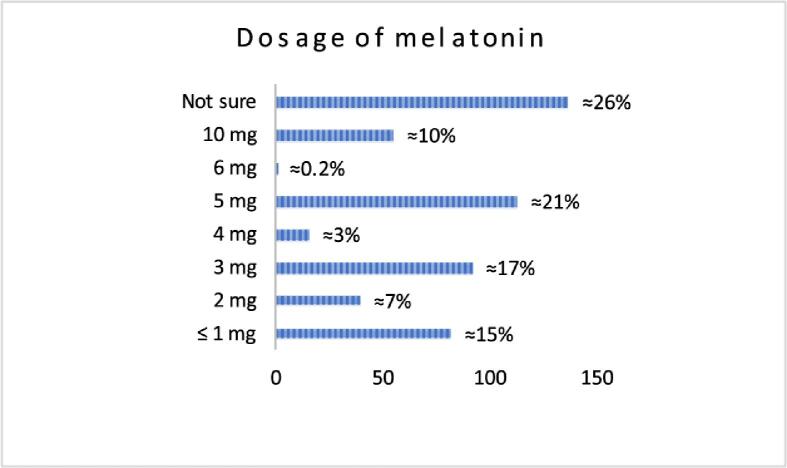
Out of 5,606 participants, 536 (10 %) were consumers of melatonin. Older age (Adjusted OR = 1.01, 95 % CI = 1.01-1.02, p = 0.002), being a male (Adjusted OR = 1.76, 95 % CI = 1.46-2.14, p = 0.001), individuals with a doctorate degree or an equivalent (adjusted OR 2.37 95 % CI = 1.35-4.17, p = 0.003), perceived poor sleep quality (Adjusted OR = 1.52, 95 % CI = 1.10-2.11, p = 0.01), and being diagnosed with a sleep disorder (Adjusted OR = 2.55, 95 % CI = 2.04-3.18, p = 0.001) were all associated with increased likelihood of sleep-related melatonin usage. 35 % of consumers self-reported taking ≥1 tablet per day, while 26 % of them were uncertain about the dosage they consume.
With a notable prevalence of 10% among the general population in Saudi Arabia, melatonin usage was more common in older adults, males, and those with higher education.
尽管近年来褪黑素补充剂的消费量激增,但沙特阿拉伯褪黑素使用的患病率和模式数据仍很缺乏。本研究的目的是评估沙特阿拉伯成年人中与睡眠相关的褪黑素使用的患病率和模式。
这是一项基于网络的横断面自我管理调查研究,在沙特阿拉伯的所有地区进行。参与者从普通人群(≥18岁)中招募。调查于2023年2月至4月期间进行。进行卡方检验和t检验用于比较双变量分析,其中进行二元逻辑回归以得出褪黑素消费的主要预测因素。
在5606名参与者中,536人(10%)是褪黑素消费者。年龄较大(调整后的OR = 1.01,95% CI = 1.01 - 1.02,p = 0.002)、男性(调整后的OR = 1.76,95% CI = 1.46 - 2.14,p = 0.001)、拥有博士学位或同等学历的人(调整后的OR 2.37,95% CI = 1.35 - 4.17,p = 0.003)、认为睡眠质量差(调整后的OR = 1.52,95% CI = 1.10 - 2.11,p = 0.01)以及被诊断患有睡眠障碍(调整后的OR = 2.55,95% CI = 2.04 - 3.18,p = 0.001)均与与睡眠相关的褪黑素使用可能性增加有关。35%的消费者自我报告每天服用≥1片,而其中26%的人不确定他们服用的剂量标准。
在沙特阿拉伯普通人群中,褪黑素使用率高达10%,在老年人、男性和受过高等教育的人群中更为常见。