Jain Supriya S, Anderson Steven A, Steele Jeremy M, Wilson Hunter C, Muniz Juan Carlos, Soslow Jonathan H, Beroukhim Rebecca S, Maksymiuk Victoria, Jacquemyn Xander, Frosch Olivia H, Fonseca Brian, Harahsheh Ashraf S, Buddhe Sujatha, Ashwath Ravi C, Thacker Deepika, Maskatia Shiraz A, Misra Nilanjana, Su Jennifer A, Siddiqui Saira, Vaiyani Danish, Vaikom-House Aswathy K, Campbell M Jay, Klein Jared, Huang Sihong, Mathis Christopher, Cornicelli Matthew D, Sharma Madhu, Nagaraju Lakshmi, Ang Jocelyn Y, Uppu Santosh C, Ramachandran Preeti, Patel Jyoti K, Han Frank, Mandell Jason G, Akam-Venkata Jyothsna, DiLorenzo Michael P, Brumund Michael, Bhatla Puneet, Eshtehardi Parham, Mehta Karina, Glover Katherine, Dove Matthew L, Aldawsari Khalifah A, Kumar Anupam, Barfuss Spencer B, Dorfman Adam L, Minocha Prashant K, Yonts Alexandra B, Schauer Jenna, Cheng Andrew L, Robinson Joshua D, Powell Zachary, Srivastava Shubhika, Chelliah Anjali, Sanil Yamuna, Hernandez Lazaro E, Gaur Lasya, Antonchak Michael, Johnston Marla, Reich Jonathan D, Nair Narayan, Drugge Elizabeth D, Grosse-Wortmann Lars
Department of Pediatrics, Division of Cardiology, New York Medical College-Maria Fareri Children's Hospital at Westchester Medical Center, Valhalla, NY, USA.
The U.S. Food and Drug Administration, Silver Spring, MD, USA.
EClinicalMedicine. 2024 Sep 6;76:102809. doi: 10.1016/j.eclinm.2024.102809. eCollection 2024 Oct.
We aimed to study the clinical characteristics, myocardial injury, and longitudinal outcomes of COVID-19 vaccine-associated myocarditis (C-VAM).
In this longitudinal retrospective observational cohort multicenter study across 38 hospitals in the United States, 333 patients with C-VAM were compared with 100 patients with multisystem inflammatory syndrome in children (MIS-C). We included patients ≤30 years of age with a clinical diagnosis of acute myocarditis after COVID-19 vaccination based on clinical presentation, abnormal biomarkers and/or cardiovascular imaging findings. Demographics, past medical history, hospital course, biochemistry results, cardiovascular imaging, and follow-up information from April 2021 to November 2022 were collected. The primary outcome was presence of myocardial injury as evidenced by late gadolinium enhancement (LGE) on cardiac magnetic resonance (CMR) imaging.
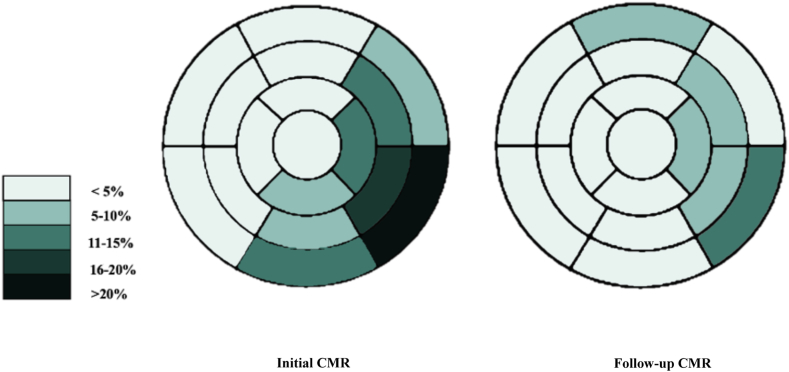
Patients with C-VAM were predominantly white (67%) adolescent males (91%, 15.7 ± 2.8 years). Their initial clinical course was more likely to be mild (80% vs. 23%, p < 0.001) and cardiac dysfunction was less common (17% vs. 68%, p < 0.0001), compared to MIS-C. In contrast, LGE on CMR was more prevalent in C-VAM (82% vs. 16%, p < 0.001). The probability of LGE was higher in males (OR 3.28 [95% CI: 0.99, 10.6, p = 0.052]), in older patients (>15 years, OR 2.74 [95% CI: 1.28, 5.83, p = 0.009]) and when C-VAM occurred after the first or second dose as compared to the third dose of mRNA vaccine. Mid-term clinical outcomes of C-VAM at a median follow-up of 178 days (IQR 114-285 days) were reassuring. No cardiac deaths or heart transplantations were reported until the time of submission of this report. LGE persisted in 60% of the patients at follow up.
Myocardial injury at initial presentation and its persistence at follow up, despite a mild initial course and favorable mid-term clinical outcome, warrants continued clinical surveillance and long-term studies in affected patients with C-VAM.
The U.S. Food and Drug Administration.
我们旨在研究新冠病毒疫苗相关心肌炎(C-VAM)的临床特征、心肌损伤及长期预后。
在这项美国38家医院开展的纵向回顾性观察性队列多中心研究中,将333例C-VAM患者与100例儿童多系统炎症综合征(MIS-C)患者进行比较。我们纳入年龄≤30岁、根据临床表现、生物标志物异常和/或心血管影像学检查结果临床诊断为新冠病毒疫苗接种后急性心肌炎的患者。收集了2021年4月至2022年11月的人口统计学资料、既往病史、住院病程、生化结果、心血管影像学检查及随访信息。主要结局是心脏磁共振成像(CMR)上延迟钆增强(LGE)所证实的心肌损伤。
C-VAM患者以白人(67%)青少年男性为主(91%,15.7±2.8岁)。与MIS-C相比,他们的初始临床病程更可能较轻(80%对23%,p<0.001),心脏功能障碍较少见(17%对68%,p<0.0001)。相比之下,CMR上的LGE在C-VAM中更常见(82%对16%,p<0.001)。男性(比值比3.28[95%置信区间:0.99,10.6,p=0.052])、年龄较大患者(>15岁,比值比2.74[95%置信区间:1.28,5.83,p=0.009])以及C-VAM发生在第一剂或第二剂mRNA疫苗接种后而非第三剂接种后的患者,LGE出现的可能性更高。C-VAM的中期临床预后在中位随访178天(四分位间距114-285天)时令人安心。在本报告提交之时,未报告心脏死亡或心脏移植情况。随访时60%的患者LGE持续存在。
尽管初始病程较轻且中期临床预后良好,但初次就诊时的心肌损伤及其在随访中的持续存在,仍需对受影响的C-VAM患者进行持续临床监测和长期研究。
美国食品药品监督管理局。