School of Public Health, Adama Hospital Medical College, Adama, Ethiopia.
School of Public Health, St Paul's Hospital Millennium Medical College, Addis Ababa, Ethiopia.
Malar J. 2023 Jan 25;22(1):28. doi: 10.1186/s12936-023-04460-2.
Malaria infection during pregnancy is a significant public health problem that puts pregnant women at risk. Interruption of transmission of asymptomatic malaria among a population remained a challenge and the host serves as a reservoir for the malaria parasite; and is also recognized as a major barrier to malaria elimination. This study aimed to assess the prevalence of asymptomatic malaria and associated factors among pregnant women in the Boset District, East Shoa Zone, Oromia, Ethiopia.
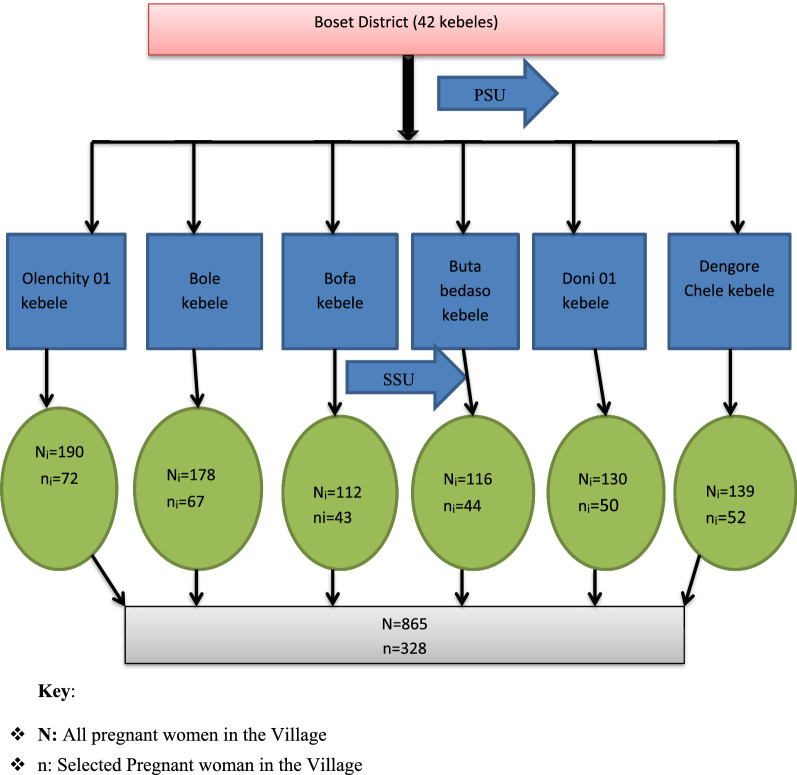
A community-based cross-sectional study was conducted to assess the prevalence of asymptomatic malaria and associated factors in pregnant women from February to March 2022. Using multistage sample techniques, 328 asymptomatic pregnant women were enrolled. Data were collected using a structured questionnaire. A rapid test and Giemsa-stained blood smear microscopy were used to diagnose Plasmodium infections. Epi info version 7 was used to code, enter, and clean data before being uploaded to SPSS version 25.0 for analysis. Bivariable and multivariable binary logistic regression were employed to find the associated factors. Variables in the multivariable model with a p-value < 0.05 were considered significantly associated with asymptomatic malaria.
Of the total 328 pregnant women who participated in this study, 9(2.74%) and 10(3.05%) were confirmed to be infected with Plasmodium species by microscopy and rapid diagnostic tests, respectively. Asymptomatic malaria during pregnancy was found to be significantly associated with not using an insecticide-treated bed net [(P = 0.002, AOR: 9.61; 95% CI (2.22-41.53)], lack of consultation and health education about malaria prevention during Antenatal care attendance [(P = 0.04, AOR: 4.05; 95% CI (1.02, 16.05)], and living close stagnant water [(P = 0.02, AOR: 4.43; 95% CI (1.17,16.82)].
The current study showed that asymptomatic malaria is prevalent in pregnant women. Not using insecticide-treated bed nets, inadequate health education during antenatal care, and living close to stagnant water are significantly associated with malaria infection. Thus, using insecticide-treated bed nets, health education, and avoiding stagnant water from residential areas could play significant roles in preventing asymptomatic malaria among pregnant women in the study area.
孕期疟疾感染是一个严重的公共卫生问题,使孕妇面临风险。在人群中中断无症状疟疾的传播仍然是一个挑战,宿主是疟原虫的储存库;也被认为是消除疟疾的主要障碍。本研究旨在评估埃塞俄比亚奥罗米亚东绍阿地区博塞特区孕妇中无症状疟疾的流行情况及其相关因素。
2022 年 2 月至 3 月,采用基于社区的横断面研究评估孕妇中无症状疟疾的流行情况及其相关因素。采用多阶段抽样技术,纳入 328 名无症状孕妇。使用结构化问卷收集数据。采用快速检测和吉姆萨染色血涂片显微镜检查诊断疟原虫感染。使用 Epi info 版本 7 对数据进行编码、输入和清理,然后上传至 SPSS 版本 25.0 进行分析。采用单变量和多变量二项逻辑回归寻找相关因素。多变量模型中 p 值<0.05 的变量被认为与无症状疟疾有显著关联。
在参与本研究的 328 名孕妇中,分别有 9(2.74%)和 10(3.05%)名经显微镜和快速诊断检测确认为感染疟原虫。孕期无症状疟疾与未使用经杀虫剂处理的蚊帐显著相关(P=0.002,AOR:9.61;95%CI(2.22-41.53))、产前保健期间缺乏疟疾预防咨询和健康教育(P=0.04,AOR:4.05;95%CI(1.02,16.05))以及居住在死水附近(P=0.02,AOR:4.43;95%CI(1.17,16.82))。
本研究表明,孕妇中无症状疟疾流行。不使用经杀虫剂处理的蚊帐、产前保健期间缺乏健康教育以及居住在死水附近与疟疾感染显著相关。因此,在研究地区,使用经杀虫剂处理的蚊帐、健康教育和避免居住区域死水可能对预防孕妇中的无症状疟疾发挥重要作用。