Hetemäki Iivo, Sarkkinen Joona, Wong Huai Hui, Heikkilä Nelli, Laakso Saila, Miettinen Simo, Mäyränpää Mikko I, Mäkitie Outi, Arstila T Petteri, Kekäläinen Eliisa
Translational Immunology Research Program, University of Helsinki and Helsinki University Hospital, Helsinki, Finland.
ImmuDocs National Doctoral Education Pilot Program, University of Helsinki, Helsinki, Finland.
Eur J Immunol. 2024 Dec;54(12):e2451189. doi: 10.1002/eji.202451189. Epub 2024 Sep 18.
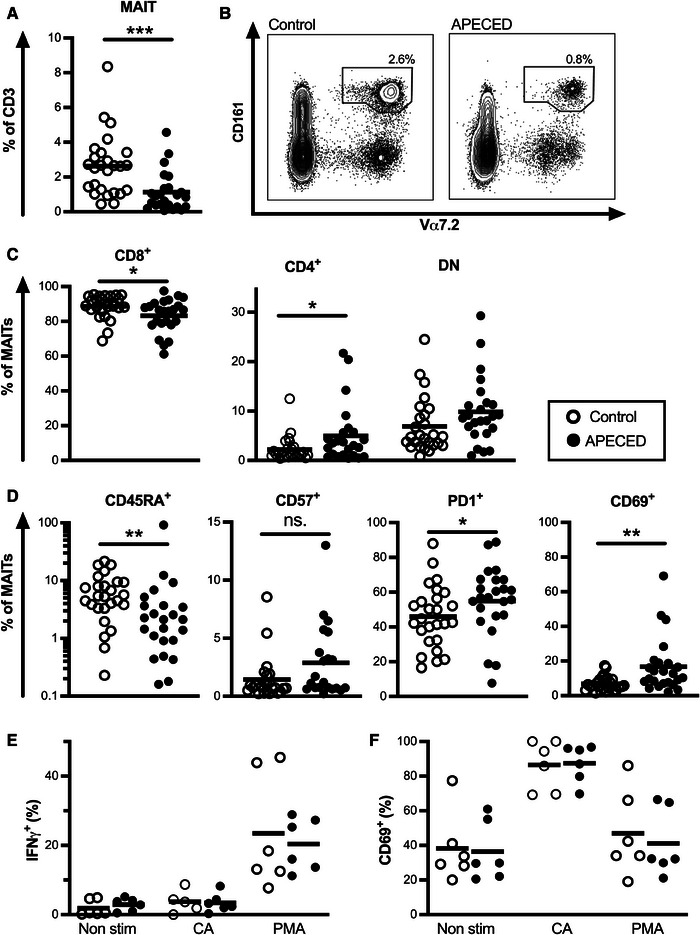
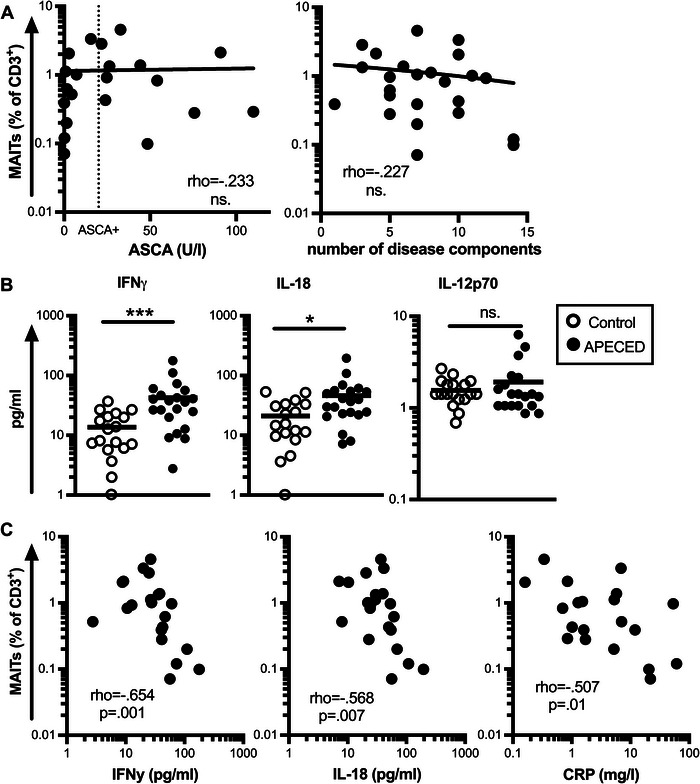
Mucosal-associated invariant T cells (MAIT) are innate-like lymphocytes enriched in mucosal organs where they contribute to antimicrobial defense. APECED is an inborn error of immunity characterized by immune dysregulation and chronic mucocutaneous candidiasis. Reduction in the frequency of circulating MAITs has been reported in many inborn errors of immunity, but only in a few of them, the functional competence of MAITs has been assessed. Here, we show in a cohort of 24 patients with APECED, that the proportion of circulating MAITs was reduced compared with healthy age and sex-matched controls (1.1% vs. 2.6% of CD3 T cells; p < 0.001) and the MAIT cell immunophenotype was more activated. Functionally the IFN-γ secretion of patient MAITs after stimulation was comparable to healthy controls. We observed in the patients elevated serum IFN-γ (46.0 vs. 21.1 pg/mL; p = 0.01) and IL-18 (42.6 vs. 13.7 pg/mL; p < 0.001) concentrations. Lower MAIT proportion did not associate with the levels of neutralizing anti-IL-22 or anti-IL-12/23 antibodies but had a clear negative correlation with serum concentrations of IFN-γ, IL-18, and protein C-reactive protein. Our data suggest that reduction of circulating MAITs in patients with APECED correlates with chronic type 1 inflammation but the remaining MAITs are functionally competent.
黏膜相关恒定T细胞(MAIT)是一类固有样淋巴细胞,在黏膜器官中富集,有助于抗菌防御。自身免疫性多内分泌腺病-念珠菌病-外胚层营养不良(APECED)是一种先天性免疫缺陷病,其特征为免疫失调和慢性黏膜皮肤念珠菌病。在许多先天性免疫缺陷病中都报道了循环MAIT细胞频率降低,但只有少数病例评估了MAIT细胞的功能能力。在此,我们对24例APECED患者进行了研究,发现与年龄和性别匹配的健康对照相比,患者循环MAIT细胞的比例降低(分别占CD3⁺ T细胞的1.1%和2.6%;p < 0.001),且MAIT细胞免疫表型更活化。在功能上,患者MAIT细胞刺激后分泌的IFN-γ与健康对照相当。我们观察到患者血清中IFN-γ(46.0 vs. 21.1 pg/mL;p = 0.01)和IL-18(42.6 vs. 13.7 pg/mL;p < 0.001)浓度升高。较低的MAIT细胞比例与中和性抗IL-22或抗IL-12/23抗体水平无关,但与血清IFN-γ、IL-18和C反应蛋白浓度呈明显负相关。我们的数据表明,APECED患者循环MAIT细胞减少与慢性1型炎症相关,但剩余的MAIT细胞功能正常。