Rizza Giorgia, Glynou Kyriaki, Eletskaya Masha
General Surgery and Liver Transplant Center, S. Giovanni Battista Hospital, Turin I-10126, Italy.
Medical Affairs, Biotest AG, Dreieich 63303, Germany.
World J Transplant. 2024 Sep 18;14(3):90949. doi: 10.5500/wjt.v14.i3.90949.
Hepatitis B immunoglobulin (HBIG) in combination with a potent nucleos(t)ide analog is considered the standard of care for prophylaxis against hepatitis B virus (HBV) reinfection after liver transplantation for HBV-associated disease.
To evaluate patients' satisfaction, preferences, and requirements for subcutaneous (SC), intramuscular (IM), and intravenous (IV) HBIG treatments.
A self-completion, cross-sectional, online, 22-question survey was conducted to examine perceptions and satisfaction with current HBIG treatment in adults receiving HBIG treatment following liver transplantation for HBV-associated disease in France, Italy, and Turkey. Hypothetical HBIG products with different administration modes were evaluated using target product profile assessment and a conjoint (trade-off) exercise.
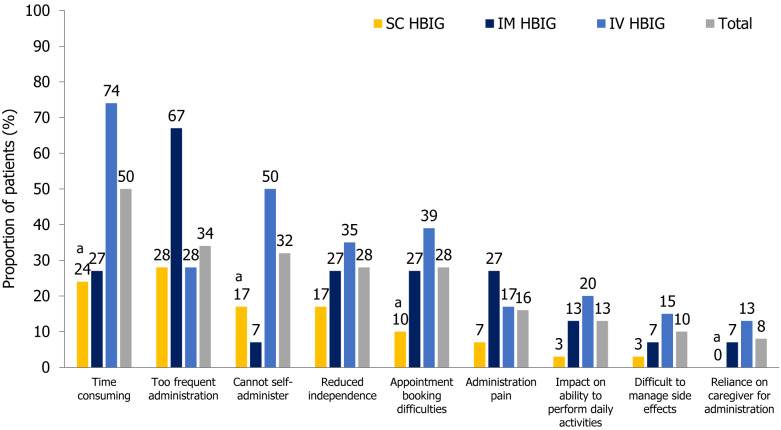
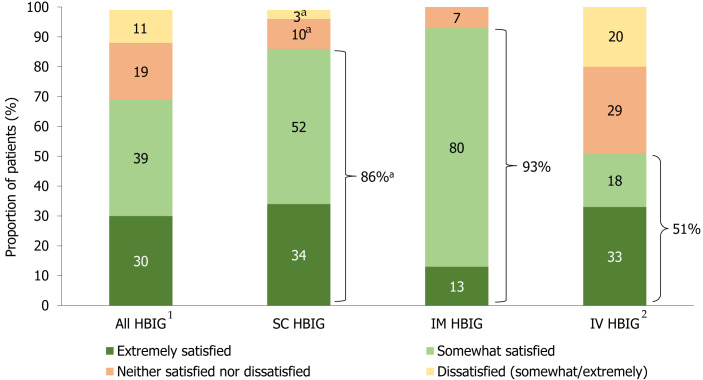
Ninety patients were enrolled; 32%, 17%, and 51% were SC, IM, and IV HBIG users, respectively. Mean duration of treatment was 36.2 months. SC HBIG had the least negative impact on emotional well-being and social life and was perceived as the most convenient, easiest to administer, least painful, and had the highest self-rating of treatment compliance. More IM HBIG users than SC or IV HBIG users reported that administration frequency was excessive (67%, 28%, and 28%, respectively). In the target product profile assessment, 76% of patients were likely to use hypothetical SC HBIG. In the conjoint exercise, administration route, frequency, and duration were key drivers of treatment preferences.
Ease, frequency, duration, and side effects of HBIG treatment administration were key drivers of treatment preferences, and SC HBIG appeared advantageous over IM and IV HBIG for administration ease, convenience, and pain. A hypothetical SC HBIG product elicited a favorable response. Patient demographics, personal preferences, and satisfaction with HBIG treatment modalities may influence long-term treatment compliance.
乙肝免疫球蛋白(HBIG)联合一种强效核苷(酸)类似物被认为是预防乙肝病毒(HBV)相关疾病肝移植后HBV再感染的标准治疗方法。
评估患者对皮下(SC)、肌肉内(IM)和静脉内(IV)注射HBIG治疗的满意度、偏好和需求。
开展了一项自我完成的横断面在线调查,共22个问题,以调查法国、意大利和土耳其接受HBIG治疗的成人对当前HBIG治疗的看法和满意度,这些成人因HBV相关疾病接受肝移植后接受HBIG治疗。使用目标产品概况评估和联合(权衡)练习评估了具有不同给药方式的假设性HBIG产品。
共纳入90名患者;分别有32%、17%和51%的患者使用SC、IM和IV注射HBIG。平均治疗持续时间为36.2个月。SC注射HBIG对情绪健康和社交生活的负面影响最小,被认为是最方便、最易于给药、最不痛且治疗依从性自评最高的方式。报告给药频率过高的IM注射HBIG使用者多于SC或IV注射HBIG使用者(分别为67%、28%和28%)。在目标产品概况评估中,76%的患者可能会使用假设性的SC注射HBIG。在联合练习中,给药途径、频率和持续时间是治疗偏好的关键驱动因素。
HBIG治疗给药的 ease、频率、持续时间和副作用是治疗偏好的关键驱动因素,SC注射HBIG在给药 ease、便利性和疼痛方面似乎优于IM和IV注射HBIG。一种假设性的SC注射HBIG产品引起了积极反应。患者的人口统计学特征、个人偏好以及对HBIG治疗方式的满意度可能会影响长期治疗依从性。