M Anis Kumar, A P Swarnalatha, J Shwetha, C Sowmya Dhanalakshmi, P Saravanan, Hatamleh Ashraf Atef, Al-Dosary Munirah Abdullah, Mani Ravishankar Ram, Chung Woo Jin, Chang Soon Woong, Ravindran Balasubramani
Department of Biotechnology, V.S.B Engineering College, Karur, Tamil Nadu, India, 639111.
Department of Biomedical Engineering, V.S.B Engineering College, Karur, Tamil Nadu, India, 639111.
Heliyon. 2024 Aug 30;10(17):e37255. doi: 10.1016/j.heliyon.2024.e37255. eCollection 2024 Sep 15.
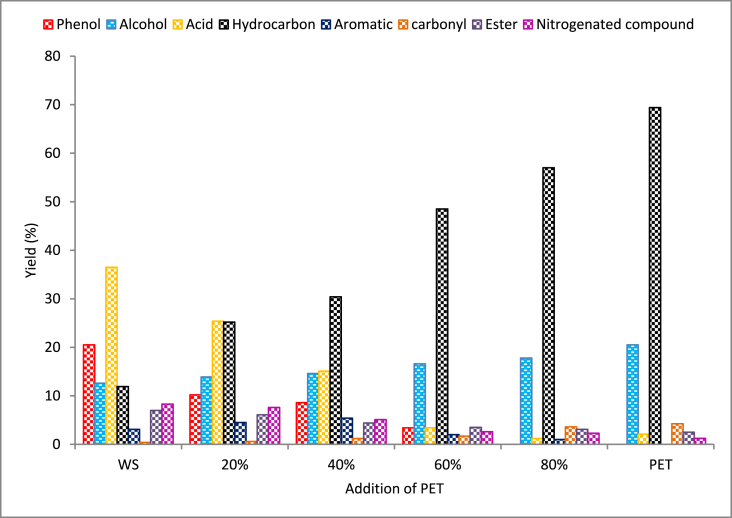
Renewable lignocellulosic biomass is a favorable energy resource since its co-pyrolysis with hydrogen-rich plastics can produce high-yield and high-quality biofuel. In contrast to earlier co-pyrolysis research that concentrated on increasing product yield, this study comprehends the synergistic effects of two distinct feedstocks that were not considered earlier. This work focuses on co-pyrolyzing wheat straw (WS) with non-reusable polyethylene terephthalate (PET) for the production of pyrolysis oil. WS and PET were blended in different ratios (100/0, 80/20, 60/40, 40/60, 20/80, and 0/100), and pyrolysis experiments were conducted in a fixed-bed reactor under different temperatures to assess their synergistic effect on oil yield. Synergy rates of up to 7.78 % were achieved on yield for the blends of plastic and biomass at a temperature of 500 °C. In comparison to individual biomass or plastics, co-pyrolyzing PET-biomass blends demonstrated good process interaction and promoted the yields of value-added products. The heating value of the pyrolysis oils was in the range of 16.45-28.64 MJ/kg, which depends on the amount of plastic present in the feedstock. The physical analysis of the oils shows that they can be used for heat production by direct combustion in boilers or furnaces. The correlation between WS and PET was validated with the aid of Fourier transform infrared spectroscopy (FT-IR) and gas chromatography-mass spectrometry (GC-MS) analysis. The GC-MS result demonstrated the presence of different compounds such as O-H compounds, esters, carbonyl group elements, acids, hydrocarbons, aromatics, and nitrogenated compounds in the pyrolysis oil, which differed based on the proportions of PET in the feedstock. The increased hydrocarbon and reduced oxygen percentages in the pyrolysis oil were implicitly caused by enhanced hydrocarbon pool mechanisms, in which the breakdown of PET may be supplied as a hydrogen donor. Overall, waste lignocellulosic biomass and plastics can be used to produce biofuels, which helps reduce the amount of solid waste that ends up in landfills. This study also revealed that future research should be focused on the reaction mechanisms of WS and PET co-pyrolysis in order to examine the synergistic interactions.
可再生木质纤维素生物质是一种理想的能源,因为它与富含氢的塑料共热解可以生产高产率和高质量的生物燃料。与早期专注于提高产品产量的共热解研究不同,本研究理解了两种不同原料的协同效应,而这在早期并未被考虑。这项工作聚焦于将小麦秸秆(WS)与不可重复使用的聚对苯二甲酸乙二酯(PET)共热解以生产热解油。WS和PET按不同比例(100/0、80/20、60/40、40/60、20/80和0/100)混合,并在固定床反应器中于不同温度下进行热解实验,以评估它们对油产量的协同效应。在500℃的温度下,塑料与生物质的混合物在产量上实现了高达7.78%的协同率。与单独的生物质或塑料相比,PET - 生物质混合物共热解表现出良好的过程相互作用,并提高了增值产品的产量。热解油的热值在16.45 - 28.64 MJ/kg范围内,这取决于原料中塑料的含量。对油的物理分析表明,它们可通过在锅炉或熔炉中直接燃烧用于产热。借助傅里叶变换红外光谱(FT - IR)和气相色谱 - 质谱(GC - MS)分析验证了WS和PET之间的相关性。GC - MS结果表明热解油中存在不同的化合物,如O - H化合物、酯、羰基元素、酸、烃、芳烃和含氮化合物,这些化合物因原料中PET的比例不同而有所差异。热解油中烃含量增加和氧含量降低是由增强的烃池机制隐含导致的,其中PET的分解可能作为氢供体。总体而言,废弃木质纤维素生物质和塑料可用于生产生物燃料,这有助于减少最终进入垃圾填埋场的固体废物量。本研究还表明,未来的研究应聚焦于WS和PET共热解的反应机制,以研究协同相互作用。