Ahmed Asmaa Kamal, Atta Mohamed Hussein Ramadan, El-Monshed Ahmed Hashem, Mohamed Alia Ibrahim
Faculty of Nursing, Fayoum University, Fayoum City, Egypt.
Psychiatric and mental- health nursing Department, Faculty of Nursing, Alexandria University, 9 Edmond Vermont Street - Smouha, Alexandria City, Egypt.
BMC Nurs. 2024 Sep 19;23(1):669. doi: 10.1186/s12912-024-02308-x.
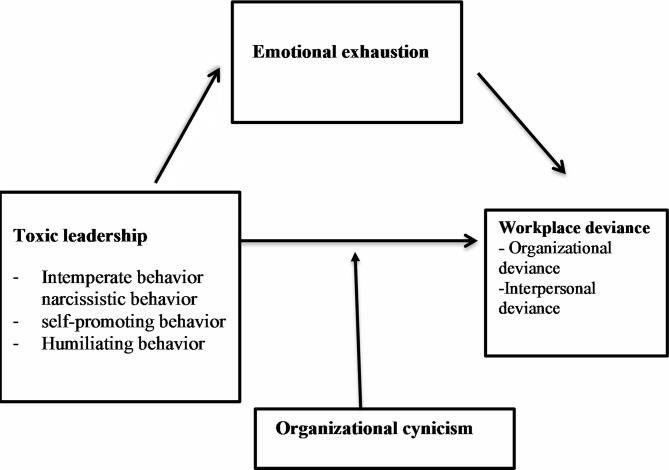
Toxic leadership is abusive, destructive, and detrimental to nurses, can decrease nurse morale, increase stress levels, diminish organizational performance, and cause employee emotional exhaustion. Emotional exhaustion, a key component of burnout, has been linked to decreased job performance and increased likelihood of engaging in deviant behaviors at work. Organizational cynicism, as a negative attitude or distrust towards the organization and its leadership, may exacerbate the relationship between toxic leadership and workplace deviance. This study aims to explore how toxic leadership, workplace deviance, emotional exhaustion, and organizational cynicism are interrelated in the nursing profession.
A multicenter descriptive, cross-sectional research design was conducted at three university hospitals affiliated with three Egyptian governorates: Zagazig, El-Fayoum, and Alexandria. Two hundred forty-three nurses completed the Personal and Job-related Data Questionnaire, Toxic Leadership Scale, Emotional Exhaustion Scale, Workplace Deviance Scale, and Organizational Cynicism Scale. Mediation analysis using SPSS PROCESS revealed that emotional exhaustion indirectly influences the relationship between toxic leadership and workplace deviance, while hierarchical multiple regression showed that organizational cynicism moderates this relationship, with linear regression confirming the predictive impact of these variables on workplace deviance.
Toxic leadership exhibits a substantial positive influence on workplace deviance (B = 16.132, p < 0.001), as does emotional exhaustion (B = 8.760, p < 0.001) and organizational cynicism (B = 5.376, p = 0.036). Furthermore, the interaction terms of toxic leadership, organizational cynicism, and emotional exhaustion are significant (B = -3.012, p = 0.036). The negative coefficient of the interaction term implies a mitigating impact, indicating that the combined presence of high toxic leadership, high emotional exhaustion, and high organizational cynicism may counterintuitively reduce workplace deviance (t = -2.110).
These results suggest that while toxic leadership, emotional exhaustion, and organizational cynicism each independently increase workplace deviance, their combined presence may unexpectedly reduce deviant behaviors.
These results highlight the significance of tackling toxic leadership practices and cultivating a positive organizational culture to enhance a healthier work environment and reduce instances of workplace deviance. Healthcare settings should prioritize interventions to improve leadership practices, enhance employee well-being, and cultivate a supportive organizational climate.
不良领导具有虐待性、破坏性,对护士有害,会降低护士士气,增加压力水平,削弱组织绩效,并导致员工情绪耗竭。情绪耗竭是职业倦怠的一个关键组成部分,与工作绩效下降以及在工作中从事越轨行为的可能性增加有关。组织犬儒主义作为对组织及其领导的消极态度或不信任,可能会加剧不良领导与工作场所越轨行为之间的关系。本研究旨在探讨不良领导、工作场所越轨行为、情绪耗竭和组织犬儒主义在护理行业中是如何相互关联的。
在隶属于埃及三个省份(扎加齐格、法尤姆和亚历山大)的三所大学医院进行了一项多中心描述性横断面研究设计。243名护士完成了个人和工作相关数据问卷、不良领导量表、情绪耗竭量表、工作场所越轨行为量表和组织犬儒主义量表。使用SPSS PROCESS进行的中介分析表明,情绪耗竭间接影响不良领导与工作场所越轨行为之间的关系,而分层多元回归表明组织犬儒主义调节了这种关系,线性回归证实了这些变量对工作场所越轨行为的预测影响。
不良领导对工作场所越轨行为有显著的正向影响(B = 16.132,p < 0.001),情绪耗竭(B = 8.760,p < 0.001)和组织犬儒主义(B = 5.376,p = 0.036)也有同样的影响。此外,不良领导、组织犬儒主义和情绪耗竭的交互项是显著的(B = -3.012,p = 0.036)。交互项的负系数意味着一种缓解作用,表明高不良领导、高情绪耗竭和高组织犬儒主义的共同存在可能会出人意料地减少工作场所越轨行为(t = -2.110)。
这些结果表明,虽然不良领导、情绪耗竭和组织犬儒主义各自独立地增加了工作场所越轨行为,但它们的共同存在可能会意外地减少越轨行为。
这些结果凸显了解决不良领导行为和培养积极组织文化以改善更健康的工作环境并减少工作场所越轨行为的重要性。医疗机构应优先采取干预措施来改善领导行为,提高员工福祉,并营造支持性的组织氛围。