Department of Endocrinology, The First Hospital of Hunan University of Chinese Medicine, Changsha, Hunan, China.
School of Traditional Chinese Medicine, Hunan University of Chinese Medicine, Changsha, Hunan, China.
Front Endocrinol (Lausanne). 2024 Sep 5;15:1375068. doi: 10.3389/fendo.2024.1375068. eCollection 2024.
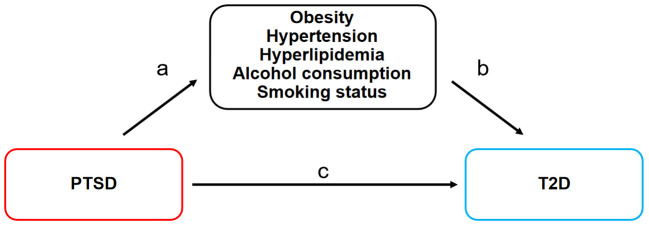
Whether the role of post-traumatic stress disorder (PTSD) on type 2 diabetes (T2D) is mediated by obesity or other mediating factors is controversial. This study was designed to assess the impact of PTSD on genetic susceptibility to T2D and mediating factors.
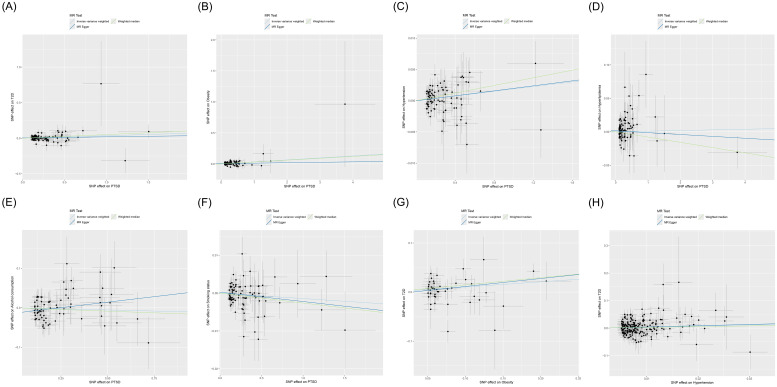
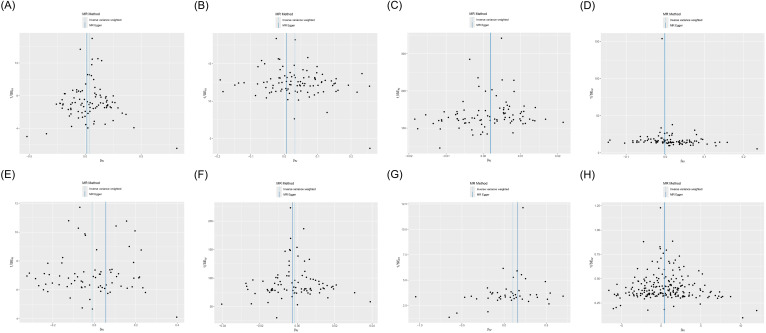
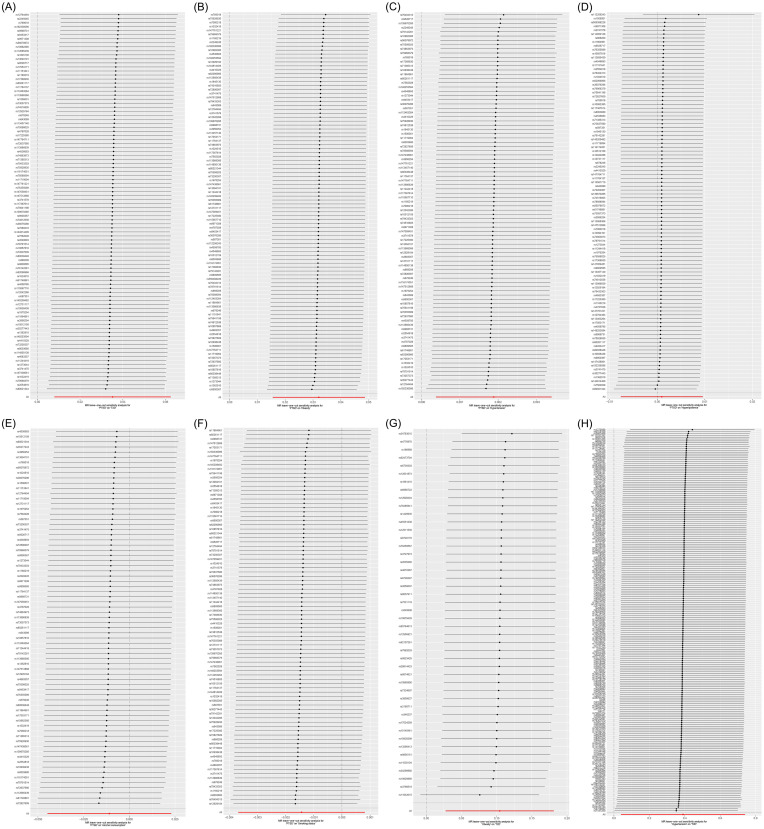
The datasets for PTSD, T2D, obesity, hypertension, hyperlipidemia, smoking status, and alcohol consumption were obtained from genome-wide association studies. Mendelian randomization (MR) was used to assess exposure-outcome causality, and inverse variance weighted was used as the primary tool for MR analysis. MR-Egger intercept, Cochran's Q, and leave-one-out sensitivity analysis were employed to assess horizontal pleiotropy, heterogeneity, and robustness, respectively.
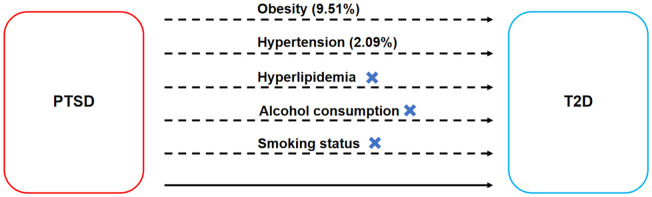
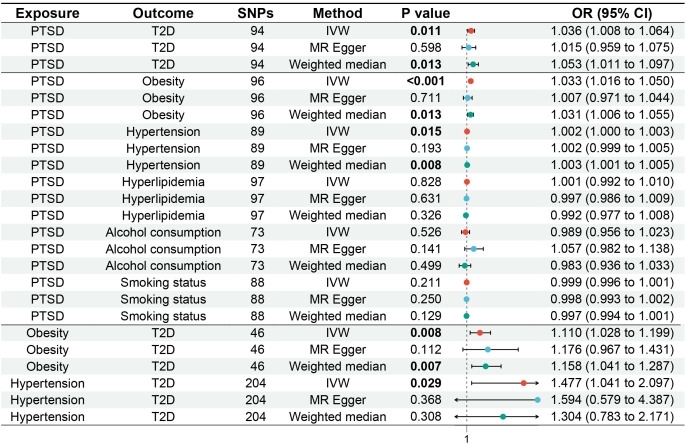
The MR analysis showed that PTSD was associated with increased genetic susceptibility to T2D (OR, 1.036; 95% CI, 1.008-1.064; = 0.011), obesity (OR, 1.033; 95% CI, 1.016-1.050; < 0.001), and hypertension (OR, 1.002; 95% CI, 1.000-1.003; = 0.015), but not not with genetic susceptibility to hyperlipidemia, alcohol consumption, and smoking status ( ≥ 0.05). Mediated effect analysis showed that PTSD increased genetic susceptibility to T2D by increasing genetic susceptibility to obesity and hypertension, with obesity accounting for 9.51% and hypertension accounting for 2.09%. MR-Egger intercept showed no horizontal pleiotropy ( ≥ 0.05). Cochran's Q showed no heterogeneity ( ≥ 0.05). Leave-one-out sensitivity analysis showed that the results were robust.
This MR analysis suggests that PTSD increases the risk of T2D and that this effect is partially mediated by obesity and hypertension. Active prevention and treatment of PTSD can help reduce the risk of T2D.
创伤后应激障碍(PTSD)是否通过肥胖或其他中介因素对 2 型糖尿病(T2D)起作用仍存在争议。本研究旨在评估 PTSD 对 T2D 遗传易感性和中介因素的影响。
从全基因组关联研究中获取 PTSD、T2D、肥胖、高血压、高血脂、吸烟状况和饮酒数据。采用孟德尔随机化(MR)评估暴露-结局因果关系,逆方差加权法作为 MR 分析的主要工具。MR-Egger 截距、Cochran's Q 和逐一剔除敏感性分析分别用于评估水平多效性、异质性和稳健性。
MR 分析表明,PTSD 与增加 T2D 的遗传易感性(OR,1.036;95%CI,1.008-1.064; = 0.011)、肥胖(OR,1.033;95%CI,1.016-1.050; < 0.001)和高血压(OR,1.002;95%CI,1.000-1.003; = 0.015)相关,但与高血脂、饮酒和吸烟状况的遗传易感性无关( ≥ 0.05)。中介效应分析表明,PTSD 通过增加肥胖和高血压的遗传易感性增加 T2D 的遗传易感性,肥胖占 9.51%,高血压占 2.09%。MR-Egger 截距未显示水平多效性( ≥ 0.05)。Cochran's Q 未显示异质性( ≥ 0.05)。逐一剔除敏感性分析表明结果稳健。
这项 MR 分析表明,PTSD 增加了 T2D 的风险,而这种影响部分是由肥胖和高血压介导的。积极预防和治疗 PTSD 有助于降低 T2D 的风险。