Graduate School of Frontier Biosciences, Osaka University, 1-3 Yamadaoka, Suita, Osaka 565-0871, Japan.
Sci Adv. 2024 Sep 20;10(38):eadp5636. doi: 10.1126/sciadv.adp5636.
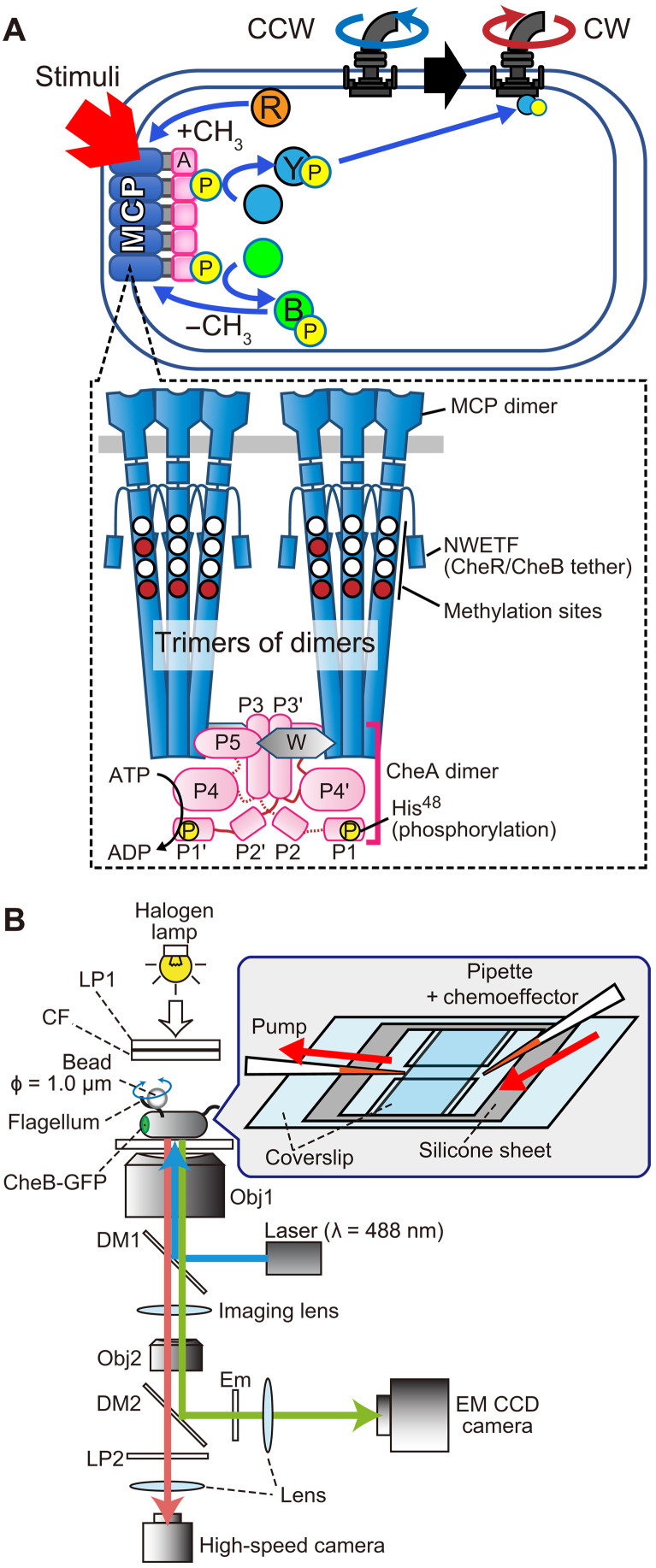
Adaptation of the response to stimuli is a fundamental process for all organisms. Here, we show that the adaptation enzyme CheB methylesterase of assembles to the ON state receptor array after exposure to the repellent l-isoleucine and dissociates from the array after adaptation is complete. The duration of increased CheB localization and the time of highly clockwise-biased flagellar rotation were similar and depended on the strength of the stimulus. The increase in CheB at the receptor array and the decrease in cytoplasmic CheB were both ~100 molecules, which represents 15 to 20% of the total cellular content of CheB. We confirmed that the main binding site for CheB in the ON state array is the P2 domain of phosphorylated CheA, with a second minor site being the carboxyl-terminal pentapeptide of the serine chemoreceptor. Thus, we have been able to quantify the regulation of the signal output of the receptor array by the intracellular dynamics of an adaptation enzyme.
适应刺激是所有生物体的基本过程。在这里,我们表明,在暴露于排斥性 l-异亮氨酸后,CheB 甲基酯酶的适应酶会组装到 ON 状态受体阵列上,并且在适应完成后从该阵列上解离。CheB 定位增加的持续时间和高度顺时针偏置的鞭毛旋转时间相似,并且取决于刺激的强度。在受体阵列处 CheB 的增加和细胞质 CheB 的减少均约为 100 个分子,这代表 CheB 的总细胞含量的 15%至 20%。我们证实,CheB 在 ON 状态阵列中的主要结合位点是磷酸化 CheA 的 P2 结构域,第二个次要位点是丝氨酸化学感受器的羧基末端五肽。因此,我们已经能够通过适应酶的细胞内动力学来定量调节受体阵列的信号输出。