Department of Aquatic Microbial Ecology, Institute of Hydrobiology, Biology Centre of the Czech Academy of Sciences, 37005, České Budějovice, Czech Republic.
Faculty of Science, University of South Bohemia, 37005, České Budějovice, Czech Republic.
ISME J. 2024 Jan 8;18(1). doi: 10.1093/ismejo/wrae177.
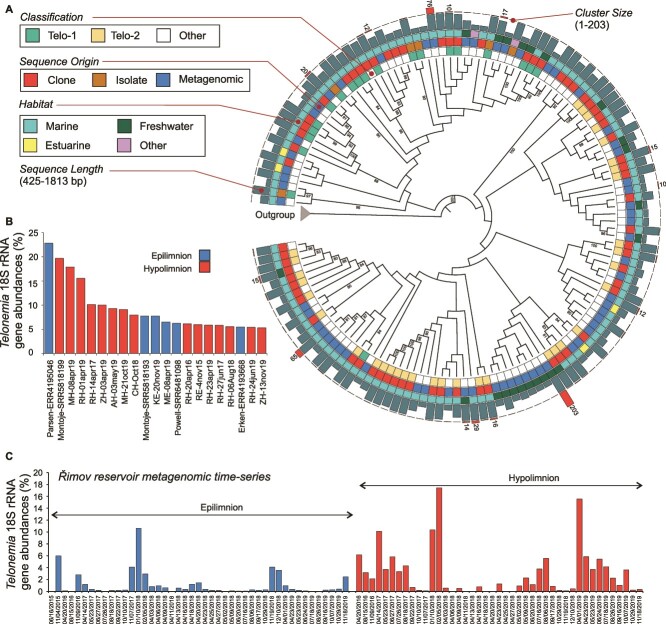
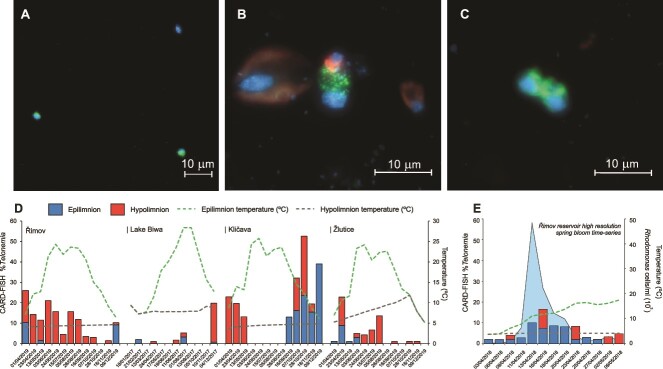
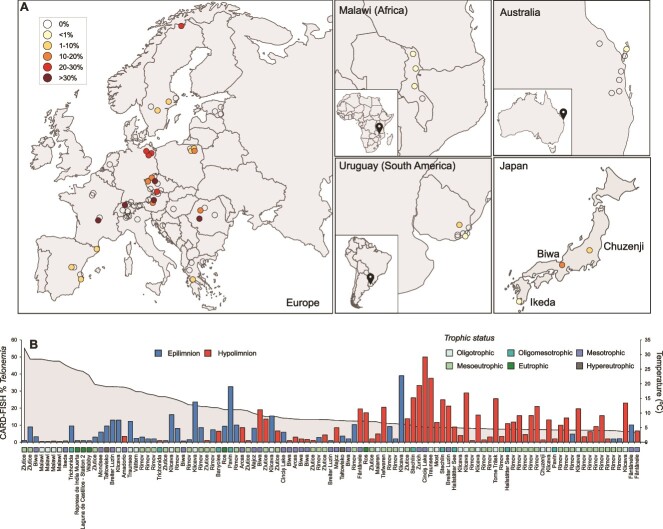
Telonemia are one of the oldest identified marine protists that for most part of their history have been recognized as a distinct incertae sedis lineage. Today, their evolutionary proximity to the SAR supergroup (Stramenopiles, Alveolates, and Rhizaria) is firmly established. However, their ecological distribution and importance as a natural predatory flagellate, especially in freshwater food webs, still remain unclear. To unravel the distribution and diversity of the phylum Telonemia in freshwater habitats, we examined over a thousand freshwater metagenomes from all over the world. In addition, to directly quantify absolute abundances, we analyzed 407 samples from 97 lakes and reservoirs using Catalyzed Reporter Deposition-Fluorescence in situ Hybridization (CARD-FISH). We recovered Telonemia 18S rRNA gene sequences from hundreds of metagenomic samples from a wide variety of habitats, indicating a global distribution of this phylum. However, even after this extensive sampling, our phylogenetic analysis did not reveal any new major clades, suggesting current molecular surveys are near to capturing the full diversity within this group. We observed excellent concordance between CARD-FISH analyses and estimates of abundances from metagenomes. Both approaches suggest that Telonemia are largely absent from shallow lakes and prefer to inhabit the colder hypolimnion of lakes and reservoirs in the Northern Hemisphere, where they frequently bloom, reaching 10%-20% of the total heterotrophic flagellate population, making them important predatory flagellates in the freshwater food web.
网被体虫是最古老的海洋原生生物之一,在其历史的大部分时间里,它们被认为是一个独特的分类地位谱系。如今,它们与 SAR 超群(Stramenopiles、Alveolates 和 Rhizaria)的进化关系已经得到了确定。然而,它们在淡水生态系统中的分布和作为自然捕食性鞭毛虫的重要性,尤其是在淡水食物网中,仍然不清楚。为了揭示淡水生境中网被体虫门的分布和多样性,我们检查了来自世界各地的一千多个淡水宏基因组。此外,为了直接定量绝对丰度,我们使用 Catalyzed Reporter Deposition-Fluorescence in situ Hybridization (CARD-FISH) 分析了来自 97 个湖泊和水库的 407 个样本。我们从来自各种生境的数百个宏基因组样本中回收了网被体虫 18S rRNA 基因序列,表明该门在全球范围内分布。然而,即使在进行了如此广泛的采样之后,我们的系统发育分析也没有揭示任何新的主要分支,这表明目前的分子调查已经接近捕捉到该群体的全部多样性。我们观察到 CARD-FISH 分析和宏基因组丰度估计之间存在极好的一致性。这两种方法都表明,网被体虫主要不存在于浅湖中,而更喜欢栖息在北半球湖泊和水库的较冷的下区,在那里它们经常大量繁殖,达到总异养鞭毛虫种群的 10%-20%,使它们成为淡水食物网中的重要捕食性鞭毛虫。