Spohn Simon K B, Farolfi Andrea, Schandeler Sarah, Vogel Marco M E, Ruf Juri, Mix Michael, Kirste Simon, Ceci Francesco, Fanti Stefano, Lanzafame Helena, Serani Francesca, Gratzke Christian, Sigle August, Combs Stephanie E, Bernhardt Denise, Gschwend Juergen E, Buchner Josef A, Trapp Christian, Belka Claus, Bartenstein Peter, Unterrainer Lena, Unterrainer Marcus, Eiber Matthias, Nekolla Stephan G, Schiller Kilian, Grosu Anca L, Schmidt-Hegemann Nina-Sophie, Zamboglou Constantinos, Peeken Jan C
Department of Radiation Oncology, University Medical Center Freiburg, Faculty of Medicine, University of Freiburg, Robert-Koch-Straße 3, 79106, Freiburg, Germany.
German Cancer Consortium (DKTK), Partner Site Freiburg, Freiburg, Germany.
Eur J Nucl Med Mol Imaging. 2022 Dec;50(1):218-227. doi: 10.1007/s00259-022-05931-5. Epub 2022 Aug 19.
This study aims to evaluate the association of the maximum standardized uptake value (SUVmax) in positron-emission tomography targeting prostate-specific membrane antigen (PSMA-PET) prior to salvage radiotherapy (sRT) on biochemical recurrence free survival (BRFS) in a large multicenter cohort.
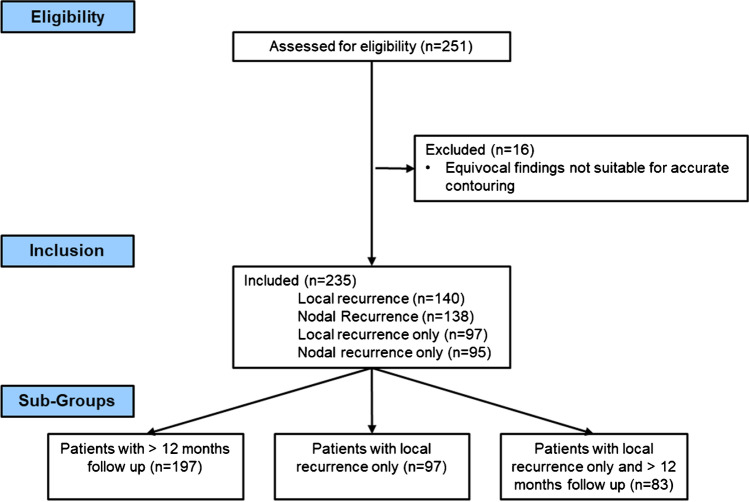
Patients who underwent Ga-PSMA11-PET prior to sRT were enrolled in four high-volume centers in this retrospective multicenter study. Only patients with PET-positive local recurrence (LR) and/or nodal recurrence (NR) within the pelvis were included. Patients were treated with intensity-modulated-sRT to the prostatic fossa and elective lymphatics in case of nodal disease. Dose escalation was delivered to PET-positive LR and NR. Androgen deprivation therapy was administered at the discretion of the treating physician. LR and NR were manually delineated and SUVmax was extracted for LR and NR. Cox-regression was performed to analyze the impact of clinical parameters and the SUVmax-derived values on BRFS.
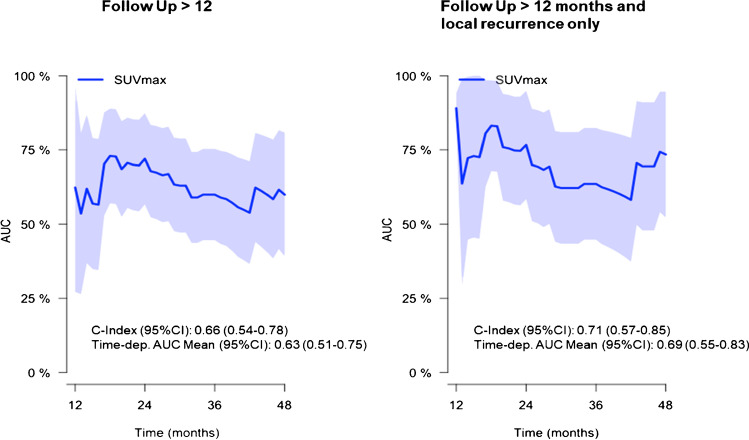
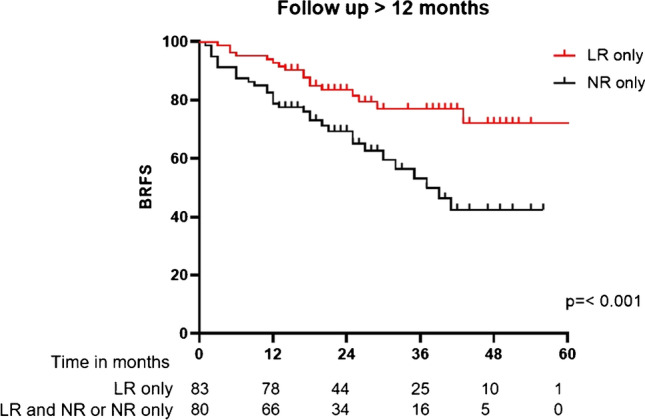
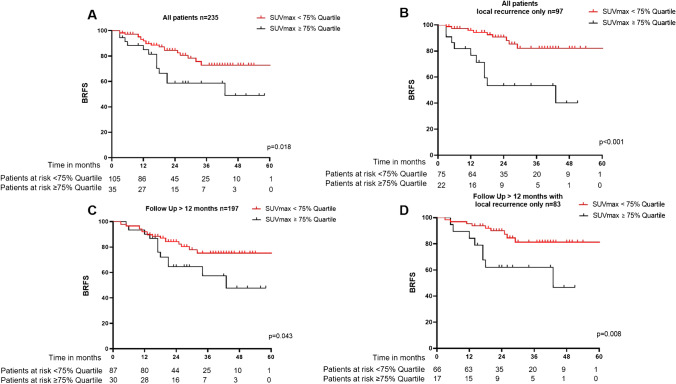
Two hundred thirty-five patients with a median follow-up (FU) of 24 months were included in the final cohort. Two-year and 4-year BRFS for all patients were 68% and 56%. The presence of LR was associated with favorable BRFS (p = 0.016). Presence of NR was associated with unfavorable BRFS (p = 0.007). While there was a trend for SUVmax values ≥ median (p = 0.071), SUVmax values ≥ 75% quartile in LR were significantly associated with unfavorable BRFS (p = 0.022, HR: 2.1, 95%CI 1.1-4.6). SUVmax value in NR was not significantly associated with BRFS. SUVmax in LR stayed significant in multivariate analysis (p = 0.030). Sensitivity analysis with patients for who had a FU of > 12 months (n = 197) confirmed these results.
The non-invasive biomarker SUVmax can prognosticate outcome in patients undergoing sRT and recurrence confined to the prostatic fossa in PSMA-PET. Its addition might contribute to improve risk stratification of patients with recurrent PCa and to guide personalized treatment decisions in terms of treatment intensification or de-intensification. This article is part of the Topical Collection on Oncology-Genitourinary.
本研究旨在评估在大型多中心队列中,挽救性放疗(sRT)前前列腺特异性膜抗原靶向正电子发射断层扫描(PSMA-PET)的最大标准化摄取值(SUVmax)与无生化复发生存(BRFS)之间的关联。
本回顾性多中心研究纳入了在sRT前接受Ga-PSMA11-PET检查的患者,这些患者来自四个大型医疗中心。仅纳入盆腔内PET阳性的局部复发(LR)和/或淋巴结复发(NR)患者。对于有淋巴结疾病的患者,采用调强放疗对前列腺窝和选择性淋巴管进行治疗。对PET阳性的LR和NR进行剂量递增。雄激素剥夺治疗由治疗医生酌情给予。手动勾勒出LR和NR,并提取其SUVmax值。进行Cox回归分析,以分析临床参数和SUVmax衍生值对BRFS的影响。
最终队列纳入了235例患者,中位随访时间(FU)为24个月。所有患者的2年和4年BRFS分别为68%和56%。LR的存在与良好的BRFS相关(p = 0.016)。NR的存在与不良的BRFS相关(p = 0.007)。虽然SUVmax值≥中位数有一定趋势(p = 0.071),但LR中SUVmax值≥四分位数75%与不良的BRFS显著相关(p = 0.022,HR:2.1,95%CI 1.1 - 4.6)。NR中的SUVmax值与BRFS无显著关联。LR中的SUVmax在多变量分析中仍具有显著性(p = 0.030)。对随访时间>12个月的患者(n = 197)进行敏感性分析,证实了这些结果。
非侵入性生物标志物SUVmax可预测接受sRT且PSMA-PET显示复发局限于前列腺窝的患者的预后。其加入可能有助于改善复发性前列腺癌患者的风险分层,并在治疗强化或弱化方面指导个性化治疗决策。本文是泌尿生殖系统肿瘤专题集的一部分。