School of Tropical Medicine and Global Health, Nagasaki University, Nagasaki, Japan; Environment & Health Modelling (EHM) Lab, Department of Public Health Environments and Society, London School of Hygiene & Tropical Medicine, London, UK.
School of Public Health, Imperial College London, London, UK.
Environ Int. 2024 Oct;192:109011. doi: 10.1016/j.envint.2024.109011. Epub 2024 Sep 14.
A causal link between air pollution exposure and cardiovascular events has been suggested. However fewer studies have investigated the shape of the associations at low levels of air pollution and identified the most important temporal window of exposure. Here we assessed long-term associations between particulate matter < 2.5 µm (PM) at low concentrations and multiple cardiovascular endpoints using the UK Biobank cohort.
Using data on adults (aged > 40) from the UK Biobank cohort, we investigated the associations between 1-year, 3-year and 5-year time-varying averages of PM and incidence of major adverse cardiovascular events (MACE), myocardial infarction (MI), heart failure, atrial fibrillation and flutter and cardiac arrest. We also investigated outcome subtypes for MI and stroke. Events were defined as hospital inpatient admissions. We fitted Cox proportional hazard regression models applying extensive control for confounding at both individual and area level. Finally, we assessed the shape of the exposure-response functions to assess effects at low levels of exposure.
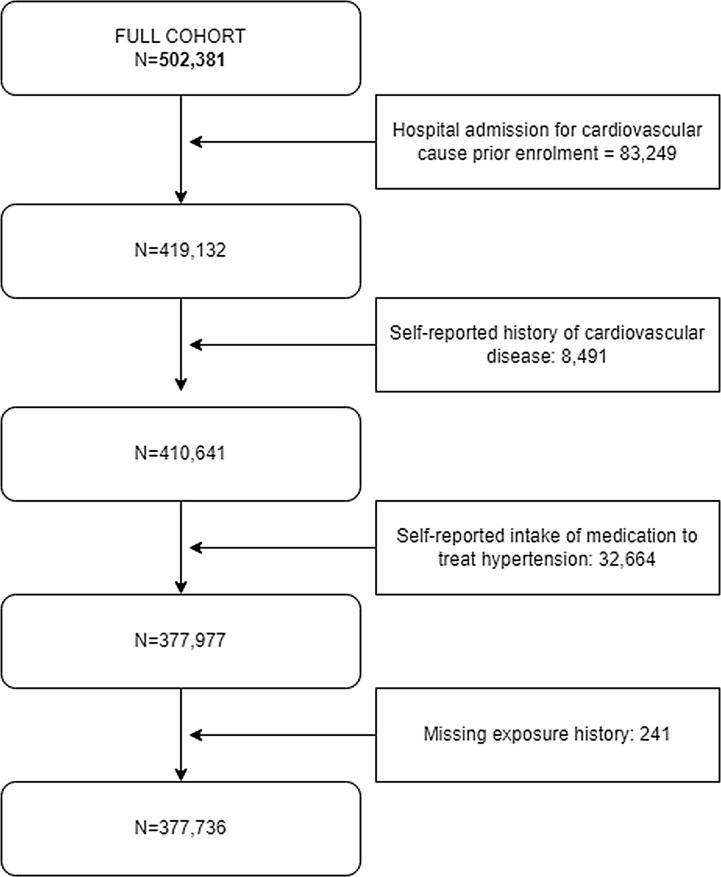
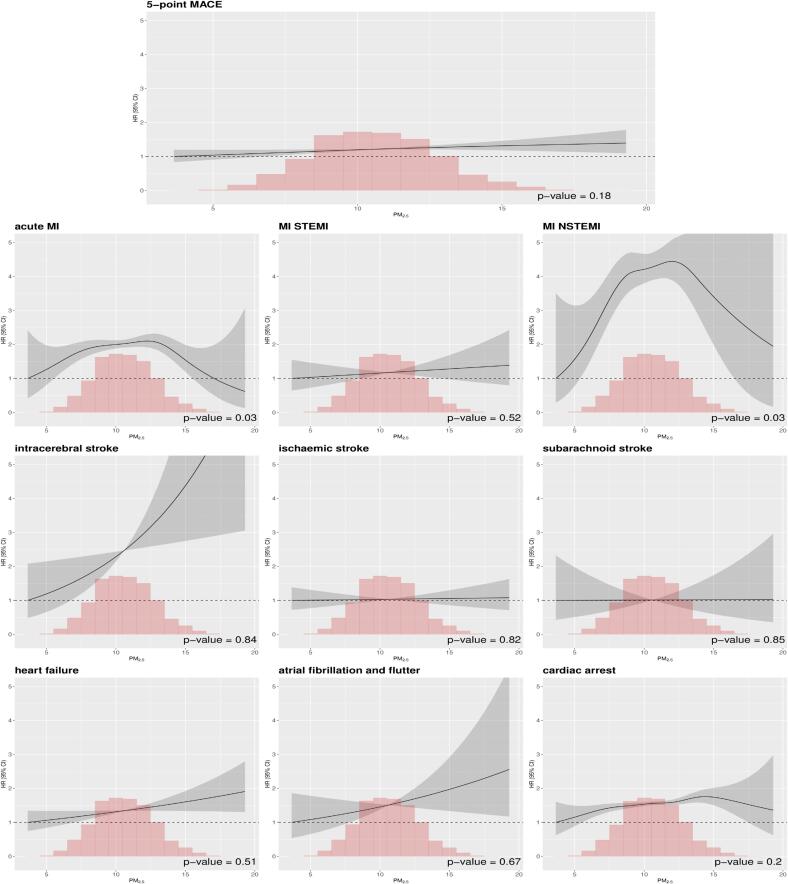
We analysed data from 377,736 study participants after exclusion of prevalent subjects. The average follow-up (2006-2021) was 12.9 years. We detected 19,353 cases of MACE, 6,562 of acute MI, 6,278 of heart failure, 1,258 for atrial fibrillation and flutter, and 16,327 for cardiac arrest. Using a 5-year exposure window, we detected positive associations (for 5 μg/m increase in PM) for 5-point MACE of [1.12 (95 %CI: 1.00-1.26)], heart failure [1.22 (1.00-1.50)] and cardiac arrest [1.16 (1.03-1.31)]. We did not find any association with acute MI, while non-ST-elevation MI was associated with the 1-year exposure window [1.52 (1.12-2.07)]. The assessment of the shape of the exposure-response relationships suggested that risk is approximately linear for most of the outcomes.
We found positive associations between long-term exposure to PM and multiple cardiovascular outcomes for different exposure windows. The cardiovascular risk tends to rise even at exposure concentrations below 12-15 μg/m, indicating high risk below UK national and international thresholds.
空气污染暴露与心血管事件之间存在因果关系。然而,较少的研究调查了低水平空气污染下的关联形状,并确定了暴露的最重要时间窗口。在这里,我们使用英国生物库队列评估了长期以来细颗粒物(PM)<2.5µm 与多种心血管终点之间的关系。
我们使用英国生物库队列中成年人(年龄>40 岁)的数据,研究了 PM 的 1 年、3 年和 5 年时间变化平均值与主要不良心血管事件(MACE)、心肌梗死(MI)、心力衰竭、心房颤动和扑动以及心搏骤停发生率之间的关联。我们还研究了 MI 和中风的结果亚型。事件定义为住院入院。我们应用广泛的个体和区域水平混杂因素控制,拟合 Cox 比例风险回归模型。最后,我们评估了暴露-反应函数的形状,以评估低暴露水平下的影响。
在排除了现患患者后,我们从 377,736 名研究参与者中分析了数据。平均随访(2006-2021 年)为 12.9 年。我们检测到 19,353 例 MACE、6,562 例急性 MI、6,278 例心力衰竭、1,258 例心房颤动和扑动以及 16,327 例心搏骤停。使用 5 年暴露窗口,我们检测到 PM 增加 5μg/m 时,MACE[5 点(1.00-1.26)]、心力衰竭[1.22(1.00-1.50)]和心搏骤停[1.16(1.03-1.31)]的阳性关联。我们没有发现与急性 MI 相关的任何关联,而非 ST 段抬高型 MI 与 1 年暴露窗口相关[1.52(1.12-2.07)]。暴露-反应关系形状的评估表明,对于大多数结果,风险大致呈线性。
我们发现长期暴露于 PM 与不同暴露窗口的多种心血管结局之间存在阳性关联。即使在低于 12-15μg/m 的暴露浓度下,心血管风险也趋于上升,表明在英国国家和国际阈值以下风险较高。