Shiri Isaac, Balzer Sebastian, Baj Giovanni, Bernhard Benedikt, Hundertmark Moritz, Bakula Adam, Nakase Masaaki, Tomii Daijiro, Barbati Giulia, Dobner Stephan, Valenzuela Waldo, Rominger Axel, Caobelli Federico, Siontis George C M, Lanz Jonas, Pilgrim Thomas, Windecker Stephan, Stortecky Stefan, Gräni Christoph
Department of Cardiology, Inselspital Bern University Hospital, University of Bern, Freiburgstrasse, Bern, CH - 3010, Switzerland.
Biostatistics Unit, Department of Medical Sciences, University of Trieste, Trieste, Italy.
Eur J Nucl Med Mol Imaging. 2025 Jan;52(2):485-500. doi: 10.1007/s00259-024-06922-4. Epub 2024 Sep 23.
Transthyretin amyloid cardiomyopathy (ATTR-CM) is a frequent concomitant condition in patients with severe aortic stenosis (AS), yet it often remains undetected. This study aims to comprehensively evaluate artificial intelligence-based models developed based on preprocedural and routinely collected data to detect ATTR-CM in patients with severe AS planned for transcatheter aortic valve implantation (TAVI).
In this prospective, single-center study, consecutive patients with AS were screened with [Tc]-3,3-diphosphono-1,2-propanodicarboxylic acid ([Tc]-DPD) for the presence of ATTR-CM. Clinical, laboratory, electrocardiogram, echocardiography, invasive measurements, 4-dimensional cardiac CT (4D-CCT) strain data, and CT-radiomic features were used for machine learning modeling of ATTR-CM detection and for outcome prediction. Feature selection and classifier algorithms were applied in single- and multi-modality classification scenarios. We split the dataset into training (70%) and testing (30%) samples. Performance was assessed using various metrics across 100 random seeds.
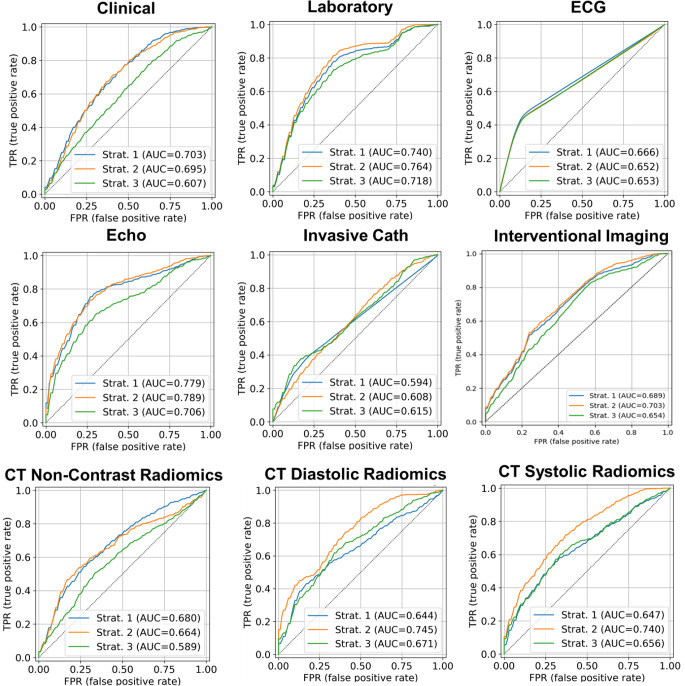
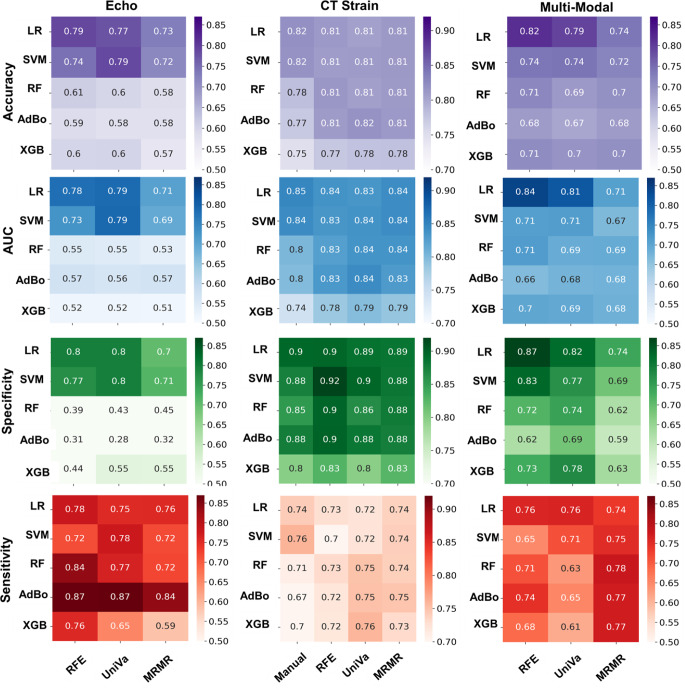
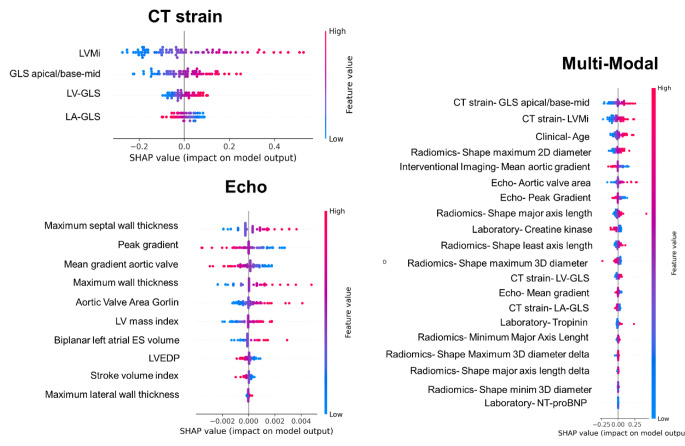
Out of 263 patients with severe AS (57% males, age 83 ± 4.6years) enrolled, ATTR-CM was confirmed in 27 (10.3%). The lowest performances for detection of concomitant ATTR-CM were observed in invasive measurements and ECG data with area under the curve (AUC) < 0.68. Individual clinical, laboratory, interventional imaging, and CT-radiomics-based features showed moderate performances (AUC 0.70-0.76, sensitivity 0.79-0.82, specificity 0.63-0.72), echocardiography demonstrated good performance (AUC 0.79, sensitivity 0.80, specificity 0.78), and 4D-CT-strain showed the highest performance (AUC 0.85, sensitivity 0.90, specificity 0.74). The multi-modality model (AUC 0.84, sensitivity 0.87, specificity 0.76) did not outperform the model performance based on 4D-CT-strain only data (p-value > 0.05). The multi-modality model adequately discriminated low and high-risk individuals for all-cause mortality at a mean follow-up of 13 months.
Artificial intelligence-based models using collected pre-TAVI evaluation data can effectively detect ATTR-CM in patients with severe AS, offering an alternative diagnostic strategy to scintigraphy and myocardial biopsy.
转甲状腺素蛋白淀粉样变心肌病(ATTR-CM)是重度主动脉瓣狭窄(AS)患者常见的伴随疾病,但往往未被发现。本研究旨在全面评估基于术前和常规收集的数据开发的人工智能模型,以检测计划接受经导管主动脉瓣植入术(TAVI)的重度AS患者中的ATTR-CM。
在这项前瞻性单中心研究中,连续纳入的AS患者接受[锝]-3,3-二膦酸-1,2-丙烷二羧酸([锝]-DPD)筛查以确定是否存在ATTR-CM。临床、实验室、心电图、超声心动图、有创测量、四维心脏CT(4D-CCT)应变数据和CT放射组学特征用于ATTR-CM检测的机器学习建模和结局预测。特征选择和分类器算法应用于单模态和多模态分类场景。我们将数据集分为训练样本(70%)和测试样本(30%)。使用100个随机种子的各种指标评估性能。
在纳入的263例重度AS患者(57%为男性,年龄83±4.6岁)中,27例(10.3%)确诊为ATTR-CM。在有创测量和心电图数据中观察到检测伴随ATTR-CM的性能最低,曲线下面积(AUC)<0.68。基于个体临床、实验室、介入成像和CT放射组学的特征表现出中等性能(AUC 0.70-0.76,敏感性0.79-0.82,特异性0.63-0.72),超声心动图表现良好(AUC 0.79,敏感性0.80,特异性0.78),4D-CT应变表现最佳(AUC 0.85,敏感性0.90,特异性0.74)。多模态模型(AUC 0.84,敏感性0.87,特异性0.76)的性能未超过仅基于4D-CT应变数据的模型性能(p值>0.05)。多模态模型在平均随访13个月时能充分区分全因死亡的低风险和高风险个体。
使用术前TAVI评估收集的数据开发的人工智能模型可以有效检测重度AS患者中的ATTR-CM,为闪烁扫描和心肌活检提供了一种替代诊断策略。