Chen Qiuyi, Wang Mina, Fu Feiyu, Nie Limin, Miao Quan, Zhao Luopeng, Liu Lu, Li Bin
Department of Acupuncture and Moxibustion, Beijing Hospital of Traditional Chinese Medicine, Capital Medical University, Beijing Key Laboratory of Acupuncture Neuromodulation, Beijing, 100010, People's Republic of China.
J Pain Res. 2024 Sep 17;17:3031-3046. doi: 10.2147/JPR.S479575. eCollection 2024.
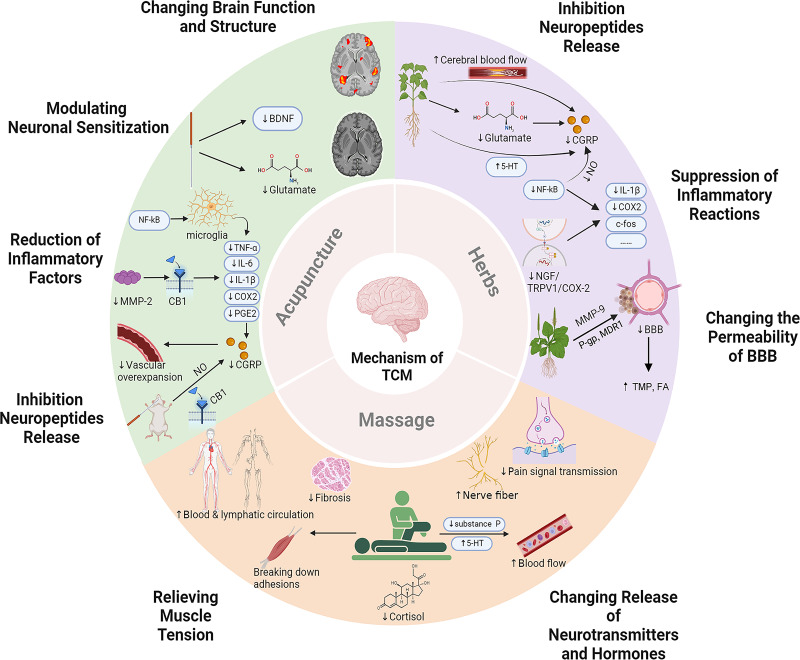
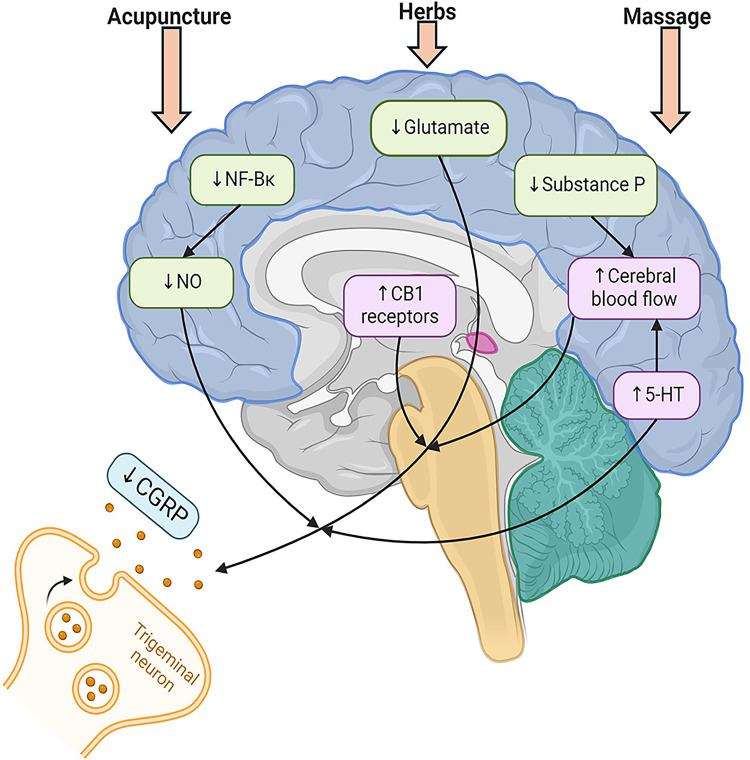
Migraine is a common neurological illness that causes a great burden on individuals and society. Many migraine patients seek relief through complementary and alternative therapies, with Traditional Chinese medicine (TCM) often being their preferred choice. Acupuncture, Chinese herbal medicine, and massage are important components of TCM, and are commonly used in clinical treatment of migraine. This review aims to consolidate the current knowledge regarding the mechanisms of the three TCM interventions for migraine: acupuncture, herbs, and massage, and how they relieve pain. However, the mechanisms underlying the effectiveness of TCM therapies in treating migraine remain unclear. Therefore, we reviewed the research progress on acupuncture, herbal medicine, and massage as TCM approaches for the treatment of migraine. We conducted a comprehensive search of CNKI, PubMed, Web of Science, and Cochrane databases using keywords such as migraine, acupuncture, needle, herbs, herbal, prescription, decoction, massage, Tuina, and TCM, covering the period from 2000 to 2023. The literature included in the review was selected based on specified exclusion criteria. We discussed the mechanism of TCM therapies on migraine from the perspective of modern medicine, focusing on changes in inflammatory factors, neurotransmitters, and other relevant biomarkers. TCM can relieve migraine by decreasing neuropeptide levels, inhibiting inflammation, modulating neuronal sensitization, changing brain function and structure, changing blood brain barrier permeability, regulating hormone levels, and relieving muscle tension. The purpose of this paper is to provide a basis for improving the clinical strategies of TCM for the treatment of migraine.
偏头痛是一种常见的神经系统疾病,给个人和社会带来了沉重负担。许多偏头痛患者通过补充和替代疗法寻求缓解,传统中医(TCM)通常是他们的首选。针灸、中药和按摩是中医的重要组成部分,常用于偏头痛的临床治疗。本综述旨在巩固目前关于中医三种治疗偏头痛干预措施(针灸、草药和按摩)的机制以及它们如何缓解疼痛的知识。然而,中医治疗偏头痛有效性的潜在机制仍不清楚。因此,我们综述了针灸、草药和按摩作为中医治疗偏头痛方法的研究进展。我们使用偏头痛、针灸、针、草药、草本、处方、汤剂、按摩、推拿和中医等关键词,对中国知网、PubMed、科学网和Cochrane数据库进行了全面检索,涵盖2000年至2023年期间。纳入综述的文献是根据特定的排除标准选择的。我们从现代医学的角度讨论了中医治疗偏头痛的机制,重点关注炎症因子、神经递质和其他相关生物标志物的变化。中医可以通过降低神经肽水平、抑制炎症、调节神经元敏感性、改变脑功能和结构、改变血脑屏障通透性、调节激素水平以及缓解肌肉紧张来缓解偏头痛。本文的目的是为改进中医治疗偏头痛的临床策略提供依据。