Sun Shiqi, Liu Lu, Zhou Mengdi, Liu Yi, Sun Mingsheng, Zhao Ling
Acupuncture and Tuina School, Chengdu University of Traditional Chinese Medicine, Chengdu, Sichuan, People's Republic of China.
Key Laboratory of Acupuncture and Moxibustion in Prevention and Treatment of Geriatric Diseases (Chengdu University of Traditional Chinese Medicine), Ministry of Education, Chengdu, Sichuan, People's Republic of China.
J Pain Res. 2023 Jul 24;16:2525-2542. doi: 10.2147/JPR.S422050. eCollection 2023.
To assess the inhibitory effect of acupuncture on pain symptoms in migraine models, and to further summarize the potential mechanisms of acupuncture in regulating hyperalgesia in the treatment of migraine.
Literature search in databases such as China National Knowledge Infrastructure (CNKI), PubMed, and Web of Science (WOS) etc. The quality was evaluated by the Systematic Review Centre for Laboratory Animal Experimentation (SYRCLE) bias risk assessment tool and Collaborative Approach to Meta-analysis and Review of Animal Data from Experimental Studies (CAMARADES) checklist. Meta-analyses were performed using Stata 17.0 software.
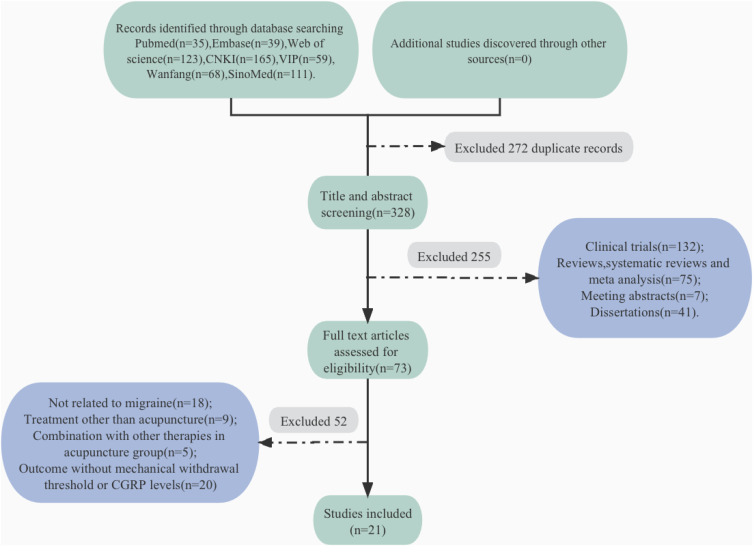
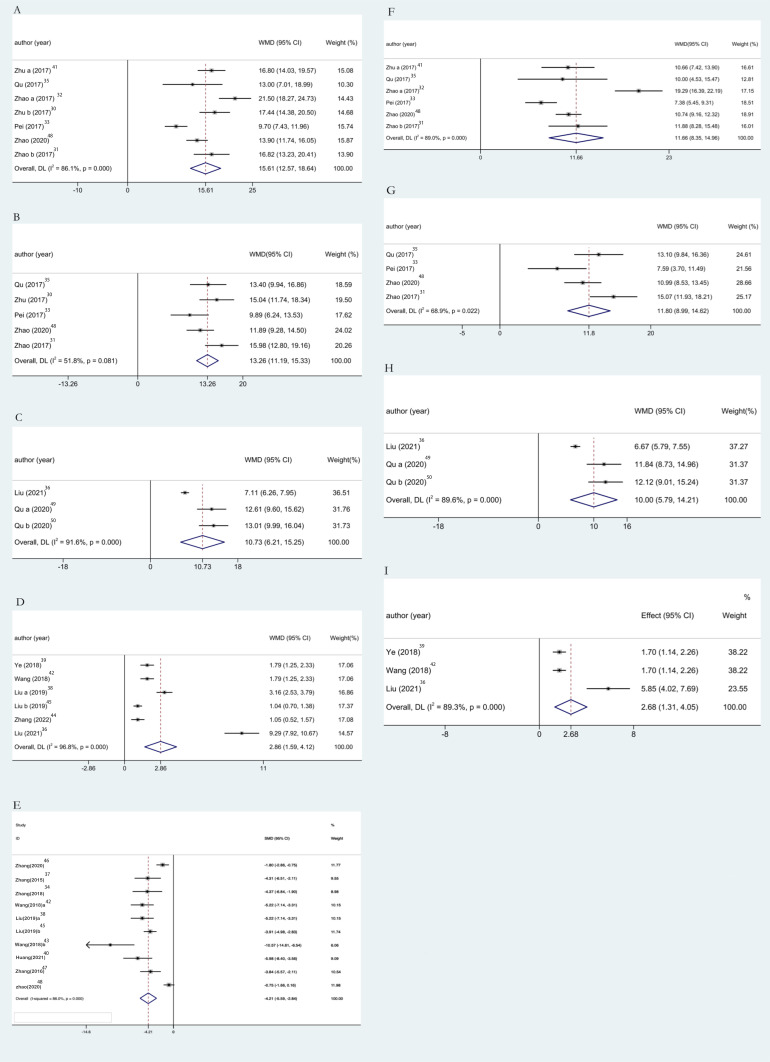
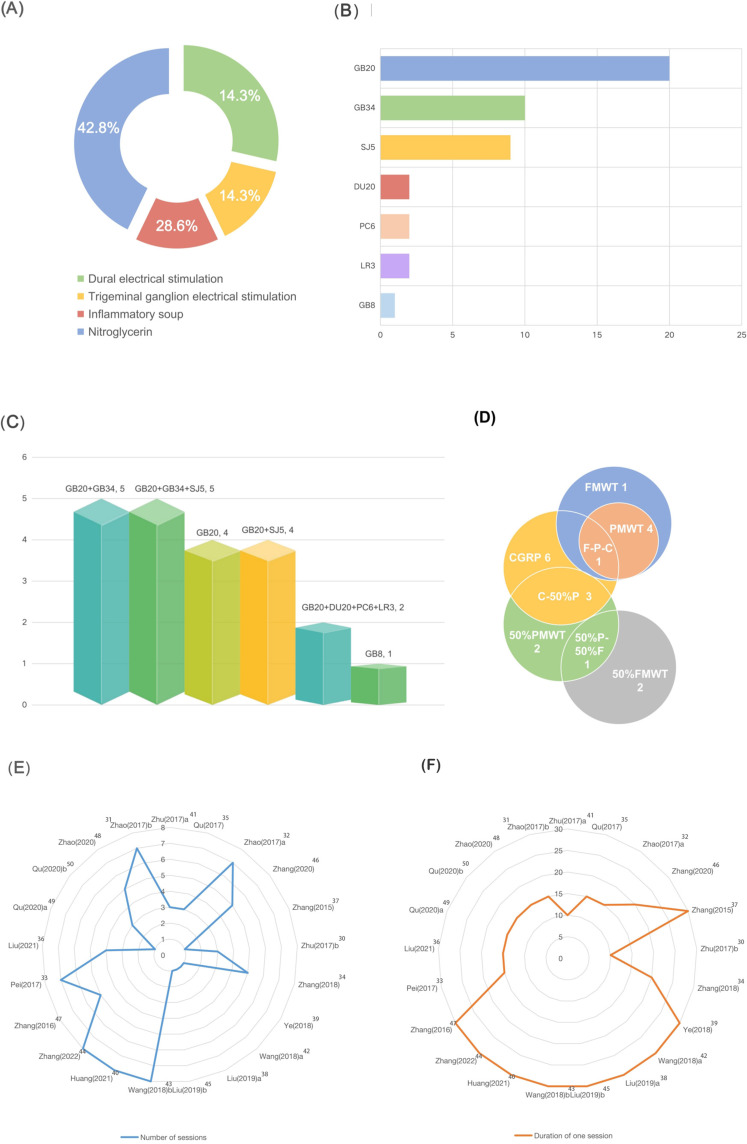
Twenty-one studies involving 489 animals were identified. The qualitative score ranged from 3 to 9 points. Facial mechanical withdrawal threshold (FMWT) and paw mechanical withdrawal threshold (PMWT) measured by Von Frey filaments were selected as major outcomes, and serum calcitonin gene-related peptide (CGRP) levels measured by ELISA were selected as secondary outcome. Meta-analysis results revealed that true acupuncture (TA) group significantly increased FMWT, PMWT and CGRP compared to model group. TA group showed superior effect in FMWT, PMWT relative to sham acupuncture (SA) group. Subgroup analysis results showed that high risk of bias scores may be responsible for the high heterogeneity of FMWT; additionally, CGRP analysis suggests that acupoint selection and blood collection sites may be sources of heterogeneity. In the treatment of migraine pain symptoms, the underlying mechanism of acupuncture treatment is either the regulation of hyperalgesia and neurotransmitters, or the reduction of inflammatory factors.
The results indicate that TA treatment effectively increased the pain threshold and reduced hyperalgesia in migraine rats. In summary, our study highlights the potential of TA as an effective treatment for migraine, but further investigation is required to fully comprehend its mechanism of action and optimize its clinical application.
评估针刺对偏头痛模型疼痛症状的抑制作用,并进一步总结针刺在偏头痛治疗中调节痛觉过敏的潜在机制。
在中国知网(CNKI)、PubMed、Web of Science(WOS)等数据库中进行文献检索。采用实验动物实验系统评价中心(SYRCLE)偏倚风险评估工具和实验研究动物数据的Meta分析与综述协作方法(CAMARADES)清单对质量进行评估。使用Stata 17.0软件进行Meta分析。
共纳入21项研究,涉及489只动物。定性评分范围为3至9分。选取用von Frey细丝测量的面部机械性撤针阈值(FMWT)和 paw 机械性撤针阈值(PMWT)作为主要结局指标,选取用ELISA测量的血清降钙素基因相关肽(CGRP)水平作为次要结局指标。Meta分析结果显示,与模型组相比,真穴针刺(TA)组显著提高了FMWT、PMWT和CGRP。相对于假穴针刺(SA)组,TA组在FMWT、PMWT方面显示出更好的效果。亚组分析结果表明,偏倚评分高风险可能是FMWT异质性高的原因;此外,CGRP分析表明穴位选择和采血部位可能是异质性来源。在偏头痛疼痛症状的治疗中,针刺治疗的潜在机制要么是调节痛觉过敏和神经递质,要么是减少炎症因子。
结果表明,TA治疗有效提高了偏头痛大鼠的痛阈并减轻了痛觉过敏。总之,我们的研究突出了TA作为偏头痛有效治疗方法的潜力,但需要进一步研究以充分理解其作用机制并优化其临床应用。